


Substrate specificity of the AmpG permease required for recycling of cell wall anhydro-muropeptides
- PMID: 12426329
- PMCID: PMC135433
- DOI: 10.1128/JB.184.23.6434-6436.2002
Substrate specificity of the AmpG permease required for recycling of cell wall anhydro-muropeptides
Abstract
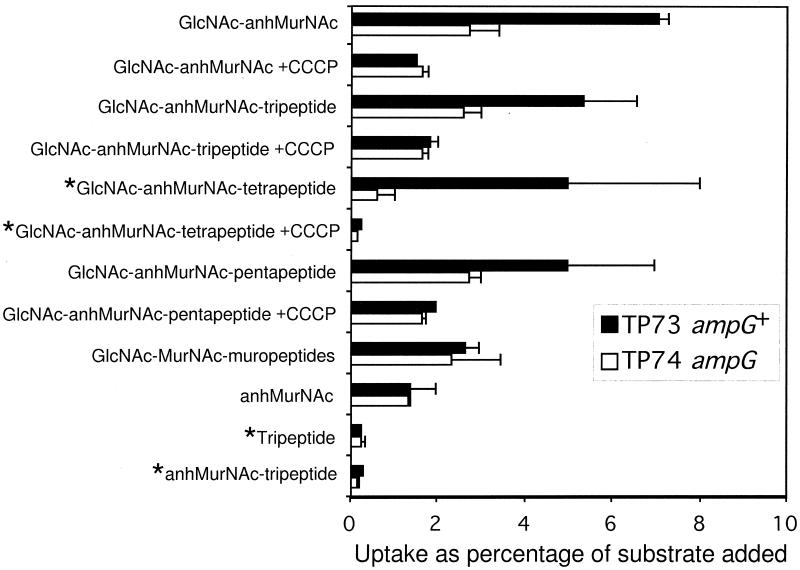
AmpG was originally identified as a gene required for induction of beta-lactamase. Subsequently, we found AmpG to be a permease required for recycling of murein tripeptide and uptake of anhydro-muropeptides. We have now studied the specificity of the AmpG permease. The principal requirement is for the presence of the disaccharide, N-acetylglucosaminyl-beta-1,4-anhydro-N-acetylmuramic acid (GlcNAc-anhMurNAc). These unique substrates for AmpG, which contain murein peptides linked to GlcNAc-anhMurNAc, are produced by turnover of the cell wall during logarithmic growth. AmpG permease is sensitive to carbonylcyanide m-chlorophenylhydrazone, demonstrating that AmpG permease is a single-component permease and that transport is dependent on the proton motive force.
Figures
References
-
- Höltje, J.-V., U. Kopp, A. Ursinus, and B. Wiedemann. 1994. The negative regulator of β-lactamase induction AmpD is a N-acetyl-anhydromuramyl-L-alanine amidase. FEMS Microbiol. Lett. 122:159-164. - PubMed
-
- Jacobs, C., B. Joris, M. Jamin, K. Klarsov, J. van Beemen, D. Mengin-Lecreulx, J. van Heijenoort, J. T. Park, S. Normark, and J.-M. Frere. 1995. AmpD, essential for both β-lactamase regulation and cell wall recycling, is a novel cytosolic N-acetylmuramyl-L-alanine amidase. Mol. Microbiol. 15:553-559. - PubMed
Publication types
MeSH terms
Substances
Grants and funding
LinkOut - more resources
Full Text Sources
Other Literature Sources
Molecular Biology Databases
