SPECT imaging of the stomach: comparison with barostat, and effects of sex, age, body mass index, and fundoplication. Single photon emission computed tomography
- PMID: 12427776
- PMCID: PMC1773479
- DOI: 10.1136/gut.51.6.781
SPECT imaging of the stomach: comparison with barostat, and effects of sex, age, body mass index, and fundoplication. Single photon emission computed tomography
Abstract
Background: Impaired gastric accommodation may lead to dyspeptic symptoms. A non-invasive method using single photon emission computed tomography (SPECT) has been developed to measure gastric volumes.
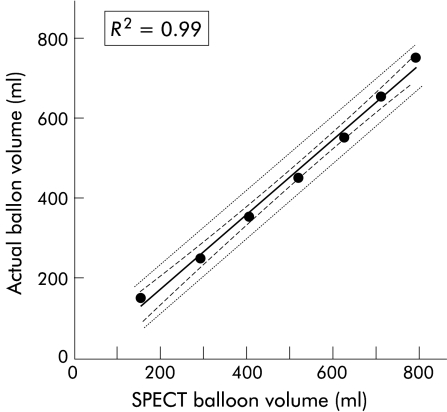
Aims and methods: Our aims were: to assess the accuracy of SPECT with three dimensional image analysis to measure balloon volumes in vitro; to compare gastric barostat balloon volumes measured post-meal and post-distension with total gastric volumes measured simultaneously with SPECT; to present normal gastric volume data for healthy adults; and to compare SPECT data in health with symptomatic post-fundoplication patients.
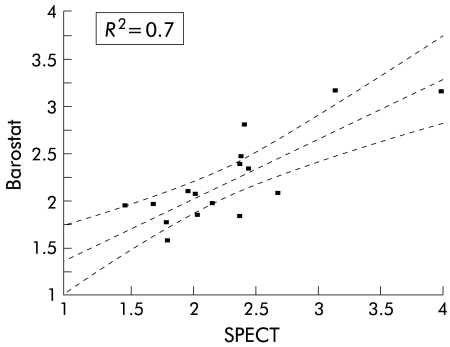
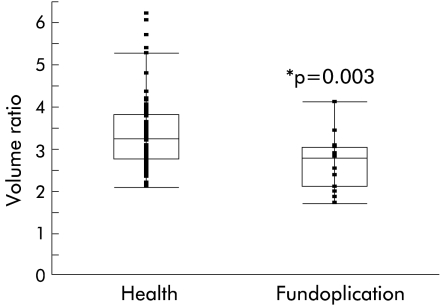
Results: In vitro balloon volumes measured by SPECT were highly accurate (R(2)=0.99). When measured simultaneously by gastric barostat and SPECT, postprandial/fasting volume ratios (2.2 (0.12) (mean (SEM)) v 2.3 (0.15), respectively; p=0.6) and post-distension volume ratios (1.4 (0.1) v1.3 (0.1); p=0.2) were highly comparable. In females, postprandial gastric volumes (675 (14) v 744 (20) ml for males; p=0.004) and changes in gastric volumes (464 (14) ml v 521 (20) ml for males; p=0.01) measured by SPECT were significantly lower than in males. No effects of age or body mass index were noted. The postprandial/fasting gastric volume ratio by SPECT was lower in post-fundoplication patients (2.7 (0.2)) than in healthy controls (3.4 (0.1); p=0.003).
Conclusions: SPECT provides a non-invasive estimate of the effect of a meal on total gastric volume that is comparable to changes in balloon volume observed with the gastric barostat. The SPECT technique is promising for investigation of gastric volumes in health and disease and the effects of pharmacological agents.
Figures
References
-
- Azpiroz F, Malagelada JR. Gastric tone measured by an electronic barostat in health and postsurgical gastroparesis. Gastroenterology 1987;92:934–43. - PubMed
-
- Samsom M, Salet GA, Roelofs JM, et al. Compliance of the proximal stomach and dyspeptic symptoms in patients with type I diabetes mellitus. Dig Dis Sci 1995;40:2037–42. - PubMed
-
- Tack J, Piessevaux H, Coulie B, et al. Role of impaired gastric accommodation to a meal in functional dyspepsia. Gastroenterology 1998;115:1346–52. - PubMed
-
- Thumshirn M, Camilleri M, Hanson RB, et al. Gastric mechanosensory and lower esophageal sphincter function in rumination syndrome. Am J Physiol 1998;275:G314–21. - PubMed
Publication types
MeSH terms
Grants and funding
LinkOut - more resources
Full Text Sources
Other Literature Sources