. 2002 Nov 15;22(22):9980-9.
doi: 10.1523/JNEUROSCI.22-22-09980.2002.

The role of spinal neuroimmune activation in morphine tolerance/hyperalgesia in neuropathic and sham-operated rats

Affiliations

The role of spinal neuroimmune activation in morphine tolerance/hyperalgesia in neuropathic and sham-operated rats

Vasudeva Raghavendra et al. J Neurosci. .

Abstract

Hypersensitivity resulting from nerve injury or morphine tolerance/hyperalgesia is predicted to involve similar cellular and molecular mechanisms. One expected but incompletely explored mechanism is the activation of central neuroimmune responses associated with these conditions. To begin to address this, we undertook three separate studies: First, we determined the acute antinociceptive action of morphine, the rate of development of opioid tolerance, and withdrawal-induced hyperalgesia/allodynia in nerve-injured and sham-operated rats using noxious (thermal and mechanical) and non-noxious (mechanical allodynia) behavioral paradigms. Second, we investigated the impact of chronic morphine treatment on spinal glial activation and cytokine expression after L5 spinal nerve transection or sham surgery. Third, we examined the consequences of spinal administration of cytokine inhibitors on the development of morphine tolerance and morphine withdrawal-induced hyperalgesia and allodynia. Results demonstrated that after nerve injury, the antinociceptive effect of acute morphine was significantly decreased, and the rate of development of tolerance and opioid withdrawal-induced hyperalgesia/allodynia was significantly enhanced compared with that after sham surgery. Chronic administration of morphine to sham-operated rats activated spinal glia and upregulated proinflammatory cytokines [interleukin (IL)-1beta, IL-6, and tumor necrosis factor-alpha]. This neuroimmune activation was further enhanced in nerve-injured rats after chronic morphine treatment. Spinal inhibition of proinflammatory cytokines restored acute morphine antinociception in nerve-injured rats and also significantly reversed the development of morphine tolerance and withdrawal-induced hyperalgesia and allodynia in nerve-injured or sham-operated rats. Targeting central cytokine production and glial activation may improve the effectiveness of morphine and reduce the incidence of morphine withdrawal-induced hyperalgesia and allodynia in neuropathic pain conditions.


Figures
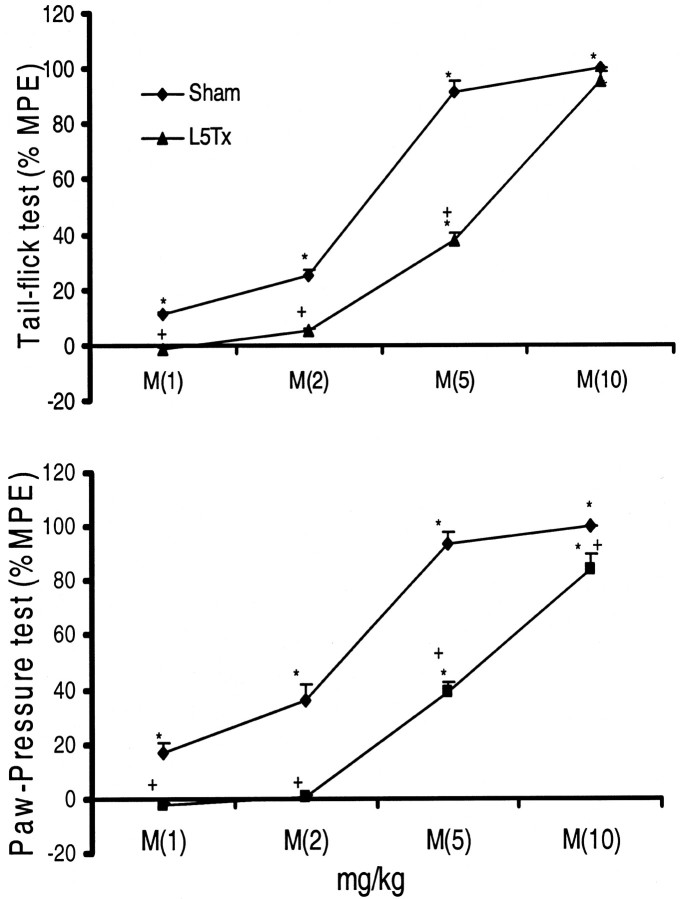
Fig. 1.
Fig. 1.
Decreased antinociceptive activity of acute morphine in L5 nerve-transected rats. Behavioral response to noxious thermal (tail-flick test) and mechanical (paw-pressure test) stimuli was recorded on postoperative days 6 or 11. Antinociceptive activity of acute morphine (M; 1–10 mg/kg) was recorded 45 min after its intravenous administration and expressed as a percentage of MPE. A rightward shift in the dose–response curve of morphine in L5 nerve-transected rats (L5Tx) compared with sham-operated rats indicates decreased antinociceptive activity of morphine in neuropathic conditions. Values are mean ± SEM (n = 6). *p < 0.05 versus basal latency (recorded before morphine administration);+p < 0.05 versus sham-operated rats (Bonferroni test).
Fig. 2.
Fig. 2.
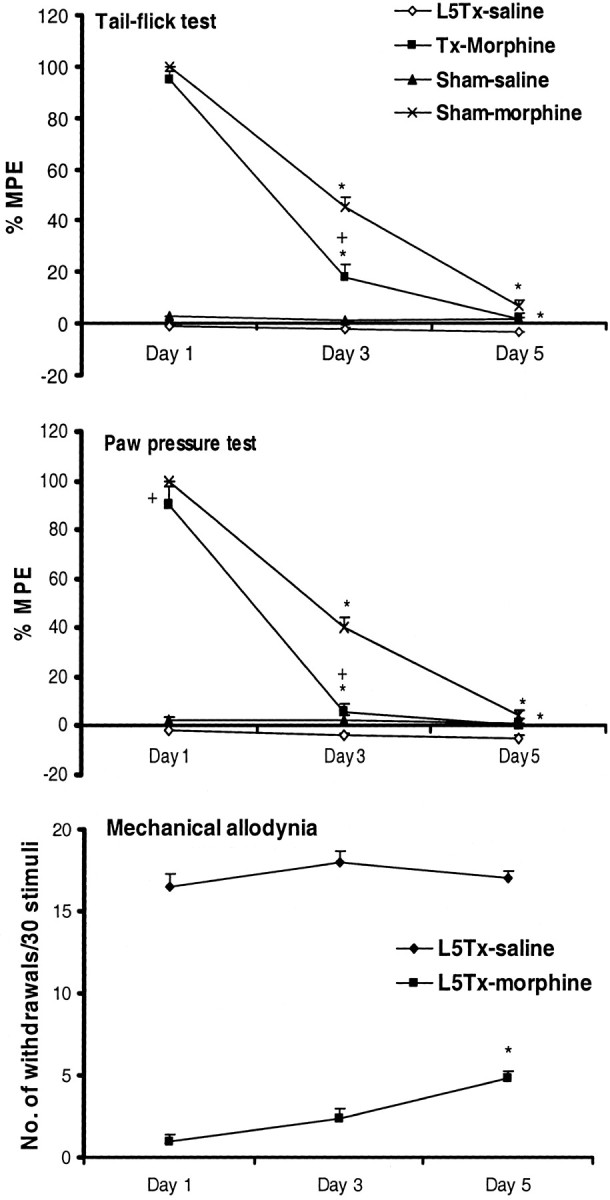
L5 nerve transection enhances the development of morphine tolerance to analgesic and antiallodynic actions. Chronic morphine (10 mg/kg, s.c., twice daily for 5 d) treatment was initiated on postoperative day 6 to L5 nerve-transected (L5Tx) and sham-operated rats. Antinociceptive and antiallodynic activity of morphine in these rats was accessed on days 1, 3, and 5 of the treatment (i.e., postoperative days 6, 8, and 10). Behavior recorded before the beginning of morphine treatment represents baseline responses. Analgesic activity of morphine against noxious thermal and mechanical stimuli was expressed as a percentage of MPE, whereas antiallodynic activity was expressed as average numbers of paw withdrawals to 30 stimuli of 12 gm of von Frey filament. A significant decrease in the antinociceptive action of morphine (both in the tail-flick and in the paw-pressure tests) in L5 nerve-transected rats (L5Tx-morphine) compared with sham rats (Sham-morphine) on day 3 of the treatment indicates early development of morphine tolerance in neuropathic conditions. Values are mean ± SEM (n = 8–10). *p < 0.05 versus antinociceptive or antiallodynic activity of morphine observed on the first day of its treatment;+p < 0.05 versus morphine-treated, sham-operated (Sham-morphine) rats (Bonferroni test). Note that sham-operated rats did not develop tactile allodynia, preventing evaluation of the antiallodynic activity of morphine in these animals.
Fig. 3.
Fig. 3.
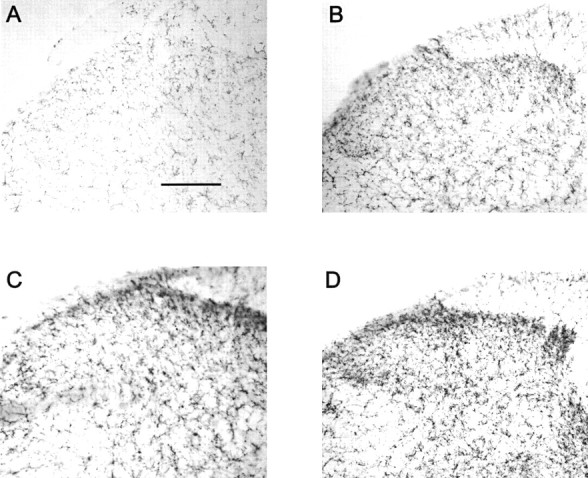
Increased microglial activation by chronic morphine treatment in sham-operated and neuropathic rats. Chronic administration of morphine to either sham-operated rats (B) or L5 nerve-transected rats (D) showed enhanced OX-42 immunostaining in the dorsal horn of the L5 lumbar spinal cord compared with saline-treated, sham-operated rats (A) or neuropathic rats (C), respectively. Scale bar, 150 μm (n = 4 per group).
Fig. 4.
Fig. 4.
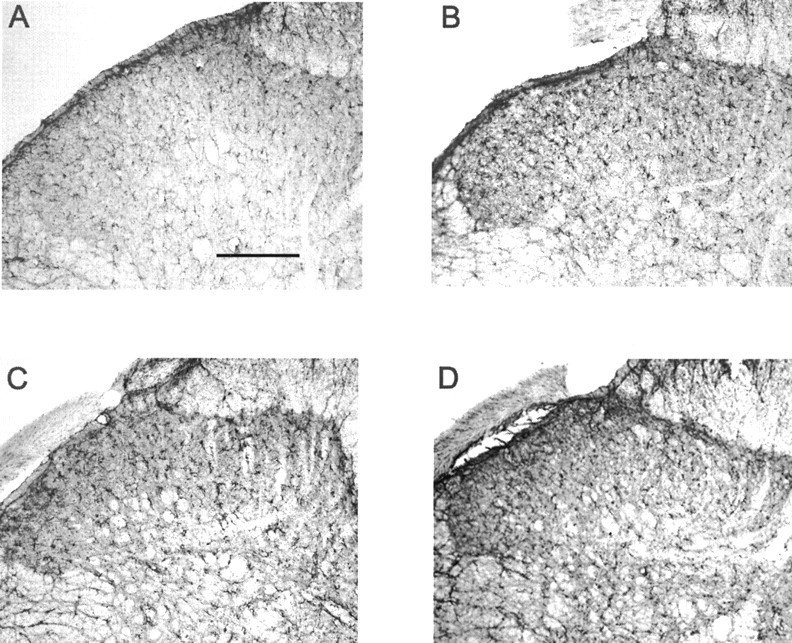
Increased astrocyte activation by chronic morphine treatment in sham-operated and neuropathic rats. Chronic administration of morphine to either sham-operated rats (B) or L5 nerve-transected rats (D) showed enhanced GFAP immunostaining in the dorsal horn of the L5 lumbar spinal cord compared with saline-treated, sham-operated rats (A) or neuropathic rats (C), respectively. Scale bar, 150 μm (n = 4 per group).
Fig. 5.
Fig. 5.
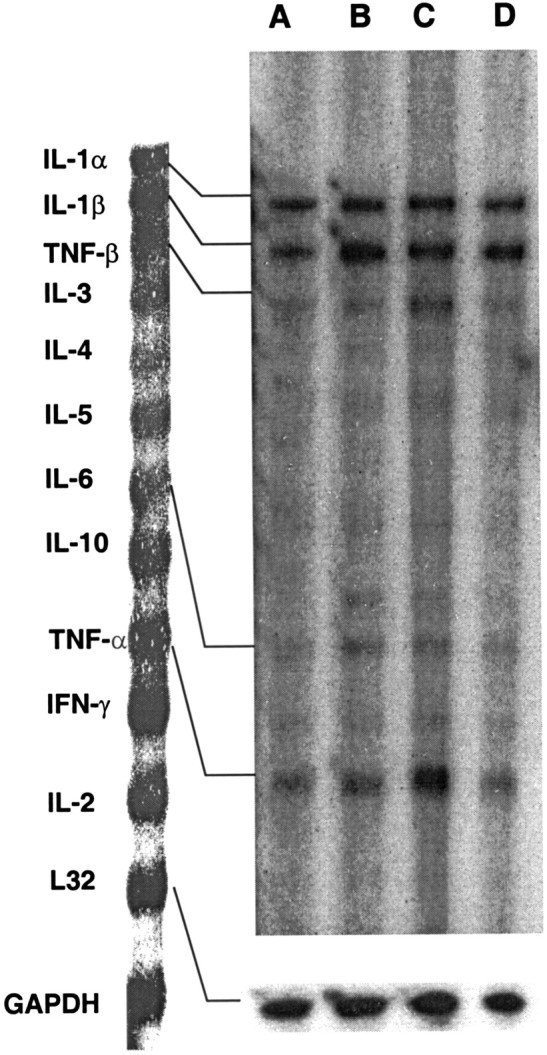
Representative RNase protection assay depicting cytokine mRNA expression for IL-1α, IL-1β, IL-6, TNF-α, and TNF-β in L5 lumbar spinal cord of saline-treated, sham-operated rats (A) and neuropathic rats (B), chronic morphine-treated neuropathic rats (C), and sham-operated rats (D) (n = 4 per group). Note that mRNA for IL-2, IL-4, IL-5, IL-10, and IFN-γ was inconsistent or not readable in nontransected animals at present experimental conditions. GAPDH, Glyceraldehyde-3-phosphate dehydrogenase.
Fig. 6.
Fig. 6.
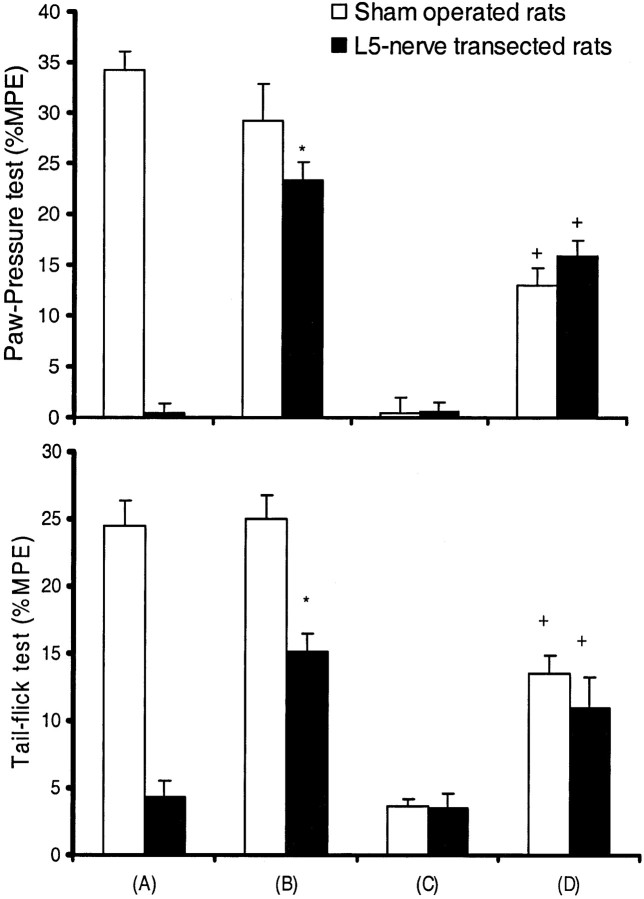
Inhibition of spinal proinflammatory cytokines restores acute analgesic action of morphine in neuropathic- and morphine-tolerant rats. Sham-operated and L5 nerve-transected rats received chronic saline (A); chronic IL-1ra, sTNFR, and anti IL-6 antibody (B); chronic morphine (C); and chronic morphine plus IL-1ra, sTNFR, and anti IL-6 antibody (D) treatment on postoperative days 6–10. Acute antinociceptive action of morphine (2 mg/kg, i.v.) in these rats was evaluated against noxious thermal (tail-flick test) and mechanical (paw-pressure test) stimuli on postoperative day 11 (for details, see Materials and Methods). Data show that chronic inhibition of proinflammatory cytokines restores the acute antinociceptive actions of intravenously administered morphine in saline- or morphine-tolerant, nerve-transected and morphine-tolerant, sham-operated rats. Values are mean (%MPE) ± SEM (n = 5). *p < 0.05 versus group A nerve-transected rats; +p < 0.05 versus group C sham or nerve-transected rats (Bonferroni test).

References

    1. Aloisi F. Immune function of microglia. Glia. 2001;36:165–179. - PubMed
    1. Arruda JL, Sweitzer S, Rutkowski MD, DeLeo JA. Intrathecal anti-IL-6 antibody and IgG attenuates peripheral nerve injury-induced mechanical allodynia in the rat: possible immune modulation in neuropathic pain. Brain Res. 2000;879:216–225. - PubMed
    1. Backonja MM, Miletic G, Miletic V. The effect of continuous morphine analgesia on chronic thermal hyperalgesia due to sciatic constriction injury in rats. Neurosci Lett. 1995;96:61–64. - PubMed
    1. Bars DL, Gozariu M, Cadden SW. Animal models of nociception. Pharmacol Rev. 2001;53:597–652. - PubMed
    1. Beitner-Johnson D, Guitart X, Nestler EJ. Glial fibrillary acidic protein and the mesolimbic dopamine system: regulation by chronic morphine and Lewis-Fisher strain differences in the rat ventral tegmental area. J Neurochem. 1993;61:1766–1773. - PubMed

Publication types

MeSH terms

LinkOut - more resources