Comparative Study
. 2002 Nov;130(3):1132-42.
doi: 10.1104/pp.009415.

LeCTR1, a tomato CTR1-like gene, demonstrates ethylene signaling ability in Arabidopsis and novel expression patterns in tomato

Affiliations
Comparative Study

LeCTR1, a tomato CTR1-like gene, demonstrates ethylene signaling ability in Arabidopsis and novel expression patterns in tomato

Julie Leclercq et al. Plant Physiol. 2002 Nov.

Abstract

LeCTR1 was initially isolated by both differential display reverse transcriptase-polymerase chain reaction screening for tomato (Lycopersicon esculentum) fruit ethylene-inducible genes and through homology with the Arabidopsis CTR1 cDNA. LeCTR1 shares strong nucleotide sequence homology with Arabidopsis CTR1, a gene acting downstream of the ethylene receptor and showing similarity to the Raf family of serine/threonine protein kinases. The length of the LeCTR1 transcribed region from ATG to stop codon (12,000 bp) is more than twice that of Arabidopsis CTR1 (4,700 bp). Structural analysis reveals perfect conservation of both the number and position of introns and exons in LeCTR1 and Arabidopsis CTR1. The introns in LeCTR1 are much longer, however. To address whether this structural conservation is indicative of functional conservation of the corresponding proteins, we expressed LeCTR1 in the Arabidopsis ctr1-1 (constitutive triple response 1) mutant under the direction of the 35S promoter. Our data clearly show that ectopic expression of LeCTR1 in the Arabidopsis ctr1-1 mutant can restore normal ethylene signaling. The recovery of normal ethylene sensitivity upon heterologous expression of LeCTR1 was also confirmed by restored glucose sensitivity absent in the Arabidopsis ctr1-1 mutant. Expression studies confirm ethylene responsiveness of LeCTR1 in various tissues, including ripening fruit, and may suggest the evolution of alternate regulatory mechanisms in tomato versus Arabidopsis.


Figures
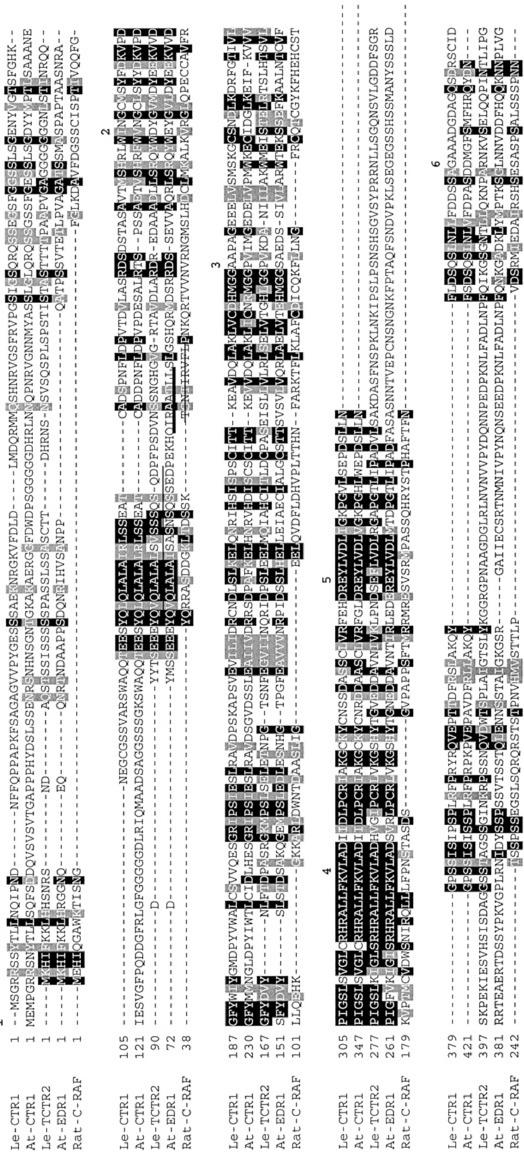
Figure 1
Figure 1
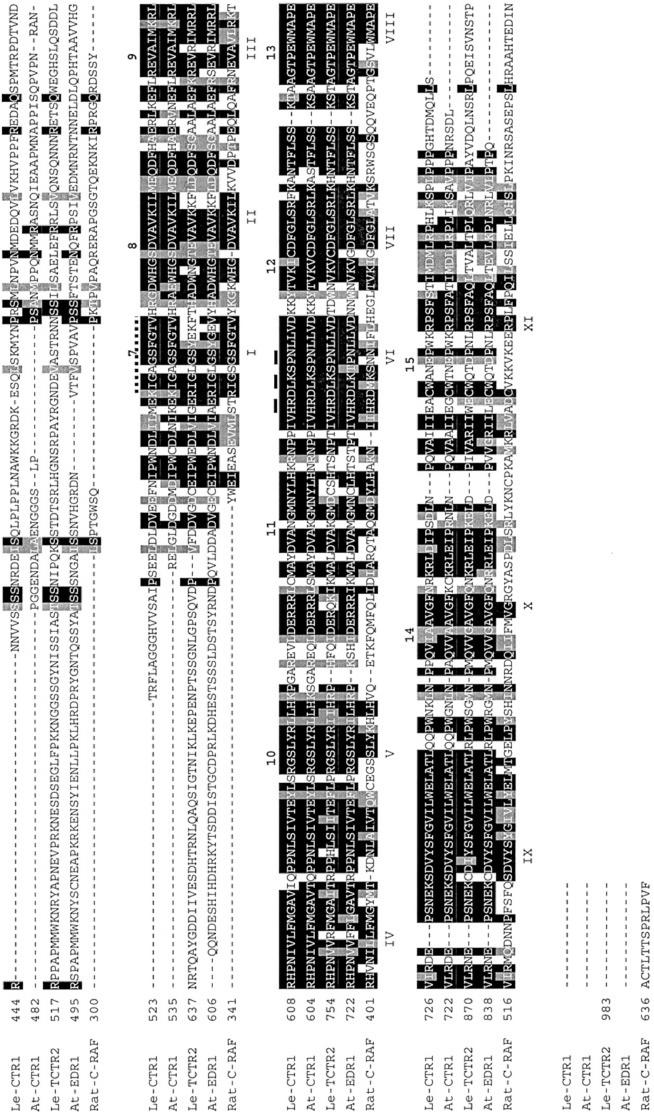
Sequence comparison between tomato LeCTR1 (AAl87456) and LeCTR2 (AJ005077), AtCTR1 (CAB82938), AtEDR1 (AAG31143), and R. norvegicus C-Raf (P11345) proteins. Identities between proteins are indicated by shaded squares. The kinase catalytic domain is located in the C-terminal side, including the 11 subdomains (roman numerals). The sequence consensus for the ATP-binding site and Ser/Thr protein kinase are also indicated (… … and - - - - - -, respectively). Arabic numbers indicate the starting of each exon for LeCTR1 and AtCTR1.(Figure continues on facing page.)
Figure 1
Figure 1
Sequence comparison between tomato LeCTR1 (AAl87456) and LeCTR2 (AJ005077), AtCTR1 (CAB82938), AtEDR1 (AAG31143), and R. norvegicus C-Raf (P11345) proteins. Identities between proteins are indicated by shaded squares. The kinase catalytic domain is located in the C-terminal side, including the 11 subdomains (roman numerals). The sequence consensus for the ATP-binding site and Ser/Thr protein kinase are also indicated (… … and - - - - - -, respectively). Arabic numbers indicate the starting of each exon for LeCTR1 and AtCTR1.(Figure continues on facing page.)
Figure 2
Figure 2
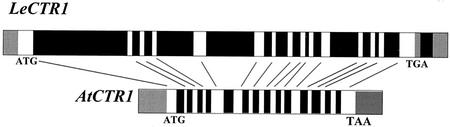
Comparison of the genomic structure of the tomato LeCTR1 (AY079048) and the Arabidopsis AtCTR1 gene (L08790). Black portions represent the introns, white portions represent the exons, and gray portions represent the untranslated region. Arrows indicate that each exon of LeCTR1 gene correspond to its homolog in the AtCTR1 gene.
Figure 3
Figure 3
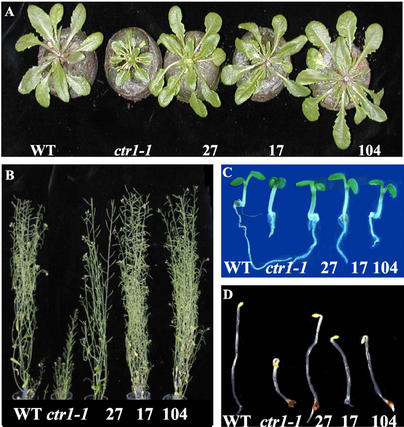
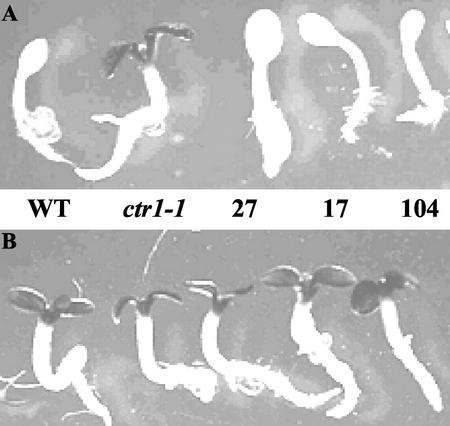
Phenotypes of the transgenic LeCTR1-overexpressing lines (27, 17, and 104) compared with that of Arabidopsis wild type and the ctr1-1 mutant. A, Adult plants at the rosette stage grown in the greenhouse. B, Adult plants at the flowering stage grown in the greenhouse. C, Four-day-old seedlings grown in the light. D, Four-day-old etiolated seedlings.
Figure 4
Figure 4
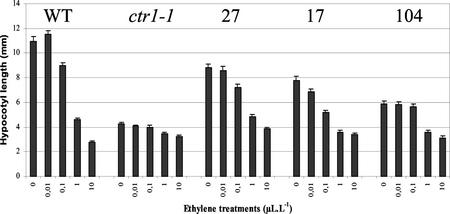
Ethylene response of the transgenic LeCTR1-overexpressing lines (27, 17, 104) compared with that of wild type and the ctr1-1 mutant. Etiolated seedlings untreated or treated with increasing ethylene concentration (0.01, 0.1, 1, and 10 μL L−1) were grown for 3 d before monitoring hypocotyl length. Each histogram represents the mean of 30 measurements and the vertical bars indicate the confidence interval.
Figure 5
Figure 5
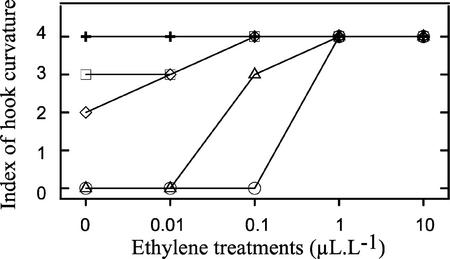
Effect of ethylene on the apical hook curvature of the transgenic LeCTR1-complemented lines (27, 17, and 104) compared with that of wild type and the ctr1-1 mutant. ○, Wild type; +, ctr1-1 mutant; Δ, line 27; ⋄, line 17; □, line 104. The level of apical curvature was estimated visually for 30 seedlings using a scale ranging from 0 to 4 (0, no apical hook; 1, 90° curvature; 2, 180° curvature; 3, beginning of hook formation; and 4, full hook). The experiment was repeated twice.
Figure 6
Figure 6
Effect of Glc on the development of the transgenic LeCTR1-complemented lines (27, 17, and 104) compared with wild type and the ctr1-1 mutant. For each line, 50 seedlings are grown on Murashige and Skoog medium containing 6% (w/v) Glc during 10 d in the light. Wild type, ctr1-1 mutant, or LeCTR1-complemented lines grown in a sealed box with air (A) or in the presence of 10 μL L−1 ethylene (B). The experiment was repeated three times.
Figure 7
Figure 7
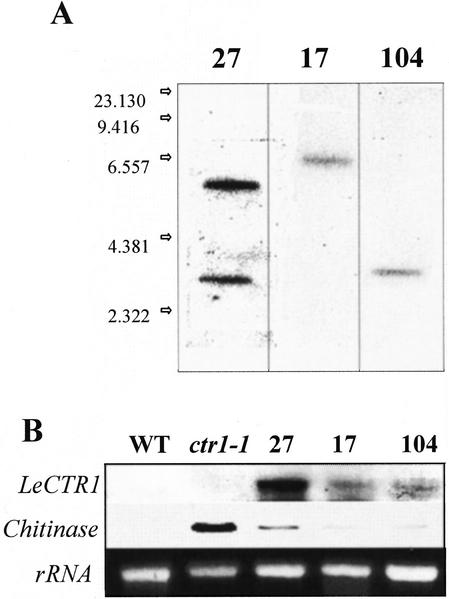
Molecular analysis of the transgenic LeCTR1-complemented lines (27, 17, and 104) compared with wild type and the ctr1-1 mutant. A, Southern analysis of the transgenic lines with a NPTII probe. Numbers indicate the fragment size in kilobase pairs. Line 27 contained two insertions, whereas line 17 and 104 contained only one copy of the transgene. B, Northern-blot analysis of LeCTR1 and basic chitinase transcript accumulation. Equal loading of the gel with the RNA samples is checked by ethidium bromide staining (bottom).
Figure 8
Figure 8
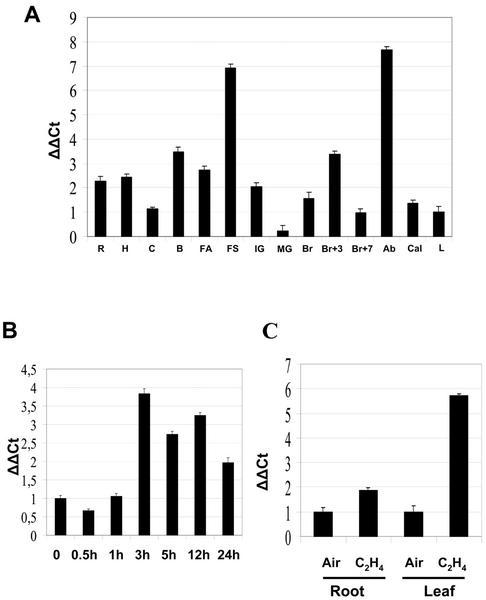
Ethylene-dependent and tissue-specific expression of LeCTR1 in tomato. The levels of LeCTR1 transcripts were assessed by real-time quantitative PCR. The experiments were carried out in triplicate. A, LeCTR1 mRNA accumulation was monitored in the root (R), hypocotyl (H), cotyledon (C), unopened buds (B), flower at anthesis (FA), senescent flowers (FS), young fruit 7 DPA (IG), mature green fruit (MG), breaker fruit (Br), breaker + 3 (Br+3), breaker + 7 (Br+7), abscission zone (Ab), callus (Cal), and leaf (L). ΔΔCt on the y axis refers to the fold difference in LeCTR1 expression relative to the leaf. B, Ethylene responsiveness of LeCTR1 in mature green fruit treated with 20 μL L−1 ethylene. ΔΔCt on the y axis refers to the fold difference in LeCTR1 expression relative to the control. C, LeCTR1 ethylene regulation in root and leaves. Ethylene treatment was performed as in B. ΔΔCt on the y axis refers to the fold difference in LeCTR1 expression relative to air-treated root and leaf, respectively.

References

    1. Abeles FB, Morgan PW, Salveit ME. Ethylene in Plant Biology. Ed 2. New York: Academic Press; 1992.
    1. Bird CR, Smith CJS, Ray JA, Moureau P, Bevan MW, Bird AS, Hughes S, Morris PC, Grierson D, Schuch W. The tomato polygalacturonase gene and ripening-specific expression in transgenic plants. Plant Mol Biol. 1988;11:651–662. - PubMed
    1. Chang C, Kwok SF, Bleecker AB, Meyerovitz EM. Arabidopsis ethylene response gene ETR1: similarity of product two-component regulators. Science. 1993;262:539–544. - PubMed
    1. Clark KL, Larsen PB, Wang X, Chang C. Association of the Arabidopsis CTR1 Raf-like kinase with the ETR1 and ERS ethylene receptors. Proc Natl Acad Sci USA. 1998;95:5401–5406. - PMC - PubMed
    1. Clough SJ, Bent AF. Floral dip: a simplified method for Agrobacterium-mediated transformation of Arabidopsis thaliana. Plant J. 1998;16:735–743. - PubMed

Publication types

MeSH terms

Associated data