. 2002 Nov;130(3):1527-35.
doi: 10.1104/pp.006775.

Supplementary ultraviolet-B radiation induces a rapid reversal of the diadinoxanthin cycle in the strong light-exposed diatom Phaeodactylum tricornutum

Affiliations

Supplementary ultraviolet-B radiation induces a rapid reversal of the diadinoxanthin cycle in the strong light-exposed diatom Phaeodactylum tricornutum

Heiko Mewes et al. Plant Physiol. 2002 Nov.

Abstract

A treatment of the diatom Phaeodactylum tricornutum with high light (HL) in the visible range led to the conversion of diadinoxanthin (Dd) to diatoxanthin (Dt). In a following treatment with HL plus supplementary ultraviolet (UV)-B, the Dt was rapidly epoxidized to Dd. Photosynthesis of the cells was inhibited under HL + UV-B. This is accounted for by direct damage by UV-B and damage because of the UV-B-induced reversal of the Dd cycle and the associated loss of photoprotection. The reversal of the Dd cycle by UV-B was faster in the presence of dithiothreitol, an inhibitor of the Dd de-epoxidase. Our results imply that the reversal of the Dd cycle by HL + UV-B was caused by an increase in the rate of gross Dt epoxidation, whereas the de-epoxidation of Dd was unaffected by UV-B. This is further supported by our finding that the in vitro de-epoxidation activity and the affinity toward the cosubstrate ascorbic acid of the Dd de-epoxidase were both unaffected by UV-B pretreatment of intact cells. We provide evidence that Dt epoxidation is normally down-regulated by a high pH gradient under HL. It is proposed that supplementary UV-B affected the pH gradient across the thylakoid membrane, which disrupted the down-regulation of Dt epoxidation and led to the observed increase in the rate of Dt epoxidation.


Figures
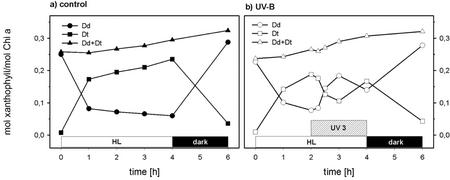
Figure 1
Figure 1
The time course of the amounts of Dd and Dt in suspensions of P. tricornutum exposed to HL + UV 3. After 30 min of dark adaptation, the control cells (a) were exposed for 4 h to HL (photosynthetic photon flux density [PPFD] 300 μmol m−2 s−1) without UV-B and then again dark adapted for 2 h. The UV-B treatment (b) consisted of 2 h of exposure to HL followed by 2 h of HL + UV 3 and 2 h of recovery in the dark. The irradiance of the supplementary UV 3 was 2.3 W m−2 at the front of the cuvette corresponding to a mean irradiance of 0.82 W m−2. The Chl a and c content was 2 mg L−1. The curves represent the average of two independent experiments.
Figure 2
Figure 2
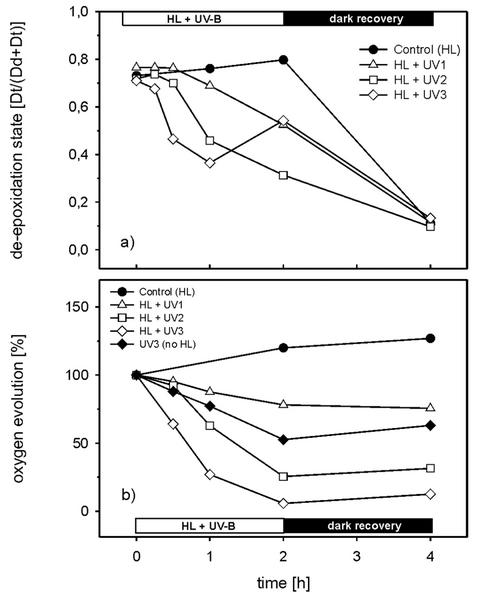
a, Time course of the de-epoxidation state (DES) [Dt/(Dd + Dt)]; b, photosynthetic oxygen evolution during combined treatment of cells with HL and different irradiances of supplementary UV-B. Before HL + UV-B treatment, all cells were HL adapted for 2 h. For the samples of UV 3 (no HL) in b, the HL was omitted during exposure to UV 3. The Chl a and c content was 2 mg L−1. The rates of oxygen evolution were normalized to the value after 2 h of HL pretreatment. One-hundred percent oxygen evolution corresponds to 160 μmol O2 mg−1 Chl h−1. Samples for the measurement of the oxygen evolution and the DES were taken from identical suspensions. The curves represent the average of two independent experiments.
Figure 3
Figure 3
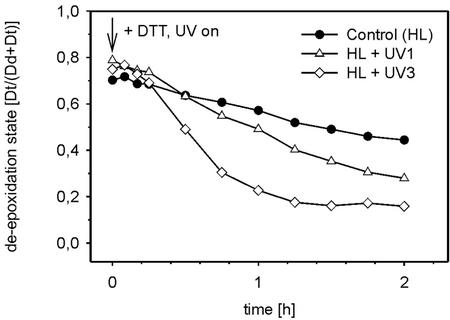
The time course of the DES [Dt/(Dd + Dt)] during combined treatment of cells with HL and different irradiances of supplementary UV-B. Before HL + UV-B treatment, all cells were HL adapted for 2 h. The Chl a and c content was 2 mg L−1. At the start of the UV-B exposure, the Dd de-epoxidase was inhibited by the addition of 10 mm DTT to the suspensions. The experiment was repeated three times. The sd did not exceed 6%.
Figure 4
Figure 4
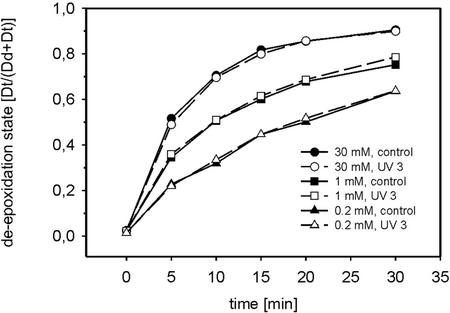
In vitro Dd de-epoxidation in broken P. tricornutum cells. The cell suspensions were pretreated with UV 3 for 2 h at a Chl a and c content of 2 mg L−1. Controls were kept in the dark. The cells were then collected by centrifugation, resuspended in a small volume of a medium buffered at pH 6.5, and broken by five freeze-thaw cycles. After dilution in a medium buffered at pH 5.5, the de-epoxidation was started by the addition of indicated concentrations of ascorbic acid. The experiments were repeated three times with dual measurement at every time point. The sd was less than 5%.
Figure 5
Figure 5
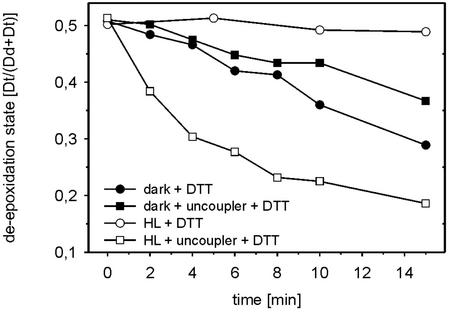
The influence of the proton gradient on Dt epoxidation in P. tricornutum cells. A DES [Dt/(Dd + Dt)] of approximately 0.5 was established in all cells by 30-min HL pretreatment. Thereafter, the Dd de-epoxidation was stopped by the addition of 10 mm DTT and the Dt epoxidation was observed in continued HL treatment as well as in the dark. The influence of uncoupling on Dt epoxidation in HL- and dark-treated cells was checked by the addition of uncoupler (25 mm ammonium chloride + 100 μm nigericin). The curves represent the average of two experiments with dual measurement at every time point.
Figure 6
Figure 6
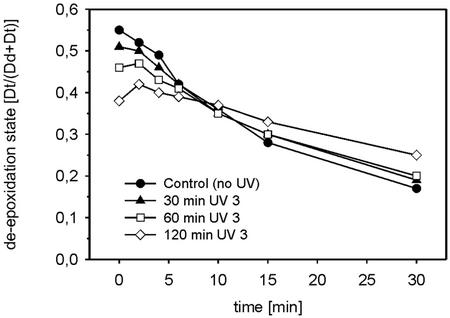
The inhibition of dark Dt epoxidation in P. tricornutum cells after different periods of UV 3 treatment. The cells were first exposed to UV 3 for 30, 60, and 120 min. The cells were then exposed to a PPFD of 800 μmol m−2 s−1 for 15 min to establish a high DES and then kept in the dark. The decrease of the DES in the dark was followed for 30 min. The curves represent the average of two experiments with dual measurement of the DES at the different time points.

References

    1. Arsalane W, Rousseau B, Duval J-C. Influence of the pool size of the xanthophyll cycle on the effects of light stress in a diatom: competition between photoprotection and photoinhibition. Photochem Photobiol. 1994;60:237–243.
    1. Bassi R, Pineau P, Dainese P, Marquardt J. Carotenoid-binding proteins of photosystem II. Eur J Biochem. 1993;212:297–303. - PubMed
    1. Brandle JR, Campbell WF, Sisson WB, Caldwell MM. Net photosynthesis, electron transport capacity, and ultrastructure of Pisum sativum L. exposed to ultraviolet-B radiation. Plant Physiol. 1977;60:165–169. - PMC - PubMed
    1. Casper-Lindley C, Björkman O. Fluorescence quenching in four unicellular algae with different light-harvesting and xanthophyll-cycle pigments. Photosynth Res. 1998;56:277–289.
    1. Chow WS, Strid A, Anderson JM. Short term treatment of pea plants with supplementary ultraviolet-B radiation: recovery time-courses of some photosynthetic functions and components. In: Murata N, editor. Research in Photosynthesis. Vol. 4. Dordrecht, The Netherlands: Kluwer Academic Publishers; 1992. pp. 361–364.

Publication types

MeSH terms

LinkOut - more resources