Bezafibrate in men with lower extremity arterial disease: randomised controlled trial
- PMID: 12433762
- PMCID: PMC133451
- DOI: 10.1136/bmj.325.7373.1139
Bezafibrate in men with lower extremity arterial disease: randomised controlled trial
Abstract
Objective: To assess the effect of bezafibrate on the risk of coronary heart disease and stroke in men with lower extremity arterial disease.
Design: Double blind placebo controlled randomised trial.
Setting: 85 general practices and nine hospital vascular clinics.
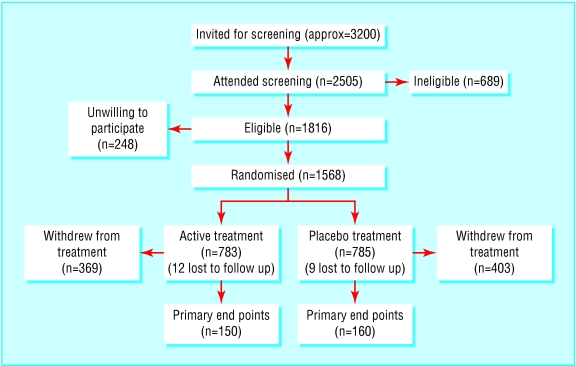
Participants: 1568 men, mean age 68.2 years (range 35 to 92) at recruitment.
Interventions: Bezafibrate 400 mg daily (783 men) or placebo (785 men).
Main outcome measures: Combination of coronary heart disease and of stroke. All coronary events, fatal and non-fatal coronary events separately, and strokes alone (secondary end points).
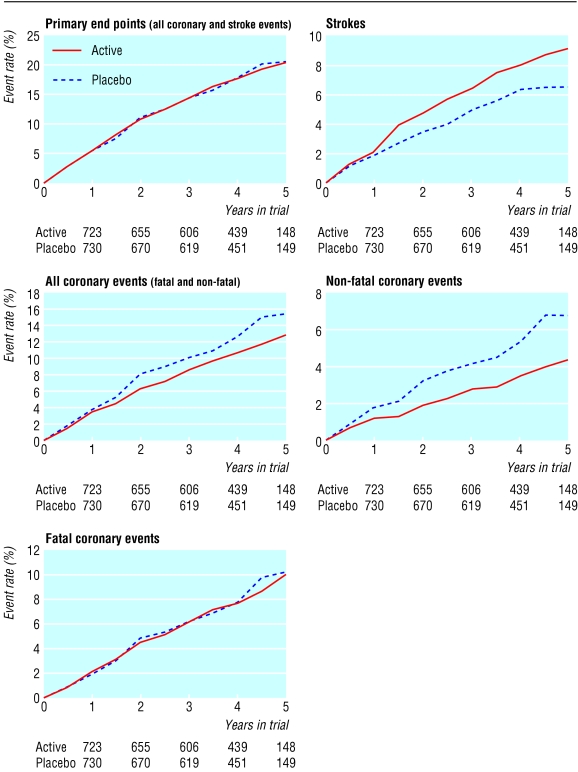
Results: Bezafibrate did not reduce the incidence of coronary heart disease and stroke. There were 150 and 160 events in the active and placebo groups respectively (relative risk 0.96, 95% confidence interval 0.76 to 1.21). There were 90 and 111 major coronary events in the active and placebo groups respectively (0.81, 0.60 to 1.08), of which 64 and 65 were fatal (0.95, 0.66 to 1.37) and 26 and 46 non-fatal (0.60, 0.36 to 0.99). Beneficial effects on non-fatal events were greatest in men aged <65 years at entry, in whom benefit was also seen for all coronary events (0.38, 0.20 to 0.72). There were no significant effects in older men. There were 60 strokes in those on active treatment and 49 in those on placebo (1.34, 0.80 to 2.01). There were 204 and 195 deaths from all causes in the two groups respectively (1.03, 0.83 to 1.26). Bezafibrate reduced the severity of intermittent claudication for up to three years.
Conclusions: Bezafibrate has no effect on the incidence of coronary heart disease and of stroke combined but may reduce the incidence of non-fatal coronary events, particularly in those aged <65 years at entry, in whom all coronary events may also be reduced.
Figures
References
-
- Danesh J, Collins R, Appleby P, Peto R. Association of fibrinogen, C-reactive protein, albumin, or leukocyte count with coronary heart disease: meta-analysis of prospective studies. JAMA. 1998;279:1477–1482. - PubMed
-
- Resch KL, Ernst E, Matrai A, Paulsen HF. Fibrinogen and viscosity as risk factors for subsequent cardiovascular events in stroke survivors. Ann Intern Med. 1992;117:371–375. - PubMed
-
- Banerjee AK, Pearson J, Gilliland EL, Goss D, Lewis JD, Stirling Y, et al. A six year prospective study of fibrinogen and other risk factors associated with mortality in stable claudicants. Thromb Haemost. 1992;68:261–263. - PubMed
-
- Koster T, Rosendaal FR, Reitsma PH, van der Velden PA, Briet E, Vandenbroucke JP. Factor VII and fibrinogen levels as risk factors for venous thrombosis. Thromb Haemost. 1994;71:719–722. - PubMed
-
- Montalescot G, Ankri A, Vicaut E, Drobinnski G, Grosgogeat Y, Thomas D. Fibrinogen after coronary angioplasty as a risk factor for restenosis. Circulation. 1995;92:31–38. - PubMed
Publication types
MeSH terms
Substances
LinkOut - more resources
Full Text Sources
Other Literature Sources
Medical