


Mitogen-activated protein kinase signaling in postgermination arrest of development by abscisic acid
- PMID: 12434021
- PMCID: PMC137798
- DOI: 10.1073/pnas.242607499
Mitogen-activated protein kinase signaling in postgermination arrest of development by abscisic acid
Abstract
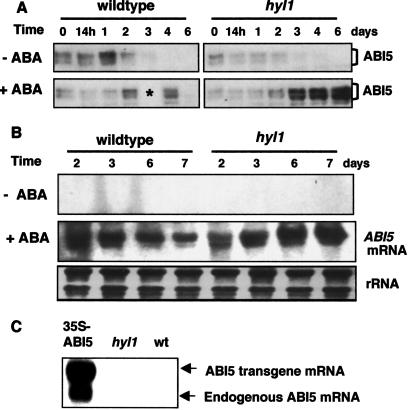
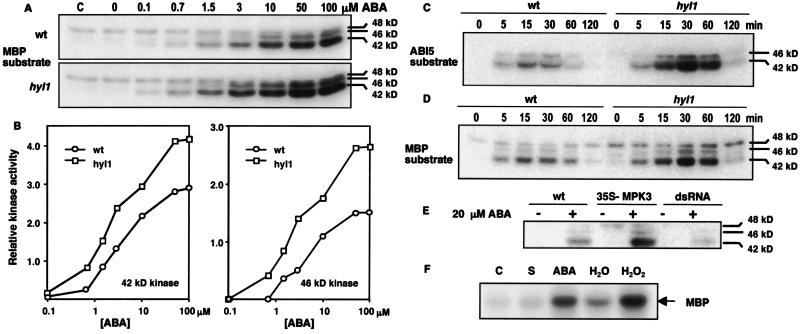
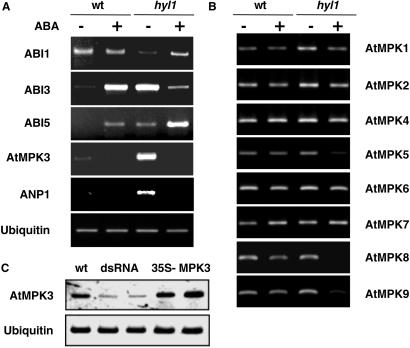
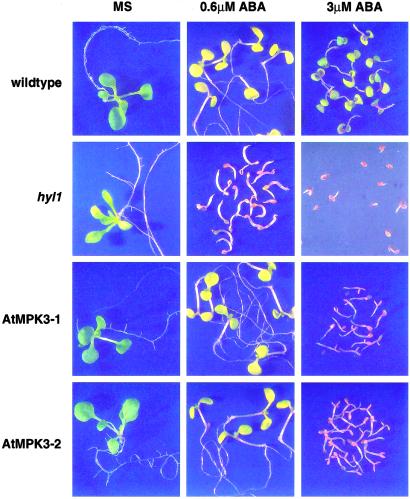
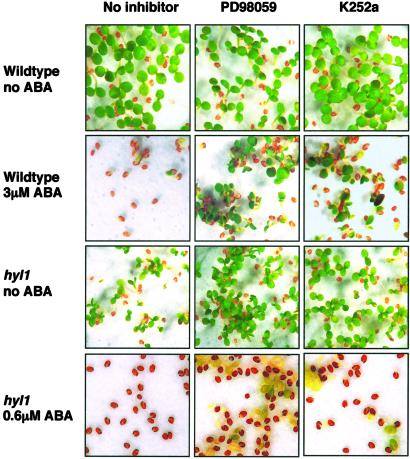
Abscisic acid (ABA) mediates plant responses to environmental stress, particularly to water status. During germination, the embryo emerges from dormancy as the ABA concentration declines. Exposure to exogenous ABA during germination arrests development rapidly, but reversibly, enabling seedlings to withstand early water stress without loss of viability. Postgermination proteolytic degradation of the essential ABI5 transcription factor is interrupted by perception of an increase in ABA concentration, leading to ABI5 accumulation and reactivation of embryonic genes. Making use of the ABA-hypersensitive hyl1 mutant of Arabidopsis, we show that the ABA signal is transmitted to the transcriptional apparatus through mitogen-activated protein kinase signaling.
Figures
References
-
- Assmann S. M. & Wang, X.-Q. (2001) Curr. Opin. Plant Biol. 4 421-428. - PubMed
-
- Hetherington A. M. (2001) Cell 107 711-714. - PubMed
-
- Bewley J. D. & Black, M., (1994) Seeds: Physiology of Development and Germination (Plenum, New York).
-
- Rock C. D. & Quatrano, R. S. (1995) in Plant Hormones: Physiology, Biochemistry and Molecular Biology, ed. Davies, P. J. (Kluwer Academic, London), pp. 671–697.
Publication types
MeSH terms
Substances
LinkOut - more resources
Full Text Sources
Molecular Biology Databases
