


Evolution of multiresistance in nontyphoid salmonella serovars from 1984 to 1998 in Argentina
- PMID: 12435702
- PMCID: PMC132759
- DOI: 10.1128/AAC.46.12.3963-3970.2002
Evolution of multiresistance in nontyphoid salmonella serovars from 1984 to 1998 in Argentina
Abstract
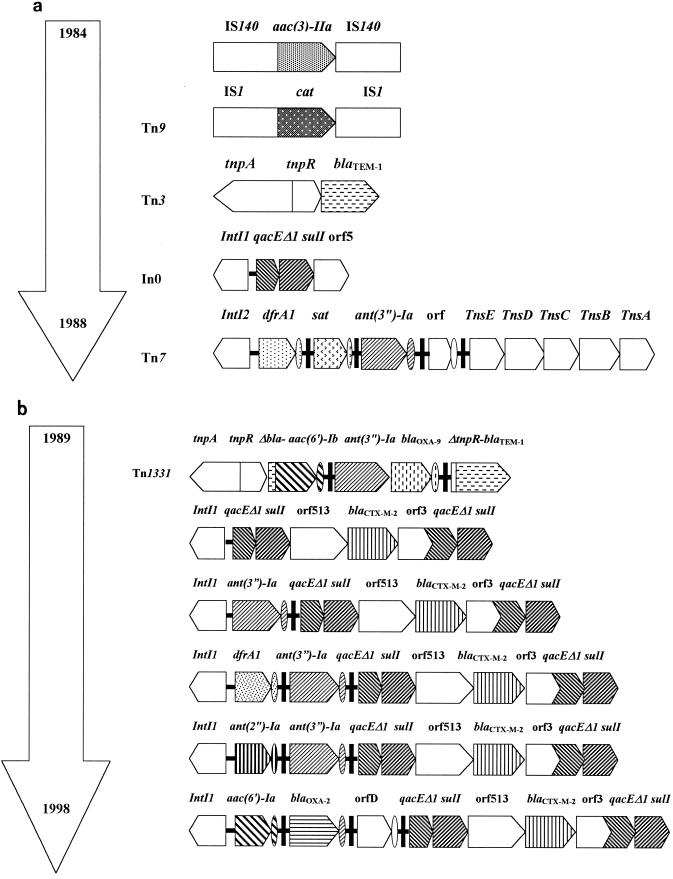
Molecular evolution of multiresistance in nontyphoid Salmonella spp. was investigated with 155 isolates obtained in Argentina from 1984 to 1998. In 74 isolates obtained from 1984 to 1988 resistance was associated with the presence of Tn3, Tn9, class I (In0) and II (Tn7) integrons, and the aac(3)-IIa gene. Extended-spectrum cephalosporin (ESC) resistance in Salmonella spp. emerged in 1989, and 81 isolates resistant to at least one ESC and one aminoglycoside were collected thereafter. Among these, two patterns of antimicrobial resistance mechanisms were found: from 1989 to 1992, resistance was related to the spreading of Tn1331 and bla(CTX-M-2), in addition to the persistence of In0 and Tn7. From 1993 to 1998, several integrons were added to the first pattern and three integron groups (IG), namely, IG1 (38% of the isolates), IG2 (51%), and IG3 (11%), were identified. At least two beta-lactamase genes were detected in 65% of the isolates (after 1989) by PCR analysis. Furthermore, five beta-lactamase genes, bla(CTX-M-(2)), bla(OXA-9), bla(OXA-2), bla(TEM-1), and bla(PER-2), were found in two isolates. The bla(CTX-M-2) gene was found in several complex sulI-type integrons with different rearrays within the variable region of class I integrons, suggesting evolution of these integrons in nontyphoid Salmonella. In conclusion, progressive acquisition and accumulation of plasmid-mediated resistance determinants occurred from 1984 to 1998 in nontyphoid Salmonella isolates of the most prevalent serovars from Argentina. It is suggested that antimicrobial resistance mechanisms in these bacteria may have been the consequence of plasmid exchange between Salmonella enterica serovar Typhimurium and Escherichia coli or Shigella flexneri and/or spreading of mobile elements from the nosocomial environment.
Figures
References
-
- Archambaud, M., G. Gerbaud, E. Labau, N. Marty, and P. Courvalin. 1991. Possible in-vivo transfer of β-lactamase TEM-3 from Klebsiella pneumoniae to Salmonella kedougou. J. Antimicrob. Chemother. 27:427-436. - PubMed
-
- Balis, E., A. C. Vatopoulos, M. Kanelopoulou, E. Mainas, G. Hatzoudis, V. Kontogianni, H. Malamou-Lada, S. Kitsou-Kiriakopoulou, and V. Kalapothaki. 1996. Indications of in vivo transfer of an epidemic R plasmid from Salmonella enteriditis to Escherichia coli of the normal human gut flora. J. Clin. Microbiol. 34:977-979. - PMC - PubMed
Publication types
MeSH terms
LinkOut - more resources
Full Text Sources
Miscellaneous
