


Antimicrobial peptides from human platelets
- PMID: 12438321
- PMCID: PMC132966
- DOI: 10.1128/IAI.70.12.6524-6533.2002
Antimicrobial peptides from human platelets
Abstract
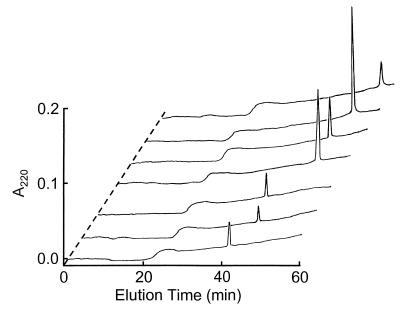
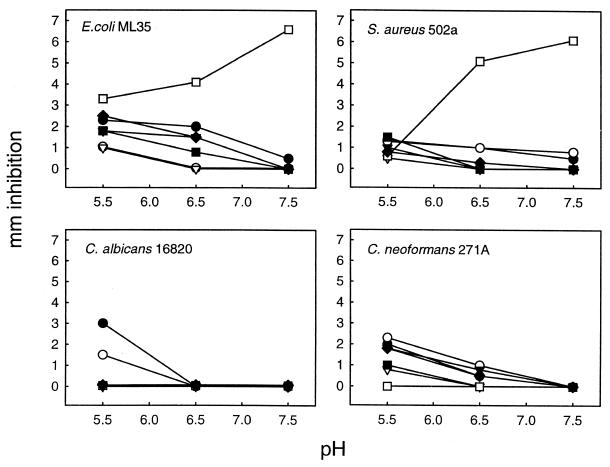
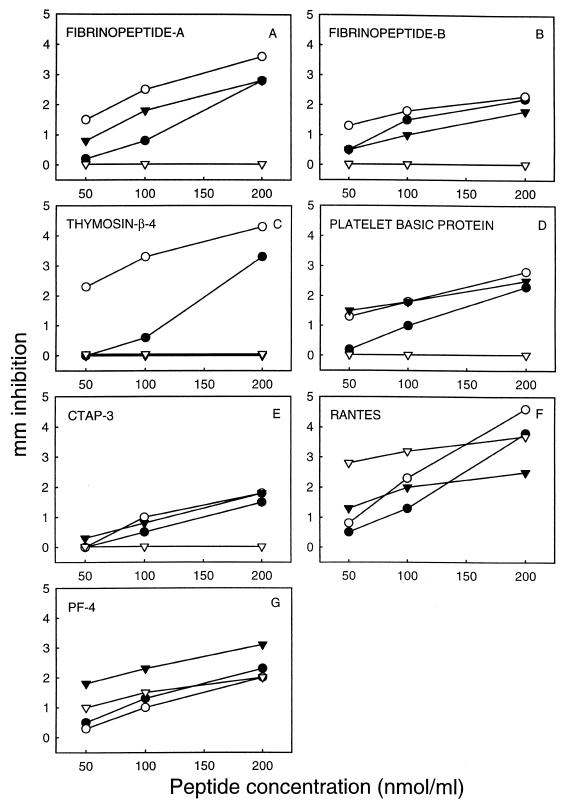
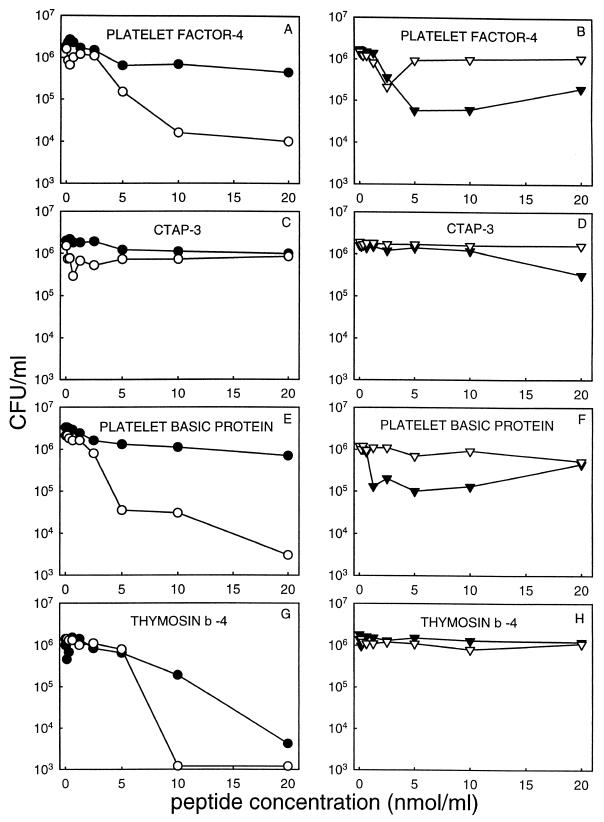
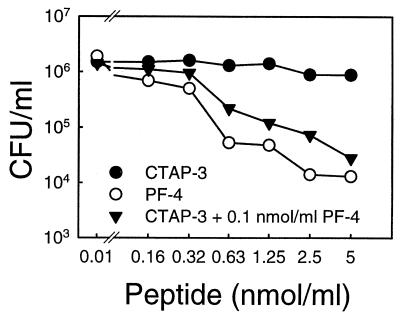
Platelets share structural and functional similarities with granulocytes known to participate in antimicrobial host defense. To evaluate the potential antimicrobial activities of platelet proteins, normal human platelets were stimulated with human thrombin in vitro. Components of the stimulated-platelet supernatants were purified to homogeneity by reversed-phase high-performance liquid chromatography. Purified peptides with inhibitory activity against Escherichia coli ML35 in an agar diffusion antimicrobial assay were characterized by mass spectrometry, amino acid analysis, and sequence determination. These analyses enabled the identification of seven thrombin-releasable antimicrobial peptides from human platelets: platelet factor 4 (PF-4), RANTES, connective tissue activating peptide 3 (CTAP-3), platelet basic protein, thymosin beta-4 (Tbeta-4), fibrinopeptide B (FP-B), and fibrinopeptide A (FP-A). With the exception of FP-A and FP-B, all peptides were also purified from acid extracts of nonstimulated platelets. The in vitro antimicrobial activities of the seven released peptides were further tested against bacteria (E. coli and Staphylococcus aureus) and fungi (Candida albicans and Cryptococcus neoformans). Each peptide exerted activity against at least two organisms. Generally, the peptides were more potent against bacteria than fungi, activity was greater at acidic pHs, and antimicrobial activities were dose dependent. Exceptions to these observations were observed with PF-4, which displayed a bimodal dose-response relationship in microbicidal assays, and Tbeta-4, which had greater activity at alkaline pHs. At concentrations at which they were individually sublethal, PF-4 and CTAP-3 exerted synergistic microbicidal activity against E. coli. Collectively, these findings suggest a direct antimicrobial role for platelets as they are activated to release peptides in response to trauma or mediators of inflammation.
Figures

Comment in
-
Chemokines meet defensins: the merging concepts of chemoattractants and antimicrobial peptides in host defense.Infect Immun. 2002 Dec;70(12):6515-7. doi: 10.1128/IAI.70.12.6515-6517.2002. Infect Immun. 2002. PMID: 12438319 Free PMC article. Review. No abstract available.
References
-
- Altschul, S. F., W. Gish, W. Miller, E. W. Myers, and D. J. Lipman. 1990. Basic local alignment search tool. J. Mol. Biol. 215:403-410. - PubMed
-
- Carney, D. H. 1992. Postclotting cellular effects of thrombin mediated by interaction with high-affinity thrombin receptors, p. 351-370. In L. J. Berliner (ed.), Thrombin: structure and function. Plenum Press, New York, N.Y.
-
- Carroll, S. F., and R. J. Martinez. 1981. Antibacterial peptide from normal rabbit serum. 1. Isolation from whole serum, activity, and microbicidal spectrum. Biochemistry 20:5973-5981. - PubMed
-
- Chang, F. Y., N. Singh, T. Gayowski, M. M. Wagener, S. M. Mietzner, J. E. Stout, and I. G. Marino. 2000. Thrombocytopenia in liver transplant recipients: predictors, impact on fungal infections, and role of endogenous thrombopoietin. Transplantation 69:70-75. - PubMed
Publication types
MeSH terms
Substances
Grants and funding
LinkOut - more resources
Full Text Sources
Other Literature Sources
Medical
Miscellaneous
