. 2002 Dec;70(12):6680-7.
doi: 10.1128/IAI.70.12.6680-6687.2002.

Analysis of Ebh, a 1.1-megadalton cell wall-associated fibronectin-binding protein of Staphylococcus aureus

Affiliations

Analysis of Ebh, a 1.1-megadalton cell wall-associated fibronectin-binding protein of Staphylococcus aureus

Simon R Clarke et al. Infect Immun. 2002 Dec.

Abstract

In order for Staphylococcus aureus to adhere to host extracellular matrix (ECM) substrates, it elicits a wide range of surface proteins. We have characterized a novel approximately 1.1-MDa protein in S. aureus, termed Ebh (for ECM-binding protein homologue), which has homology to other ECM-binding proteins. Ebh consists of several domains, including a large central region with 44 imperfect repeats of 126 amino acids. Expression analysis revealed ebh to be growth phase regulated and repressed by agr. A fragment of the central repeat region of Ebh was cloned, overexpressed, and used in ligand-binding studies to determine Ebh function. The recombinant protein was found to specifically bind human fibronectin. Ebh is produced during human infection since serum samples taken from patients with confirmed S. aureus infections were found to contain anti-Ebh antibodies. Localization studies revealed Ebh to be cell envelope associated and is proposed to form a specialized surface structure involved in cellular adhesion.


Figures
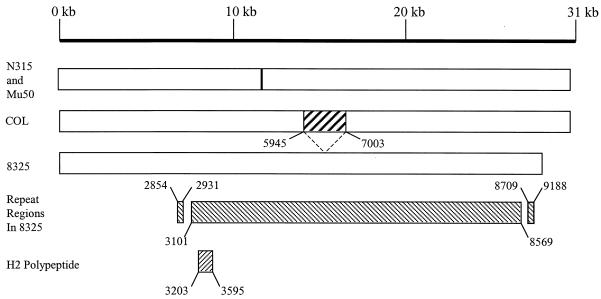
FIG. 1.
FIG. 1.
Organization of ebh in S. aureus strains 8325 and COL and ebhA and ebhB in Mu50 and N315. The crossed box in COL represents the missing sequence in 8325. The positions of the repeat regions and the H2 polypeptide are shown.
FIG. 2.
FIG. 2.
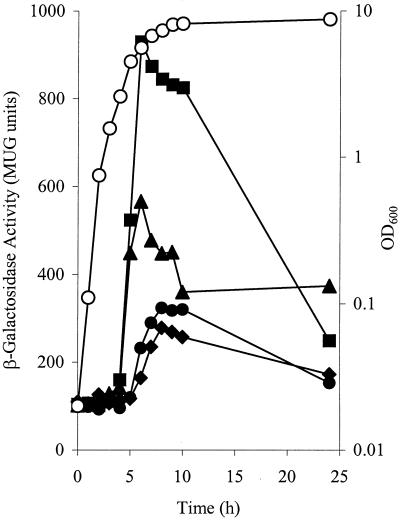
Expression of ebh::lacZ fusion during growth of S. aureus, as described in Materials and Methods. A representative growth curve of LH10 [8325-4] at an optical density at 600 nm is shown (○). β-Galactosidase activity was measured for LH10 (8325-4; •), SRC001 (COL; ▴), LH11 (8325-4; agr; ▪), and LH12 (8325-4, sarA; ⧫).
FIG. 3.
FIG. 3.
Western immunoblot of H2 polypeptide (each lane containing ∼1 μg), with serum samples collected from four patients recovering from S. aureus infections. Lanes 1, Coomassie blue-stained H2 polypeptide; 2, patient diagnosed with toxic shock syndrome; 3, patient diagnosed with discitis; 4, patient diagnosed with a deep abscess; 5, patient diagnosed with septic arthritis.
FIG. 4.
FIG. 4.
Western immunoblot of S. aureus cell wall extracts with anti-H2 antisera. Samples were taken at time 3 and 8 h postinoculation. Lanes: 1, LH9 (8325-4 ebh) at 3 h; 2, LH9 at 8 h; 3, 8325-4 at 3 h; 4, 8325-4 at 8 h; 5: LH17 (COL ebh) at 3 h; 6, LH17 at 8 h; 7, COL at 3 h; 8, COL at 8 h. The band corresponding to Ebh appears ∼2 mm into the resolving gel (total length, 6 cm).
FIG. 5.
FIG. 5.
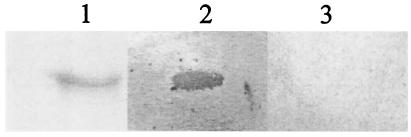
Screening for Fn-binding activity by using the Western affinity blotting technique. H2 polypeptide binds human Fn but not Fg. Lanes: 1, Coomassie blue-stained H2 polypeptide (∼1 μg); 2, H2 polypeptide (∼1 μg) blotted with human Fn; 3, H2 polypeptide (∼1 μg) blotted with human Fg.
FIG. 6.
FIG. 6.
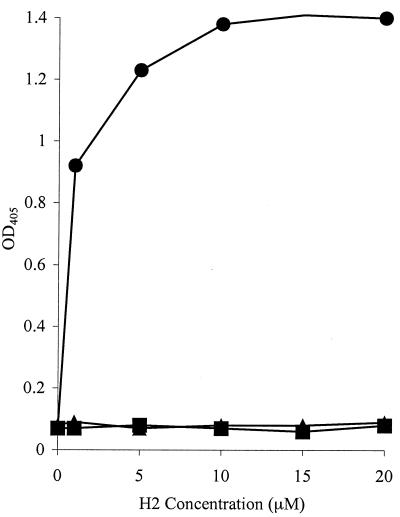
Binding of H2 polypeptide to microtiter plate wells coated with Fn (•), Fg (▴), or BSA (▪). Increasing concentrations of H2 were incubated in the wells for 1 h at room temperature. Bound protein was detected with anti-H2 antibodies and anti-rabbit AP-conjugated antibodies. Values represent the means of triplicate wells. H2 polypeptide binds immobilized Fn, but not Fg or BSA.
FIG. 7.
FIG. 7.
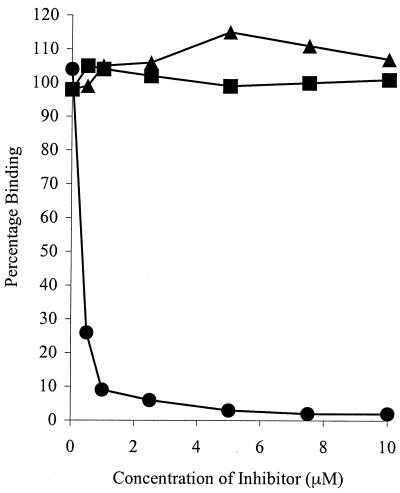
Inhibition of H2 polypeptide binding to immobilized Fn. Wells were coated with Fn. H2 was preincubated for 1 h with increasing concentrations of Fn (•), Fg (▴), and BSA (▪) prior to incubation in Fn-coated wells. Bound proteins was detected with anti-H2 antibodies and anti-rabbit AP-conjugated antibodies. Values represent the means of triplicate wells. H2 polypeptide binds soluble Fn, but not Fg or BSA, inhibiting binding to immobilized Fn.

References

    1. Ahmed, S., S. Meghji, R. J. Williams, B. Henderson, J. H. Brock, and S. P. Nair. 2001. Staphylococcus aureus fibronectin-binding proteins are essential for internalization of osteoblasts but do not account for differences in intracellular levels of bacteria. Infect. Immun. 69:2872-2877. - PMC - PubMed
    1. Allignet, J., S. Aubert, K. G. H. Dyke, and N. El Solh. 2001. Staphylococcus caprae strains carry determinants known to be involved in pathogenicity: a gene encoding an autolysin-binding fibronectin and the ica operon involved in biofilm formation. Infect. Immun. 69:712-718. - PMC - PubMed
    1. Braun, L., S. Dramsi, P. Dehoux, H. Bierne, G. Lindahl, and P. Cossart. 2001. InlB: and invasion protein of Listeria monocytogenes with a novel type of surface association. Mol. Microbiol. 25:285-294. - PubMed
    1. Chan, P. F., and S. J. Foster. 1998. The role of environmental factors in the regulation of virulence determinant expression in Staphylococcus aureus 8325-4. Microbiology 144:2469-2479. - PubMed
    1. Chan, P. F., and S. J. Foster. 1998. Role of SarA in virulence determinant production and environmental signal transduction in Staphylococcus aureus. J. Bacteriol. 180:6232-6241. - PMC - PubMed

Publication types

MeSH terms

LinkOut - more resources