


doi: 10.1128/jvi.76.24.12483-12490.2002.
Evidence that replication of the antitumor adenovirus ONYX-015 is not controlled by the p53 and p14(ARF) tumor suppressor genes
Affiliations
- PMID: 12438574
- PMCID: PMC136704
- DOI: 10.1128/jvi.76.24.12483-12490.2002
Item in Clipboard
Evidence that replication of the antitumor adenovirus ONYX-015 is not controlled by the p53 and p14(ARF) tumor suppressor genes
J Virol.
2002 Dec.
Abstract
The adenovirus mutant ONYX-015 is in phase III clinical trials as a novel antitumor therapy. Its apparent efficacy is thought to be due to its ability to replicate selectively in tumor cells defective in the signaling pathway for p53. Recent data have shown that p14(ARF), a positive regulator of p53, inhibits ONYX-015 replication in cells with a wild-type p53, a phenotype that characterizes normal cells. We, however, found that ONYX-015 activates p53 in tumor cells and in normal cells and that this can occur without p14(ARF) induction. We also show that ONYX-015 is not attenuated in cells with functional p53, whether or not p14(ARF) is expressed, and that where attenuation does occur, it is cell type specific.
Figures
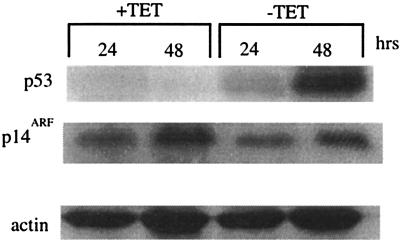
Overexpression of p53 does not reduce the level of p14ARF. H24-H1299 cells were seeded and incubated for the indicated times in the absence (p53 induced) or presence of 4.5 μg of tetracycline per ml. Cells were harvested, and immunoblotting was carried out with antibodies to p53, p14ARF, and actin. Actin was used as a loading control.
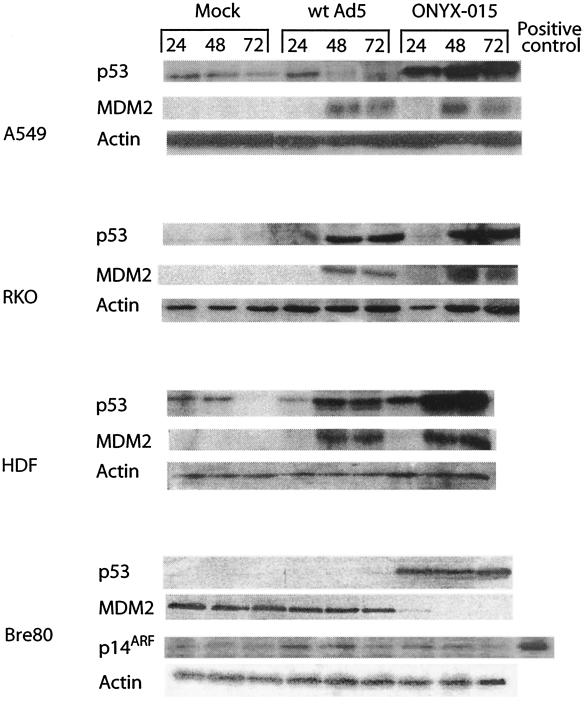
ONYX-015 can induce p53 in the absence of p14ARF after infection of both tumor and normal cells. A549, RKO, HDF, and Bre80 cells were infected as described in Materials and Methods, and at the indicated times (hours) they were harvested and immunoblotting was carried out with antibodies to p53, p14ARF, MDM2, and actin. Protein lysate from HT29 cells was used as a positive control for p14ARF.
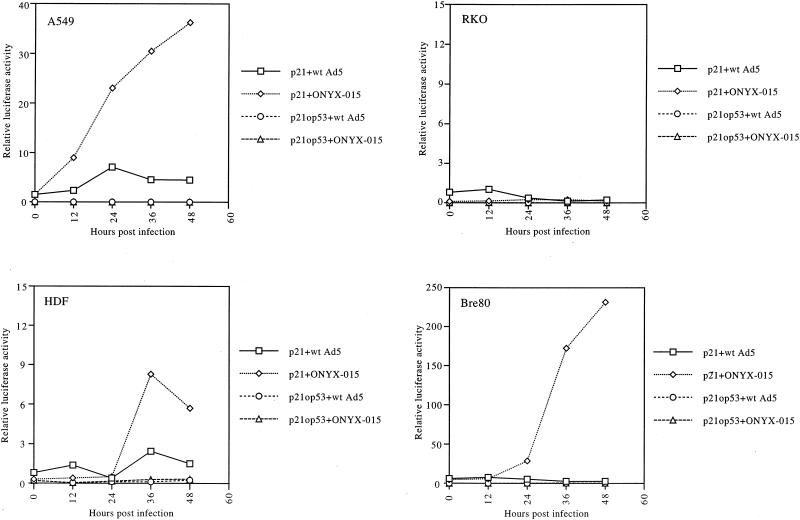
ONYX-015 can activate the p21CIP1/WAF1 promoter in tumor and normal cells. Cells were transfected with the p21CIP1/WAF1 promoter-luciferase reporter constructs with and without (op53) the p53 response element and subsequently infected with wt Ad5 or ONYX-015 as described in Materials and Methods. At different times postinfection, cells were harvested and luciferase activity was determined. All samples were standardized to the same cell number.
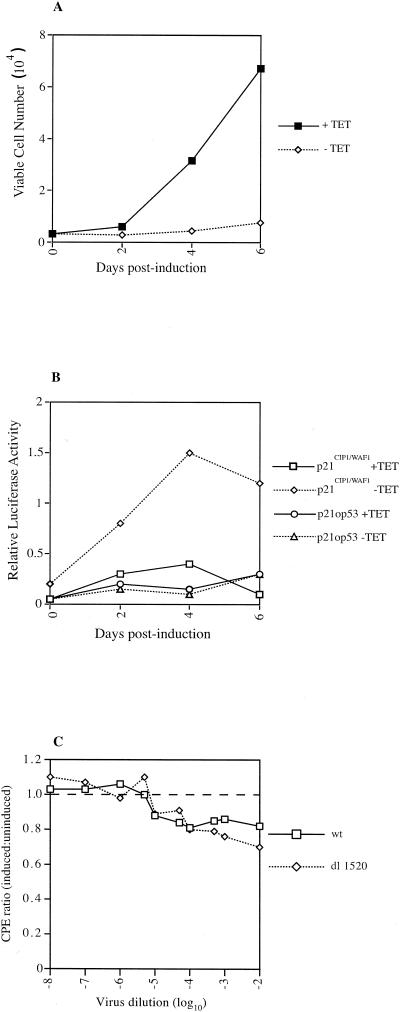
High levels of p53 and p14ARF do not selectively inhibit ONYX-015 replication. H24-H1299 cells were seeded and incubated either in the presence of 4.5 μg of tetracycline per ml or in its absence (p53 induced; see Fig. 1). (A) Cell growth was determined over time by direct cell counting. Viable and nonviable cells were distinguished by using trypan blue staining. (B) Cells were seeded, grown in the presence and absence of tetracycline, and transfected with the p21CIP1/WAF1 luciferase reporter constructs. At the indicated times posttransfection, cells were harvested and luciferase activity was determined. All samples were standardized to the same cell number. (C) Cells were infected with serial dilutions of wt Ad5 and ONYX-015, and a CPE analysis was carried out at about 3 to 4 days postinfection on 293 cells. The ratio of CPE induced by each virus under induced conditions to that induced under uninduced conditions is plotted against virus dilution. A ratio of 1.0 (dashed line) indicates no preference for the different conditions.
References
-
- Barker, D. D., and A. J. Berk. 1987. Adenovirus proteins from both E1b reading frames are required for transformation of rodent cells by viral infection and DNA transfection. Virology 156:107-121. - PubMed
-
- Bates, S., A. C. Phillips, P. A. Clark, F. Stott, G. Peters, R. L. Ludwig, and K. H. Vousden. 1998. p14ARF links the tumour suppressors Rb and p53. Nature 395:124-125. - PubMed
-
- Bischoff, J. R., D. H. Kirn, A. Williams, C. Heise, S. Horn, M. Muna, L. Ng, J. A. Nye, A. Sampson-Johannes, A. Fattaey, and F. McCormick. 1996. An adenovirus mutant that replicates selectively in p53-deficient human tumour cells. Science 274:373-376. - PubMed
-
- Braithwaite, A. W., G. E. Blair, C. C. Nelson, J. McGovern, and A. J. Bellett. 1991. Adenovirus E1b58kD antigen binds to p53 during infection of rodent cells: evidence for an N-terminal binding site on p53. Oncogene 6:781-787. - PubMed
Publication types
MeSH terms
Substances
LinkOut - more resources
Full Text Sources
Research Materials
Miscellaneous
