Comparative Study
. 2002 Nov 26;99(24):15681-6.
doi: 10.1073/pnas.252630999. Epub 2002 Nov 18.

Cultivating the uncultured

Affiliations
Comparative Study

Cultivating the uncultured

Karsten Zengler et al. Proc Natl Acad Sci U S A. .

Abstract

The recent application of molecular phylogeny to environmental samples has resulted in the discovery of an abundance of unique and previously unrecognized microorganisms. The vast majority of this microbial diversity has proved refractory to cultivation. Here, we describe a universal method that provides access to this immense reservoir of untapped microbial diversity. This technique combines encapsulation of cells in gel microdroplets for massively parallel microbial cultivation under low nutrient flux conditions, followed by flow cytometry to detect microdroplets containing microcolonies. The ability to grow and study previously uncultured organisms in pure culture will enhance our understanding of microbial physiology and metabolic adaptation and will provide new sources of microbial metabolites. We show that this technology can be applied to samples from several different environments, including seawater and soil.


Figures
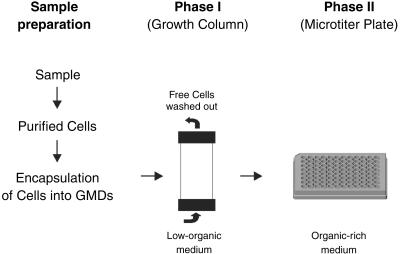
Fig 1.
Fig 1.
Model of the experimental setup. Cells captured from environmental samples were encapsulated into GMDs and incubated in growth columns (phase I). GMDs containing microcolonies were detected and separated by flow cytometry into 96-well microtiter plates containing a rich organic medium (phase II).
Fig 2.
Fig 2.
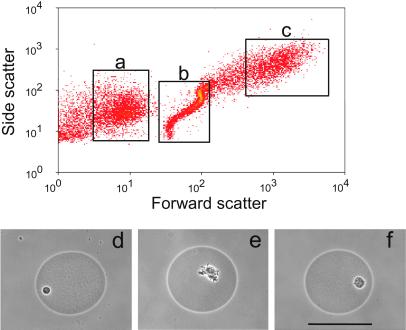
Discrimination among (a) free-living cells, (b) singly occupied or empty GMDs, and (c) GMDs containing microcolonies was accomplished by flow cytometry in forward and side light-scatter mode. (d–f) Phase contrast photomicrographs of separated GMDs containing microcolonies. (Bar = 50 μm.)
Fig 3.
Fig 3.
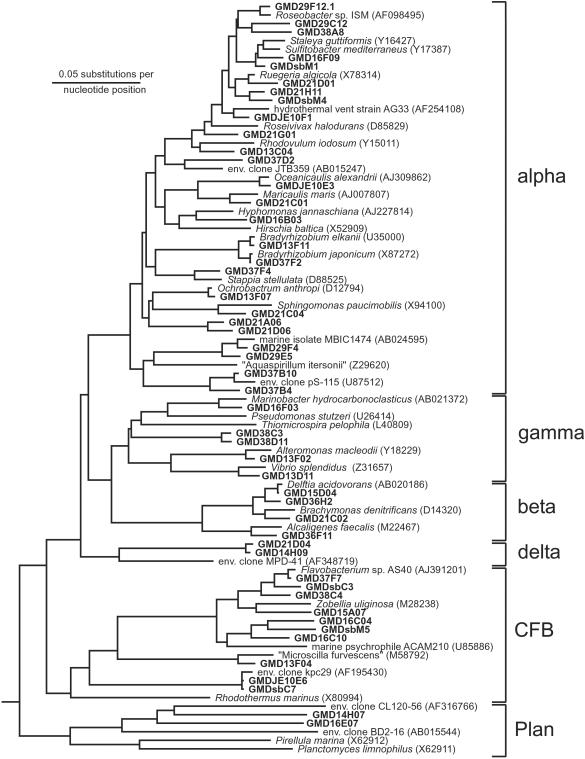
Phylogenetic tree based on 16S rRNA sequences that were retrieved from GMDs obtained from the Sargasso Sea. Shown are groups of the alpha, beta, gamma, and delta subclasses of Proteobacteria, as well as of the Cytophaga–Flavobacterium–Bacteroides and relatives (CFB) and Planctomycetes and relatives (Plan).
Fig 4.
Fig 4.
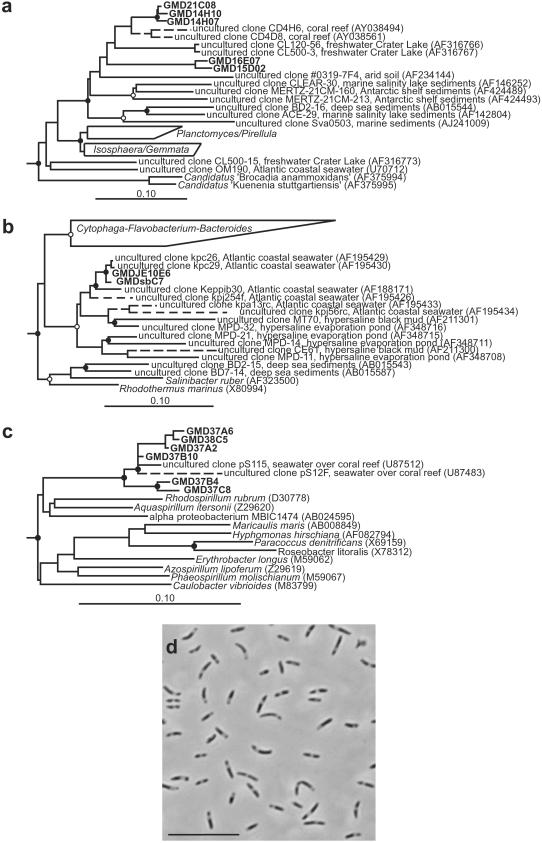
Phylogenetic analysis of 16S rDNA sequences from GMDs obtained from Sargasso Sea water. Nodes supported by bootstrap proportions >90% in both distance and parsimony analyses are shown as filled circles; open circles indicate ≤70% support. Scale bars (a–c) correspond to 0.10 substitutions per nucleotide position. Dotted lines represent lineages added by the ARB parsimony insertion tool. (a) Planctomycetes and relatives. Verrucomicrobia and Chlamydiae sequences were used as outgroups. (b) Cytophaga–Flavobacterium–Bacteroides and relatives. Chlorobiaceae sequences were used as outgroups. (c) Alpha Proteobacteria. Gamma and beta Proteobacteria sequences were used as outgroups. (d) Phase contrast photomicrograph of strain GMDJE10E6. (Bar = 10 μm.)
Fig 5.
Fig 5.
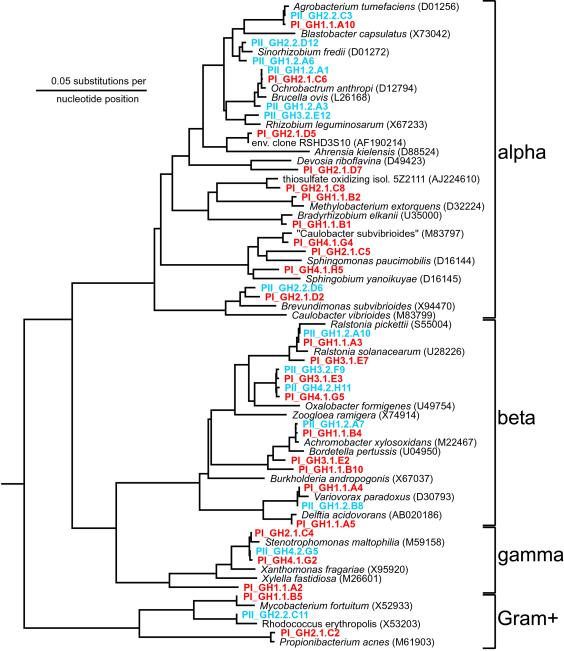
Phylogenetic tree based on 16S rRNA sequences that were retrieved from GMDs obtained from a soil sample (Ghana). Shown are groups of the alpha, beta, and gamma subclasses of Proteobacteria, as well as of Gram-positive bacteria. Cultures obtained in phase I (PI) are marked in red; cultures obtained in phase II (PII) are marked in blue.

References

    1. Pace N. R. (1997) Science 276 734-740. - PubMed
    1. Amann R. I., Ludwig, W. & Schleifer, K.-H. (1995) Microbiol. Rev. 59 143-169. - PMC - PubMed
    1. Giovannoni S. J. & Rappe, M. (2000) in Microbial Ecology of the Ocean, ed. Kirchman, D. L. (Wiley, New York), pp. 47–84.
    1. Fuhrman J. A., McCallum, K. & Davis, A. A. (1993) Appl. Environ. Microbiol. 59 1294-1302. - PMC - PubMed
    1. Kaeberlein T., Lewis, K. & Epstein, S. S. (2002) Science 296 1127-1129. - PubMed

Publication types