Comparative Study
. 2002 Nov 26;99(24):15456-61.
doi: 10.1073/pnas.232444199. Epub 2002 Nov 18.

Pineal expression-promoting element (PIPE), a cis-acting element, directs pineal-specific gene expression in zebrafish

Affiliations
Comparative Study

Pineal expression-promoting element (PIPE), a cis-acting element, directs pineal-specific gene expression in zebrafish

Yoichi Asaoka et al. Proc Natl Acad Sci U S A. .

Abstract

The pineal gland, sharing morphological and biochemical similarities with the retina, plays a unique and central role in the photoneuroendocrine system. The unique development of the pineal gland is directed by a specific combination of the expressed genes, but little is known about the regulatory mechanism underlying the pineal-specific gene expression. We isolated a 1.1-kbp fragment upstream of the zebrafish exo-rhodopsin (exorh) gene, which is expressed specifically in the pineal gland. Transgenic analysis using an enhanced green fluorescent protein reporter gene demonstrated that the proximal 147-bp region of the exorh promoter is sufficient to direct pineal-specific expression. This region contains three copies of a putative cone rod homeobox (Crx)Otx-binding site, which is known to be required for expression of both retina- and pineal-specific genes. Deletion and mutational analyses of the exorh promoter revealed that a previously uncharacterized sequence TGACCCCAATCT termed pineal expression-promoting element (PIPE) is required for pineal-specific promoter activity in addition to the CrxOtx-binding sites. By using the zebrafish rhodopsin (rh) promoter that drives retina-specific expression, we created a reporter construct having ectopic PIPE in the rh promoter at a position equivalent to that in the exorh promoter by introducing five nucleotide changes. Such a slight modification in the rh promoter induced ectopic enhanced green fluorescent protein expression in the pineal gland without affecting its retinal expression. These results identify PIPE as a critical cis-element contributing to the pineal-specific gene expression, in combination with the CrxOtx-binding site(s).


Figures
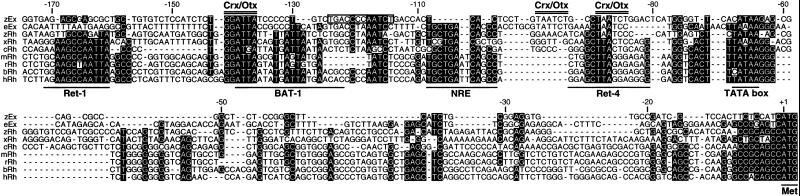
Fig 1.
Fig 1.
The proximal promoter sequences of exorh and rh genes of vertebrates. The upstream sequence of the zebrafish exorh (zEx) was aligned with those of rh genes of the zebrafish (zRh), Xenopus (xRh), chicken (cRh), mouse (mRh), rat (rRh), bovine (bRh), and human (hRh). The upstream sequence of the European eel exorh (eEx) was determined in the present study and included in the alignment. Nucleotides conserved among at least six sequences are shown with white characters on black backgrounds. Horizontal lines indicate TATA box, ATG initiation codon, and conserved cis-elements identified previously in the rh promoters. Potential Crx/Otx-binding sites found in the zebrafish exorh promoter are double-lined. The PIPE sequence in the zebrafish exorh gene is boxed. The nucleotide numbers are relative to the translation initiation site of the zebrafish exorh gene. Accession numbers of the sequences obtained from GenBank are (xRh), (cRh), (mRh), (rRh), and (hRh). The bRh sequence was obtained from the original paper (17).
Fig 2.
Fig 2.
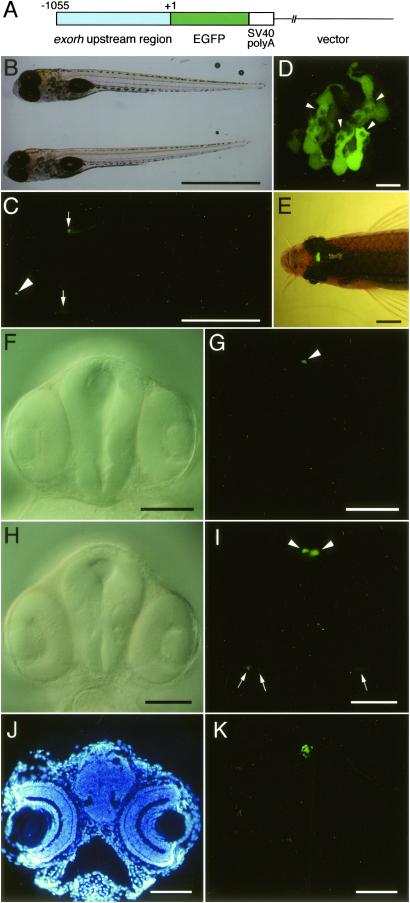
Pineal-specific EGFP expression in Ex(−1055) transgenic zebrafish. (A) Schematic representation of Ex(−1055) construct in a linearized form used for microinjection. (B) Dorsolateral views (bright field image) of a WT larva (upper) and Ex(−1055) transgenic larva (lower) at 7 dpf. (C) Fluorescent image of B. The transgene-dependent fluorescence signal was observed specifically in the pineal gland of Ex(−1055) transgenic larva (arrowhead), and autofluorescence signals observed in transgenic and WT fish are marked by arrows. (D) High-magnification confocal image (dorsal view) of EGFP-positive pineal cells of 7-dpf-larva, with anterior to the left. The outer segment-like extrusion is indicated by each arrowhead. (E) Dorsal view of Ex(−1055) transgenic adult fish illuminated with both tungsten lamp and blue light. EGFP fluorescence signals were observed only in the pineal gland throughout its life. (FI) Frontal views (dorsal up) of living transgenic embryos observed at 28 hpf (F and G) or 43 hpf (H and I) by using Nomarski optics (F and H) or fluorescence microscopy (G and I). Arrowheads in G and I indicate EGFP-positive cells in the pineal gland, and arrows in I point to EGFP-positive cells in the retina. The embryos in G and I were photographed under the same exposure conditions. (J) 4′,6-diamidino-2-phenylindole staining of a 10-μm-thick cross-section of the head of Ex(−1055) transgenic larva at 7 dpf. (K) EGFP fluorescent image of J. [Bars = 1 mm (B and C), 10 μm (D), 2 mm (E), and 100 μm (FK).] For a clear demonstration, pigmentation of the embryos and larvae was reduced by treatment with 0.003% 1-phenyl-2-thiourea (Nacalai Tesque, Kyoto).
Fig 3.
Fig 3.
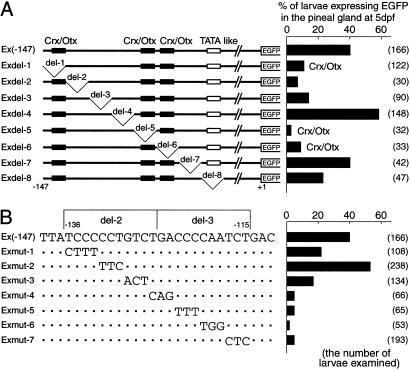
Effects of internal deletions (A) and site-directed mutations (B) in the exorh promoter sequence. (Right) Bar graphs indicate the percentage of larvae that expressed EGFP fluorescence signals in the pineal gland at 5 dpf, and the number of larvae examined at 5 dpf is shown in parentheses. (A Left) The parental construct Ex(−147) and its deletion mutants (Exdel-1 to Exdel-8) are schematically depicted. Black and white boxes indicate the positions of three putative Crx/Otx-binding sites and the TATA-like sequence, respectively. (B Left) The partial nucleotide sequences of the parental construct Ex(−147) and its seven mutant constructs, Exmut-1 to Exmut-7, with dots representing unaltered nucleotides. Numbers at the top indicate the positions of nucleotides relative to the translation initiation site.
Fig 4.
Fig 4.
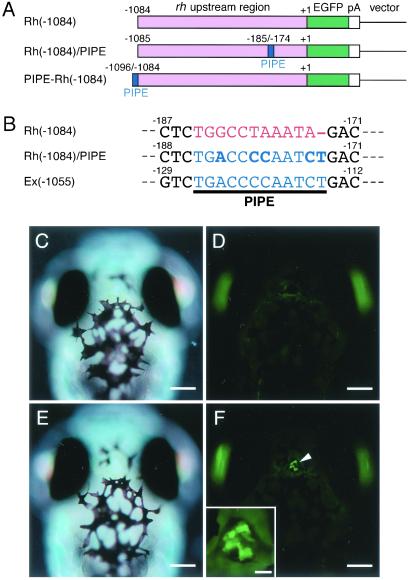
Ectopic gene expression in the pineal gland driven by the zebrafish rh chimeric promoter carrying the PIPE sequence. (A) Schematic representation of the constructs, Rh(−1084), Rh(−1084)/PIPE, and PIPE-Rh(−1084). (B) Comparison of PIPE and nearby sequence in Ex(−1055) with those in the corresponding region of Rh(−1084) or Rh(−1084)/PIPE. Bold characters in Rh(−1084)/PIPE represent five nucleotides (four substitutions and a single insertion) modified from Rh(−1084) to create an ectopic PIPE sequence. (CF) Dorsal views (anterior up) of Rh(−1084) (C and D) and Rh(−1084)/PIPE (E and F) transgenic larvae at 7 dpf. Nomarski (C and E) and fluorescent (D and F) images were taken at the same focal plane without moving the larvae. EGFP fluorescence signals in the pineal gland of Rh(−1084)/PIPE transgenic larva are marked by an arrowhead (F). (F Inset) High-magnification image of the EGFP-positive pineal structure. The larvae in CF were not treated with 1-phenyl-2-thiourea, so that strong EGFP fluorescence signals in the pigmented eyes (D and F) are only visible through the pupil. [Bars = 100 μm (CF), 20 μm (F Inset).]

References

    1. Pu G. A. & Dowling, J. E. (1981) J. Neurophysiol. 46 1018-1038. - PubMed
    1. Cole W. C. & Youson, J. H. (1982) Am. J. Anat. 165 131-163. - PubMed
    1. Tamotsu S. & Morita, Y. (1986) J. Comp. Physiol. A 159 1-5. - PubMed
    1. Collin J. P., Voisin, P., Falcón, J., Faure, J. P., Brisson, P. & Defaye, J. R. (1989) Arch. Histol. Cytol. 52 441-449. - PubMed
    1. Shedpure M. & Pati, A. K. (1995) Indian J. Exp. Biol. 33 625-640. - PubMed

Publication types

MeSH terms

Associated data