


Docetaxel vs 5-fluorouracil plus vinorelbine in metastatic breast cancer after anthracycline therapy failure
- PMID: 12439707
- PMCID: PMC2408916
- DOI: 10.1038/sj.bjc.6600645
Docetaxel vs 5-fluorouracil plus vinorelbine in metastatic breast cancer after anthracycline therapy failure
Abstract
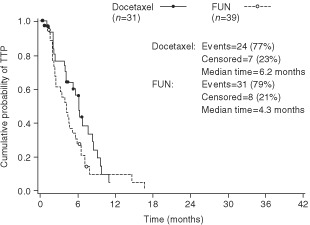
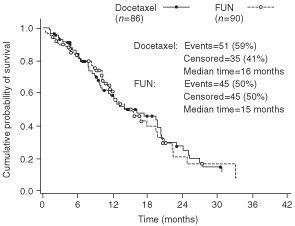
This multicentre, randomised phase III study compared docetaxel with 5-fluorouracil+vinorelbine in patients with metastatic breast cancer after failure of neo/adjuvant or one line of palliative anthracycline-based chemotherapy. One hundred and seventy-six metastatic breast cancer patients were randomised to receive docetaxel (100 mg m(-2)) every 3 weeks or 5-fluorouracil+vinorelbine: 5-fluorouracil (750 mg m(-2) per day continuous infusion) D1-5 plus vinorelbine (25 mg m(-2)) D1 and D5 of each 3-week cycle. Eighty-six patients received 516 cycles of docetaxel; 90 patients received 476 cycles of 5-fluorouracil+vinorelbine. Median time to progression (6.5 vs 5.1 months) and overall survival (16.0 vs 15.0 months) did not differ significantly between the docetaxel and 5-fluorouracil+vinorelbine arms, respectively. Six (7%) complete responses and 31 (36%) partial responses occurred with docetaxel (overall response rate 43%, 95% confidence interval: 32-53%), while 4 (4.4%) complete responses and 31 (34.4%) partial responses occurred with 5-fluorouracil+vinorelbine (overall response rate 38.8%, 95% confidence interval: 29-49%). Main grade 3-4 toxicities were (docetaxel vs 5-fluorouracil+vinorelbine): neutropenia 82% vs 67%; stomatitis 5% vs 40%; febrile neutropenia 13% vs 22%; and infection 2% vs 7%. There was one possible treatment-related death in the docetaxel arm and five with 5-fluorouracil+vinorelbine. In anthracycline-pretreated metastatic breast cancer patients, docetaxel showed comparable efficacy to 5-fluorouracil+vinorelbine, but was less toxic.
Figures

References
-
- AlexopoulosCGRigatosGEfremidisAPPapacharalambousAAlexopoulosAVassilomanolakisMPatilaE1999A phase II study of the effectiveness of docetaxel (Taxotere) in women with advanced breast cancer previously treated with polychemotherapy. Hellenic Cooperative Interhospital Group in Oncology Cancer Chemother Pharmacol 44253258 - PubMed
-
- BrodowiczTKoestlerWJTomekSVaclavikIHerscoviciVWiltschkeCStegerGGZielinskiCC2000Monotherapy with docetaxel in second- or third-line treatment of anthracycline-resistant metastatic breast cancer Anticancer Drugs 11149153 - PubMed
-
- BrufmanGColajoriEGhilezanNLassusMMartoniAPerevodchikovaNToselloCViaroDZielinskiC1997Doubling epirubicin dose intensity (100 mg/m2 versus 50 mg/m2) in the FEC regimen significantly increases response rates. An international randomised phase III study in metastatic breast cancerThe Epirubicin High Dose (HEPI 010) Study GroupAnn Oncol 8155162 - PubMed
-
- CaballeroGAAismanRKQuebbemanEJ1985Long-term, ambulatory continuous IV infusion of 5-FU for the treatment of advanced adenocarcinomas Cancer Treat Rep 691315 - PubMed
-
- CanyLToulouseCRavaudADurandMMauriacL1996Vinorelbine/5-FU combination in metastatic breast cancer chemotherapy. A retrospective study of 63 cases Eur J Cancer 32A370371 - PubMed
Publication types
MeSH terms
Substances
LinkOut - more resources
Full Text Sources
Other Literature Sources
Medical
