


Selenosugars are key and urinary metabolites for selenium excretion within the required to low-toxic range
- PMID: 12441402
- PMCID: PMC138542
- DOI: 10.1073/pnas.252610699
Selenosugars are key and urinary metabolites for selenium excretion within the required to low-toxic range
Abstract
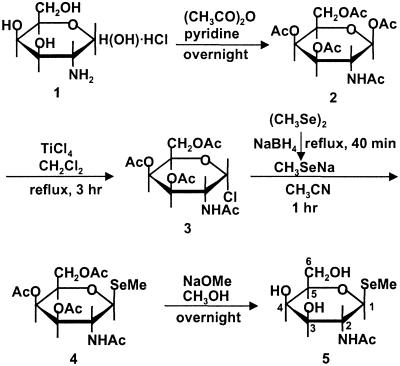
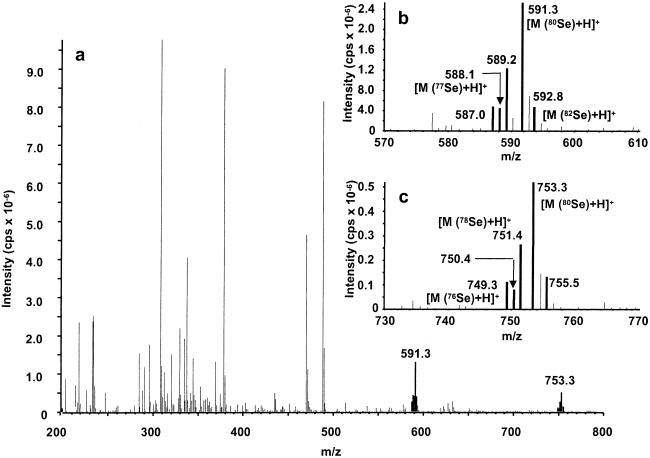
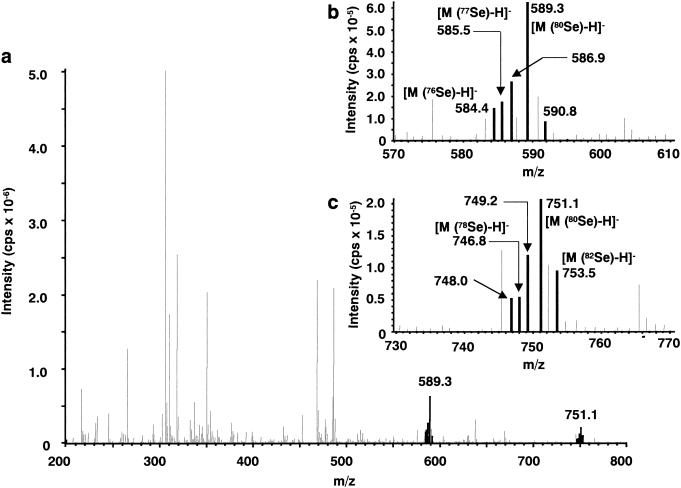
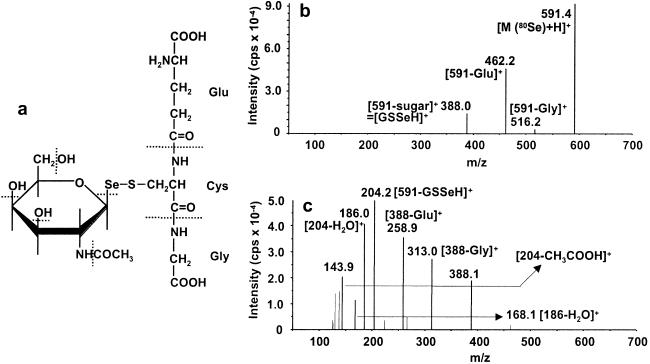
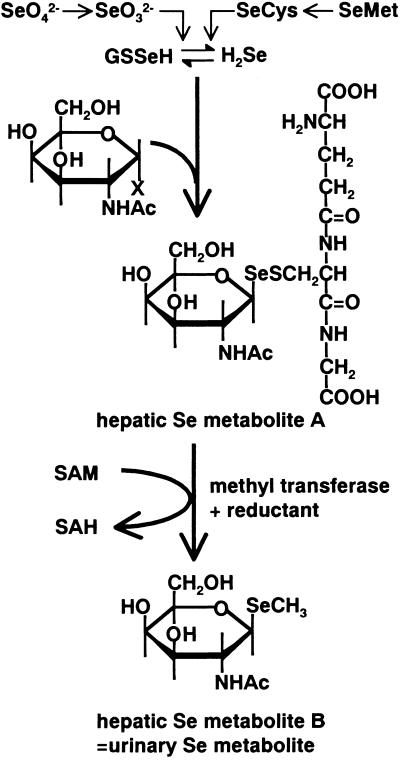
Essential micronutrient selenium is excreted into the urine andor expired after being transformed to methylated metabolites. Monomethylated selenium is excreted into the urine in response to a supply within the required to low-toxic range, whereas tri- and dimethylated selenium increase with excessive supply at a toxic dose. Here we show that the major urinary selenium metabolite within the required to low-toxic range is a selenosugar. The structure of 1beta-methylseleno-N-acetyl-d-galactosamine was deduced from the spectroscopic data and confirmed by chemical synthesis. This metabolite was also detected in the liver, and an additional metabolite increased with inhibition of methylation. The latter metabolite was again a selenosugar conjugated with glutathione instead of a methyl group and was assumed to be a precursor for methylation to the former metabolite. A metabolic pathway for the urinary excretion of selenium, i.e., from the glutathione-S-conjugated selenosugar to the methylated one, was proposed. Urinary monomethylated (selenosugar) and trimethylated selenium can be used as specific indices that increase within the required to low-toxic range and with a distinct toxic dose, respectively.
Figures
References
-
- Stadtman T. C. (1974) Science 183, 915-922. - PubMed
-
- Burk R. F. (1978) World Rev. Nutr. Diet. 30, 88-106. - PubMed
-
- Yang G. Q., Ge, K. Y., Chen, J. S. & Chen, X. S. (1988) World Rev. Nutr. Diet. 55, 98-152. - PubMed
-
- Wilber C. G. (1980) Clin. Toxicol. 17, 171-230. - PubMed
-
- Fox J. M. (1992) Methods Find. Exp. Clin. Pharmacol. 14, 275-287. - PubMed
Publication types
MeSH terms
Substances
LinkOut - more resources
Full Text Sources
