. 2002 Dec 10;99(25):16226-31.
doi: 10.1073/pnas.202617399. Epub 2002 Nov 21.

The role of chromosomal instability in tumor initiation

Affiliations

The role of chromosomal instability in tumor initiation

Martin A Nowak et al. Proc Natl Acad Sci U S A. .

Abstract

Chromosomal instability (CIN) is a defining characteristic of most human cancers. Mutation of CIN genes increases the probability that whole chromosomes or large fractions of chromosomes are gained or lost during cell division. The consequence of CIN is an imbalance in the number of chromosomes per cell (aneuploidy) and an enhanced rate of loss of heterozygosity. A major question of cancer genetics is to what extent CIN, or any genetic instability, is an early event and consequently a driving force for tumor progression. In this article, we develop a mathematical framework for studying the effect of CIN on the somatic evolution of cancer. Specifically, we calculate the conditions for CIN to initiate the process of colorectal tumorigenesis before the inactivation of tumor suppressor genes.


Figures
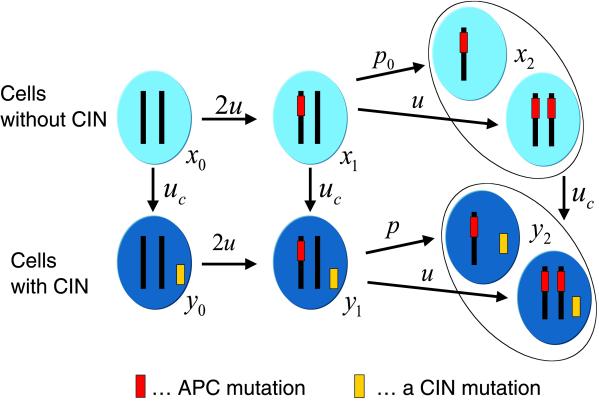
Fig 1.
Fig 1.
Mutational network of cancer initiation describing inactivation of a TSP gene and activation of CIN. Normal cells, x0, have two functioning copies of the gene and no CIN. Cells with one inactivated copy, x1, arise from x0 cells at a rate of 2u; each copy can mutate with probability u per cell division. Cells with two inactivated copies of the TSP gene, x2, arise from x1 cells at a rate of u + p0. The parameter p0 describes the probability that the second copy of the TSP gene is lost during a cell division because of LOH. CIN cells, yi, arise from non-CIN cells, xi, at a rate of uc = 2ncu, where nc denotes the number of genes that cause CIN if a single copy of them is mutated or inactivated. CIN cells with two functioning copies of the TSP gene, y0, mutate into y1 cells at a rate of 2u. CIN cells of type y1 mutate to y2 cells at a rate of u + p, where p is the rate of LOH in CIN cells. We expect p to be much greater than u and p0. For simplicity, we neglect the possibility that APC might be inactivated by an LOH event followed by a point mutation. If CIN (or LOH in 5q) has a cost, then this pathway will contribute very little; otherwise it could enhance the relative success of CIN by a factor of ≈2.
Fig 2.
Fig 2.
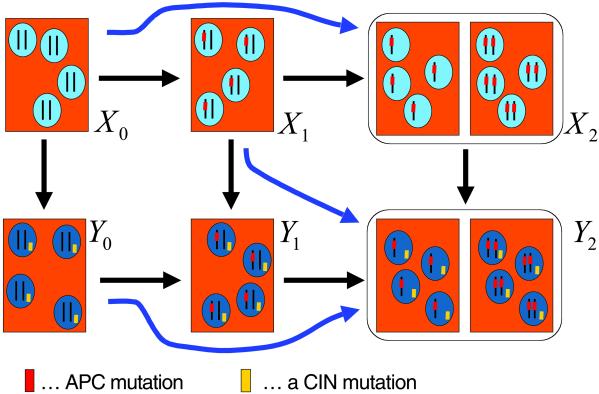
The early steps of colon cancer occur in small crypts that contain a few thousand cells. The whole crypt is replenished from a small number of stem cells. The effective population size of the crypt, N, with respect to the somatic evolution of cancer might be of the order of 10 cells. As long as N2 ≪ 1/u (where u ≈ 10−7–10−6), then there is a high probability that at any one time crypts contain cells of only one type. Hence, we can investigate a stochastic process describing transitions among six different states, X0, X1, X2, Y0, Y1, and Y2, referring to homogeneous crypts of cell type x0, x1, x2, y0, y1, and y2, respectively. The transitions reflect the mutational network of Fig. 1. In addition, there are three stochastic tunnels. For certain parameter values, the system can tunnel from X0 to X2 without reaching X1. Similarly, there are tunnels from Y0 to Y2 and from X1 to Y2. Tunnels occur if the second step in a consecutive transition is much faster than the first one and if the final cell has a strong selective advantage.
Fig 3.
Fig 3.
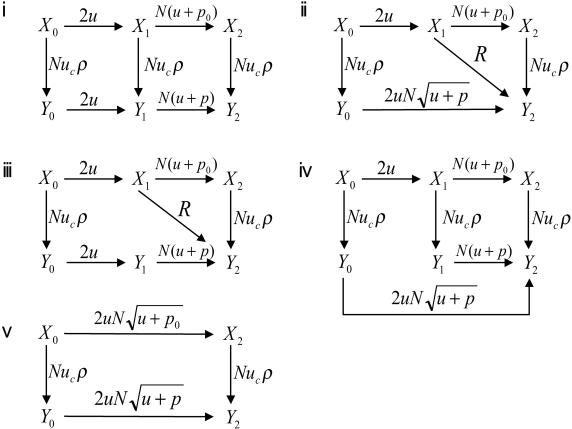
Transition rates and stochastic tunnels of the probabilistic process describing the dynamics of early steps in colon cancer. The states X0, X1, and X2 refer to homogeneous crypts of non-CIN cells with 0, 1, and 2 inactivated copies of APC, respectively. The states Y0, Y1, and Y2 refer to homogeneous crypts of CIN cells with 0, 1, and 2 inactivated copies of APC, respectively. The probability that a CIN cell with reproductive rate r reaches fixation in a crypt of N cells is given by ρ = rN−1(1 − r)/(1 − rN). The mutation rate per gene per cell division is given by u. The mutation rate from non-CIN cells to CIN cells is given by uc = 2ncu, where nc is the number of genes that cause CIN if one copy of them is mutated. The rate of LOH in CIN and non-CIN cells is given by p and p0, respectively. Let γ = (1 − r)2rN−2 if r < 1 and γ = (r − 1)/{rN log[N(r − 1)/r]} if r > 1. Network i occurs in two cases: (ia) formula image ≪ 1/N and |1 − r| ≪ 1/N and (ib) formula image ≪ 1/N and |1 − r| ≫ 1/N and p ≪ γ. Network ii occurs in three cases: (iia) if formula image ≫ 1/N and |1 − r| ≪ formula image, then R = Nucformula image, (iib) if r < 1 and formula image ≫ 1/N and 1 − rformula image, then R = Nucpr/(1 − r), and (iic) if r > 1 and formula image ≫ 1/N and r − 1 ≫ formula image and p ≫ γ, then R = N2ucplog[N(r − 1)/r]. Network iii occurs if r < 1, p ≫ γ, and formula image ≪ 1/N ≪ 1 − r; we have R = Nucpr/(1 − r). Network iv occurs if r > 1, p ≪ γ, and r − 1 ≫ formula image ≫ 1/N. In addition, networks iiv require that formula image ≪ 1/N. Network v occurs if formula image ≫ 1/N. This is a complete classification of all generic cases.

References

    1. Knudson A. G. (1971) Proc. Natl. Acad. Sci. USA 68, 820-823. - PMC - PubMed
    1. Friend S. H., Bernards, R., Rogels, S., Weinberg, R. A., Rapaport, J. M., Albert, D. M. & Dryja, T. P. (1986) Nature 323, 643-646. - PubMed
    1. Lengauer C., Kinzler, K. W. & Vogelstein, B. (1998) Nature 396, 643-649. - PubMed
    1. Sen S. (2000) Curr. Opin. Oncol. 12, 82-88. - PubMed
    1. Loeb L. A., Springgate, C. F. & Battula, N. (1974) Cancer Res. 34, 2311-2321. - PubMed

Publication types

LinkOut - more resources