. 2002;10(5-6):201-11.
doi: 10.3727/000000002783992424.

The smooth muscle gamma-actin gene is androgen responsive in prostate epithelia

Affiliations

The smooth muscle gamma-actin gene is androgen responsive in prostate epithelia

R A Filmore et al. Gene Expr. 2002.

Abstract

Nkx 3.1 is an evolutionarily conserved vertebrate homolog of the Drosophila Nk-3 homeodomain gene bagpipe that is expressed by a variety of cells during early mammalian development and has been shown to be a critical factor for prostate development and function. Previous studies utilizing a heterologous cell transfection strategy from our laboratory identified the smooth muscle gamma-actin (SMGA) gene as a novel molecular target of Nkx 3.1 regulatory activity. In the studies presented here, SMGA gene activity and regulation were evaluated in normal and cancerous prostate epithelial cells. SMGA transcripts were demonstrated in prostate epithelia and SMGA mRNA levels were increased in androgen-responsive LNCaP cancer and normal prostate epithelial cells. SMGA gene transcriptional activity was androgen responsive in these cells and required a segment of the human SMGA promoter containing NKE and SRF (serum response factor) binding elements. This region of the human SMGA proximal promoter is well conserved across species and is synergistically activated by coexpression of Nkx 3.1 and SRF in heterologous CV-1 cells. SMGA transcription was not responsive to steroid in PC-3 prostate epithelial cancer cells, which do not express Nkx 3.1. However, SMGA transcription was influenced by expression of androgen receptor in these cells, a situation that allows the androgen-dependent expression of Nkx 3.1. Furthermore, SMGA gene activity was influenced by direct Nkx 3.1 expression in the PC-3 cells. Thus, SMGA gene activity in prostate epithelia is due, in part, to the androgen-dependent expression of Nkx 3.1. As such, our studies provide the initial description of Nkx 3.1 target gene regulatory activity in the prostate.


Figures

Figure 1
Figure 1
SMGA mRNA presence and androgen responsiveness within LNCaP cells. (A) Representative autoradiograms from Northern analyses using RNA isolated from LNCaP cells treated with either vehicle (lane 1) or increasing amounts of androgen (R1881; 0.1–10 nM) with 32P-labeled DNA probes representing human SMGA, SRF, or murine Nkx 3.1 are shown. (B) Striped bars represent each specific band appearing in (A) derived from cells cultured in the presence of vehicle, while the black bars represent those bands appearing in (A) in the presence of 10 nM R1881. The results are shown as the mean ± SE. *Statistical significance in the presence of R1881 versus its absence at p < 0.05.
Figure 2
Figure 2
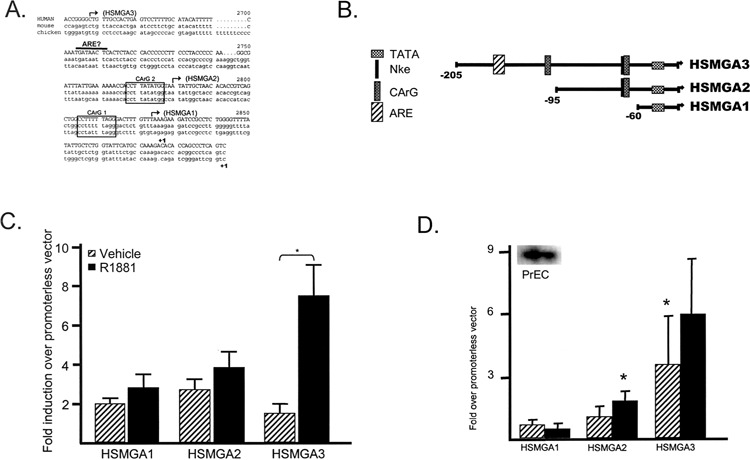
SMGA transcriptional activity within normal and cancerous prostate epithelial cells. (A) Sequences representing the first ∼200 bp of the avian, murine, and human SMGA promoter are compared. The two CArG elements are indicated by boxes, and the bent arrows represent the 5′ limit of human promoter sequences fused to the firefly luciferase reporter gene used in the present study. Also indicated is a putative half-site ARE found in the mammalian SMGA promoters. (B) The human SMGA promoter fragments linked to the firefly luciferase gene indicating the location of the TATA box, CArG, NKE element, and putative half-site ARE. (C) Luciferase results from the transfection of LNCaP cells with 1.2 μg of the indicated SMGA promoter construct. After transfection, the cells were either maintained in vehicle (striped bars) or 10 nM R1881 (black bars) before harvesting at 48 h for analysis. The results are shown as the fold induction by each promoter fragment over that obtained by the promoterless vector (pGL3-Basic). Results are derived from a minimum of six experiments performed in quadruplicate for each condition and are shown as the mean ± SEM. *Statistical significance at p < 0.05 for the activation obtained in the presence of R1881 over the activation obtained in its absence. (D) The luciferase activity results from the transfection of normal prostate epithelial cells with 1.2 μg of the indicated SMGA promoter construct. After transfection, the cells were maintained in either vehicle (striped bars) or R1881 (10 nM; black bars) before harvesting at 48 h for analysis. The results are shown as the fold induction by each promoter fragment over that obtained by the pGL3-Basic promoterless vector. The results represent four experiments performed in quadruplicate for each condition and are shown as the mean ± SEM. The inset is representative autoradiogram of slot blots consisting of 10 μg RNA isolated from normal prostate epithelial cells treated with 10 nM R1881 and hybridized with the 32P-labeled SMGA probe.
Figure 3
Figure 3
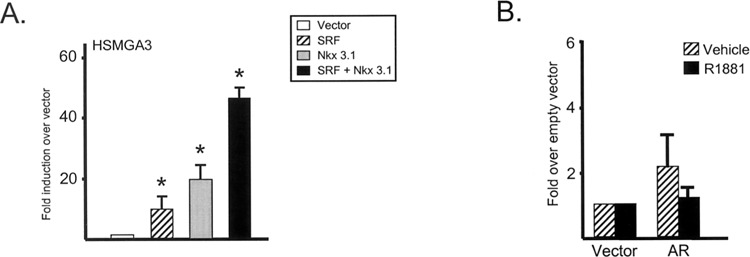
Human SMGA promoter is stimulated by SRF and Nkx 3.1 while androgen receptor is not sufficient for transcriptional activation. (A) The human −205 bp SMGA promoter fragment fused to the firefly luciferase reporter gene (0.3 μg) was transfected into CV-1 cells along with either empty CMV (open bar), SRF (striped bar), Nkx 3.1 (gray bar), or SRF in combination with Nkx 3.1 (black bar; both at 0.3 μg each). The transactivation reactions were balanced to 1.2 μg DNA content by the addition of empty CMV expression vector (pCG). The results are shown as the fold induction by each vector or combination of vectors over that obtained by the empty CMV expression vector (white bar). Results were derived from three experiments performed in quadruplicate for each condition and are shown as the mean ± SEM. *Statistical significance at p < 0.05 for the activation obtained by the condition indicated over that derived from the empty vector alone. (B) The HSMGA3 promoter fragment fused to luciferase (0.3 μg) was transfected into CV-1 cells along with either AR (0.3 μg) or the empty CMV expression vector are shown. After transfection, the cells were maintained in either vehicle (striped bars) or R1881 (black bars) for 48 h before harvesting for luciferase analyses. The results are shown as the fold induction of luciferase activity in the presence of AR over that obtained by the empty expression vector. The reactions were balanced to 1.2 μg DNA content by the addition of empty CMV promoter vector (pCG). The results were determined from a minimum of three experiments performed in quadruplicate for each condition and are shown as the mean ± SEM.
Figure 4
Figure 4
AR and Nkx 3.1-mediated stimulation of HSMGA3 gene activity. (A) Representative autoradiograms from Northern analyses using RNA isolated from PC-3 cells treated with either vehicle (lane 1) or increasing amounts of androgen (R1881; 0.1–10 nM) with 32P-labeled DNA probes representing human SMGA, SRF, or murine Nkx 3.1 are shown. (B) The HSMGA3 promoter fragment fused to the firefly luciferase gene (0.3 μg) was transfected into PC-3 cells along with either AR (0.5 μg), Nkx 3.1 (0.5 μg), or the corresponding empty CMV expression vector. The results are shown as the fold induction seen by the presence of the various factors over that seen by the empty vector. The results are representative of a minimum of two experiments performed in triplicate for each condition and are shown as the mean ± SEM. *Statistical significance at p < 0.05 for the activation obtained by AR in the presence of androgen versus its absence. PC-3 cells were transfected with expression vector encoding human AR or the empty vector and the cultures then incubated with R1881 to examine the AR-dependent expression of Nkx 3.1 by RT-PCR (C) and Western blotting (D) analyses. (C) The relevant portion of a gel in which RNA from PC-3 cells transfected with empty vector (lanes 2 and 3) or an AR expression vector (lanes 4 and 5) were probed by RT-PCR using oligos specific for Nkx 3.1 mRNA (680-bp band) and GAPD (420-bp band). Quantitative analyses of three separate experiments revealed an increase of approximately fivefold (4.97 ± 0.05) of Nkx 3.1 mRNA in cells expressing human AR and incubated in 10 nM R1881. (D) Western blot of protein extracted from PC-3 cells transfected with a human AR expression vector or empty vector. Total cellular proteins were separated on 12.5% SDS-PAGE and transferred to nitrocellulose sheets. The blots were probed with an anti-Nkx 3.1 antibody (gift of Dr. Ed Gelmann) at a dilution of 1:10,000. The blots were developed with a chemilumenesence kit as previously described (7). Lanes 1 and 2 are proteins from control, vector-only cells while lanes 3 and 4 represent proteins derived from cells treated with a human AR expression vector. Lane 5 shows protein derived from Nkx 3.1-positive LNCaP cells as a positive control.

References

    1. Abate-Shen C.; Shen M. M. Molecular genetics of prostate cancer. Genes Dev. 14:2410–2434; 2000. - PubMed
    1. Bergerheim U. S.; Kunimi K.; Collins V. P.; Ekman P. Deletium mapping of chromosomes 8, 10, and 16 in human prostatic carcinoma. Genes Chromosomes Cancer 3:215–220; 1991. - PubMed
    1. Bevan C. L.; Hoare S.; Claessens F.; Heery D. M.; Parker M. G. The AF1 and AF2 domains of the androgen receptor interaction with distinct regions of SRC1. Mol. Cell. Biol. 19:8383–8392; 1999. - PMC - PubMed
    1. Bhatia-Gaur R.; Donjacour A. A.; Sciavolino P. J.; Kim M.; Desai N.; Young P.; Norton C. R.; Gridley T.; Cardiff R. D.; Cunha G. R.; Abate-Shen C.; Shen M. M. Roles for Nkx 3.1 in prostate development and cancer. Genes Dev. 13:966–977; 1999. - PMC - PubMed
    1. Bieberich C. J.; Fujita K.; He W. W.; Jay G. Prostate-specific and androgen-dependent expression of a novel homeobox gene. J. Biol. Chem. 271:31779–31782; 1996. - PubMed

Publication types

MeSH terms

LinkOut - more resources