


Review
doi: 10.1128/AEM.68.12.5804-5815.2002.
Dimethylsulfoniopropionate: its sources, role in the marine food web, and biological degradation to dimethylsulfide
Affiliations
- PMID: 12450799
- PMCID: PMC134419
- DOI: 10.1128/AEM.68.12.5804-5815.2002
Item in Clipboard
Review
Dimethylsulfoniopropionate: its sources, role in the marine food web, and biological degradation to dimethylsulfide
Appl Environ Microbiol.
2002 Dec.
No abstract available
Figures
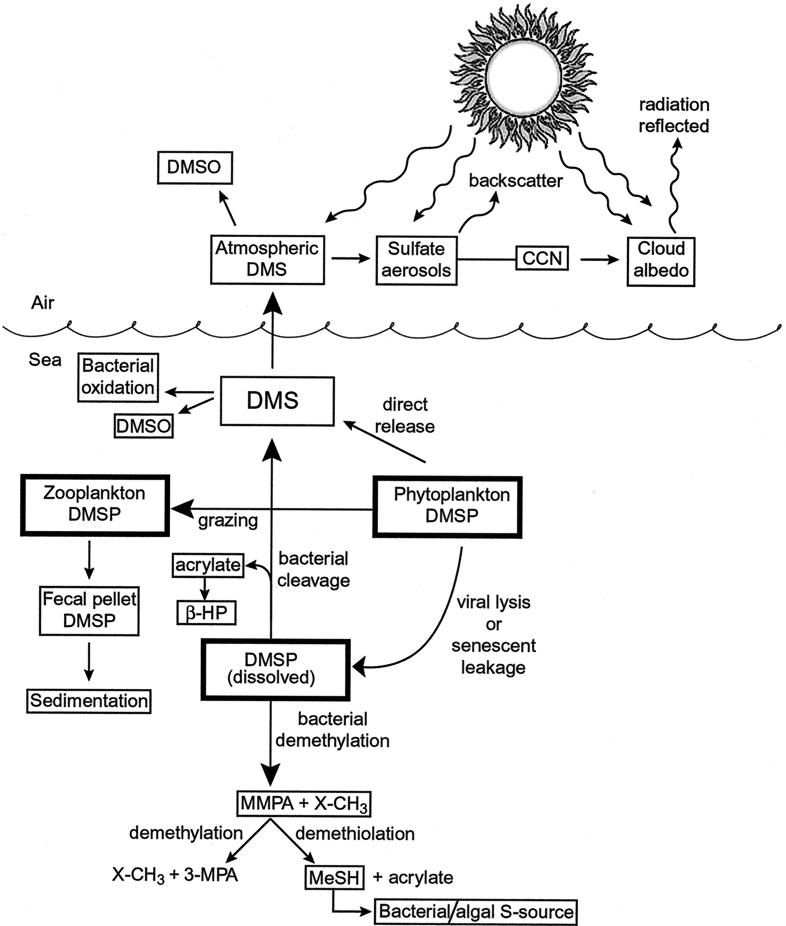
Scheme representing the mechanisms of DMSP and DMS cycling in the marine water column and atmosphere. DMSO, dimethyl sulfoxide; CCN, cloud-condensing nuclei; MMPA, 3-methiolpropionate; β-HP, β-hydroxypropionate; 3-MPA, 3-mercaptopropionate; MeSH, methanethiol; X-CH3, unidentified molecule with a terminal methyl group.
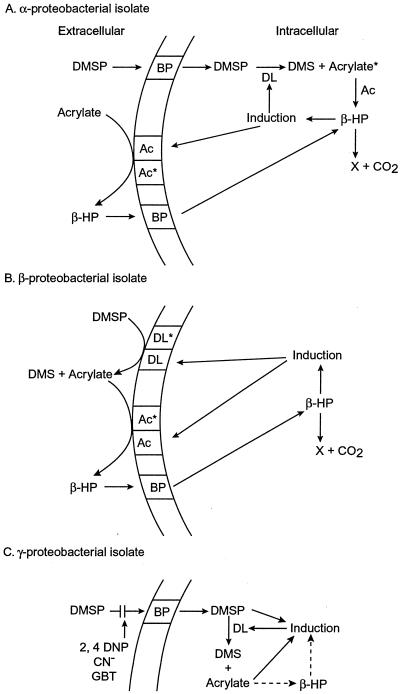
Models comparing the uptake and metabolism of DMSP and acrylate in (A) strain LFR, (B) Alcaligenes faecalis, and (C) Pseudomonas doudoroffii. Abbreviations: β-HP, beta-hydroxypropionate; DL and DL*, inducible and constitutive DMSP lyase, respectively; Ac and Ac*, inducible and constitutive acrylase, respectively; acrylate∗, assumed to be present but not detectable; 2,4 DNP, the energy uncoupler 2,4-dinitrophenol; BP, binding protein; GBT, glycine betaine. Dashed lines in C represent the assumed mechanism of acrylate (via β-hydroxypropionate) induction of DMSP lyase in this organism.
References
-
- Ackman, R. G., C. S. Tocher, and J. McLachan. 1966. Occurrence of dimethyl-β-propiothetin in marine phytoplankton. J. Fish. Res. Board Can. 23:357-364.
-
- Adams, D. F., S. O. Farwell, D. Robinson, M. R. Merrill, and W. L. Bamesberger. 1981. Biogenic sulfur source strengths. Environ. Sci. Technol. 15:1493-1498.
-
- Names?. Yr? bacteria inhabiting macroscopic organic aggregates (marine snow) from surface waters. Limnol. Oceanogr. 31:68-78.
-
- Andreae, M. O. 1990. Ocean-atmosphere interactions in the global biogeochemical sulfur cycle. Mar. Chem. 30:1-29.
-
- Andreae, M. O. 1985. The emission of sulfur to the remote atmosphere, p. 5-25. In J. N. Galoway, R. J. Charlson, M. O. Andreae, and H. Rode (ed.). The biogeochemical cycling of sulfur and nitrogen in the remote atmosphere. D. Reidel Publishing Co., Boston, Mass.
Publication types
MeSH terms
Substances
LinkOut - more resources
Full Text Sources
Other Literature Sources
