


Rhodanobacter sp. strain BPC1 in a benzo[a]pyrene-mineralizing bacterial consortium
- PMID: 12450801
- PMCID: PMC134403
- DOI: 10.1128/AEM.68.12.5826-5833.2002
Rhodanobacter sp. strain BPC1 in a benzo[a]pyrene-mineralizing bacterial consortium
Abstract
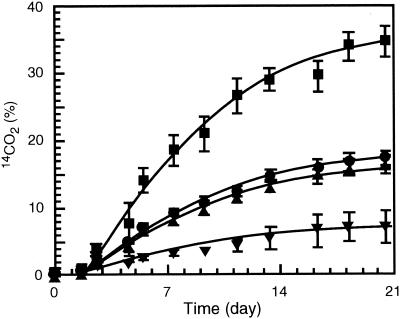
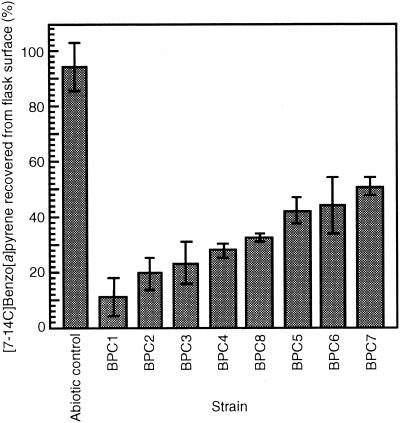
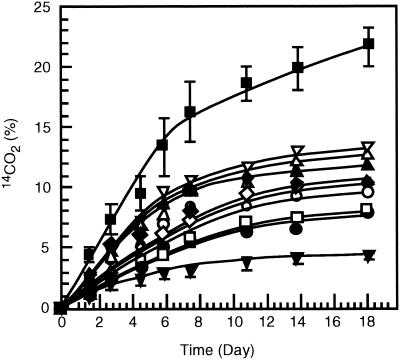
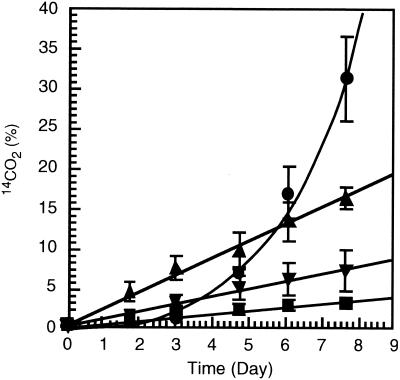
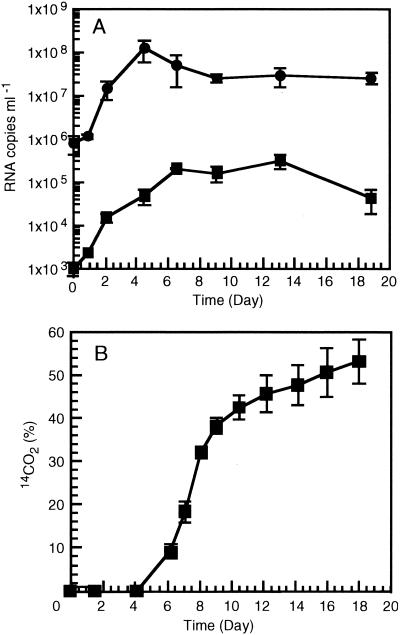
A bacterial consortium which rapidly mineralizes benzo[a]pyrene when it is grown on a high-boiling-point diesel fuel distillate (HBD) was recovered from soil and maintained for approximately 3 years. Previous studies have shown that mobilization of benzo[a]pyrene into the supernatant liquid precedes mineralization of this compound (R. Kanaly, R. Bartha, K. Watanabe, and S. Harayama, Appl. Environ. Microbiol. 66:4205-4211, 2000). In the present study, we found that sterilized supernatant liquid filtrate (SSLF) obtained from the growing consortium stimulated mineralization of benzo[a]pyrene when it was readministered to a consortium inoculum without HBD. Following this observation, eight bacterial strains were isolated from the consortium, and SSLF of each of them was assayed for the ability to stimulate benzo[a]pyrene mineralization by the original consortium. The SSLF obtained from one strain, designated BPC1, most vigorously stimulated benzo[a]pyrene mineralization by the original consortium; its effect was more than twofold greater than the effect of the SSLF obtained from the original consortium. A 16S rRNA gene sequence analysis and biochemical tests identified strain BPC1 as a member of the genus Rhodanobacter, whose type strain, Rhodanobacter lindaniclasticus RP5557, which was isolated for its ability to grow on the pesticide lindane, is not extant. Strain BPC1 could not grow on lindane, benzo[a]pyrene, simple hydrocarbons, and HBD in pure culture. In contrast, a competitive PCR assay indicated that strain BPC1 grew in the consortium fed only HBD and benzo[a]pyrene. This growth of BPC1 was concomitant with growth of the total bacterial consortium and preceded the initiation of benzo[a]pyrene mineralization. These results suggest that strain BPC1 has a specialized niche in the benzo[a]pyrene-mineralizing consortium; namely, it grows on metabolites produced by fellow members and contributes to benzo[a]pyrene mineralization by increasing the bioavailability of this compound.
Figures
References
-
- Aitken, M. D., W. T. Stringfellow, R. D. Nagel, C. Kazunga, and S.-H. Chen. 1998. Characteristics of phenanthrene-degrading bacteria isolated from soils contaminated with polycyclic aromatic hydrocarbons. Can. J. Microbiol. 44:743-752. - PubMed
-
- Altschul, S. F., W. Gish, W. Miller, E. W. Myers, and D. J. Lipman. 1990. Basic local alignment search tool. J. Mol. Biol. 215:403-410. - PubMed
-
- Angerer, J., C. Mannschreck, and J. Gündel. 1997. Biological monitoring and biochemical effect monitoring of exposure to polycyclic aromatic hydrocarbons. Int. Arch. Occup. Environ. Health 70:365-377. - PubMed
-
- Atlas, R. M. 1993. Handbook of microbiological media. CRC Press, Inc., Boca Raton, Fla.
Publication types
MeSH terms
Substances
LinkOut - more resources
Full Text Sources
Molecular Biology Databases
