


Impact of integrated fish farming on antimicrobial resistance in a pond environment
- PMID: 12450826
- PMCID: PMC134385
- DOI: 10.1128/AEM.68.12.6036-6042.2002
Impact of integrated fish farming on antimicrobial resistance in a pond environment
Abstract
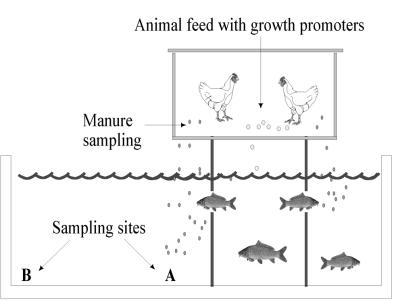
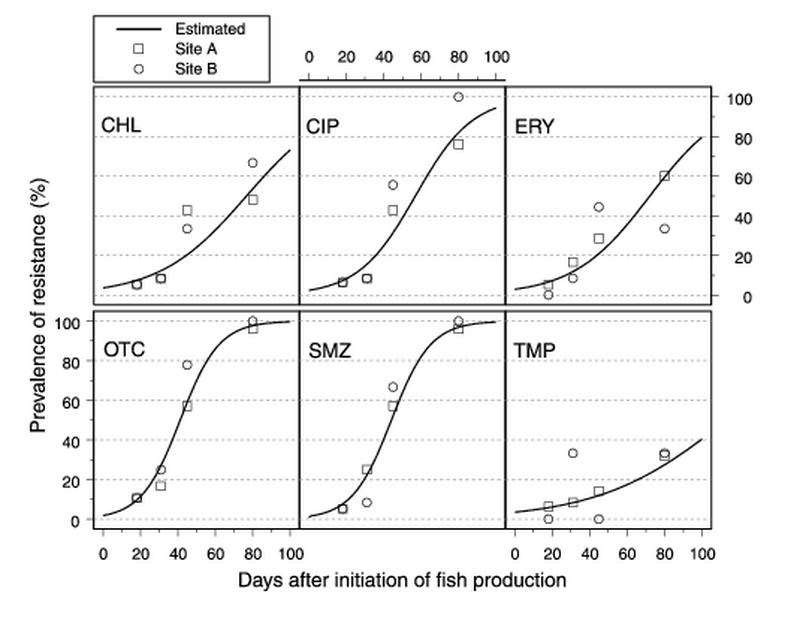
Integrated fish farming combines livestock production with fish farming. Animal manure is shed directly into a fish pond as fertilizer and supports the growth of photosynthetic organisms. The livestock, mainly chickens and pigs, is often fed feed containing growth promoters. In this study we investigated the impact of integrated fish farming on the levels of antimicrobial-resistant bacteria in a pond environment. One integrated broiler chicken-fish farm was studied for 2 months immediately after the start of a new fish production cycle. A significant increase over time in the resistance to six different antimicrobials was found for the indicator organism Acinetobacter spp. isolated from composite water-sediment samples. The initial resistance levels prior to the new production cycle were 1 to 5%. After 2 months the levels of resistance to oxytetracycline and sulfamethoxazole reached 100%, and the levels of resistance to ciprofloxacin were more than 80%. The long-term effects of resistance on integrated farming were studied on seven additional farms. The resistance levels were particularly high among Enterococcus spp. and were also high among Acinetobacter spp. isolated from water-sediment samples compared to the resistance levels at four control farms. In conclusion, integrated fish farming seems to favor antimicrobial-resistant bacteria in the pond environment. This could be attributed to the selective pressure of antimicrobials in the pond environment and/or to the introduction of antimicrobial-resistant bacteria from animal manure. Potential risks to human health were not addressed in this study and remain to be elucidated.
Figures
References
-
- Aarestrup, F. M., F. Bager, N. E. Jensen, M. Madsen, A. Meyling, and H. C. Wegener. 1998. Resistance to antimicrobial agents used for animal therapy in pathogenic-, zoonotic- and indicator bacteria isolated from different food animals in Denmark: a baseline study for the Danish Integrated Antimicrobial Resistance Monitoring Programme (DANMAP). APMIS 106:745-770. - PubMed
-
- Aarestrup, F. M., F. Bager, N. E. Jensen, M. Madsen, A. Meyling, and H. C. Wegener. 1998. Surveillance of antimicrobial resistance in bacteria isolated from food animals to antimicrobial growth promoters and related therapeutic agents in Denmark. APMIS 106:606-622. - PubMed
-
- Alderman, D. J., and T. S. Hastings. 1998. Antibiotic use in aquaculture: development of antibiotic resistance—potential for consumer health risks. Int. J. Food Sci. Technol. 33:139-155.
-
- Andersen, J. S. 1998. Statistical analysis of biotests. Ph.D. thesis. Technical University of Denmark, Lyngby, Denmark.
-
- Bager, F., M. Madsen, J. Christensen, and F. M. Aarestrup. 1997. Avoparcin used as a growth promoter is associated with the occurrence of vancomycin-resistant Enterococcus faecium in Danish poultry and pig farms. Prev. Vet. Med. 31:95-112. - PubMed
Publication types
MeSH terms
Substances
LinkOut - more resources
Full Text Sources
Medical
Miscellaneous
