


Apolipoprotein E4 influences amyloid deposition but not cell loss after traumatic brain injury in a mouse model of Alzheimer's disease
- PMID: 12451108
- PMCID: PMC6758744
- DOI: 10.1523/JNEUROSCI.22-23-10083.2002
Apolipoprotein E4 influences amyloid deposition but not cell loss after traumatic brain injury in a mouse model of Alzheimer's disease
Abstract
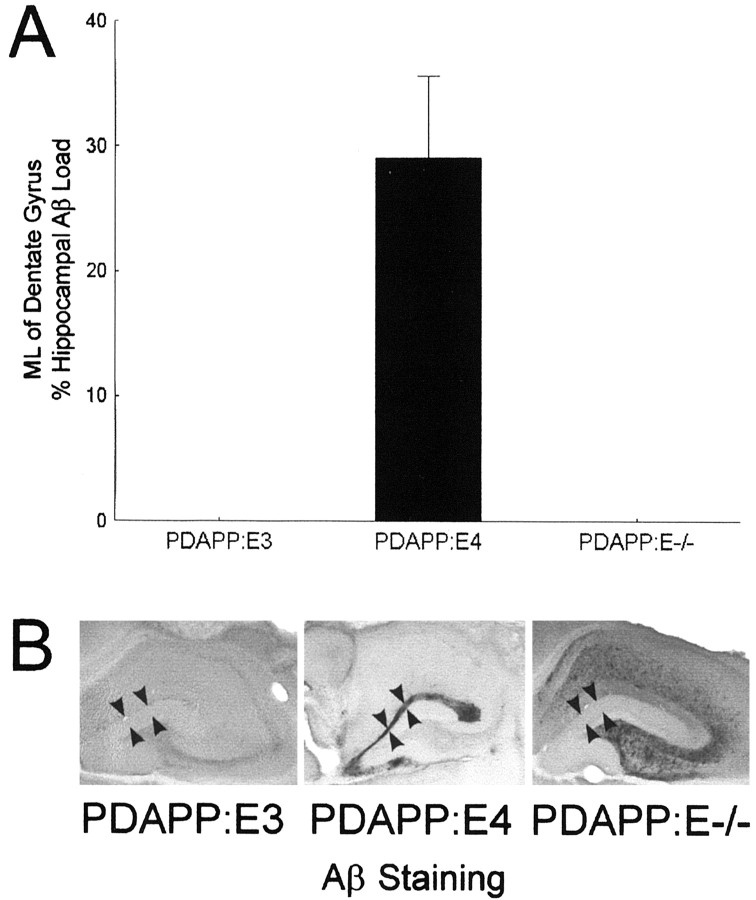
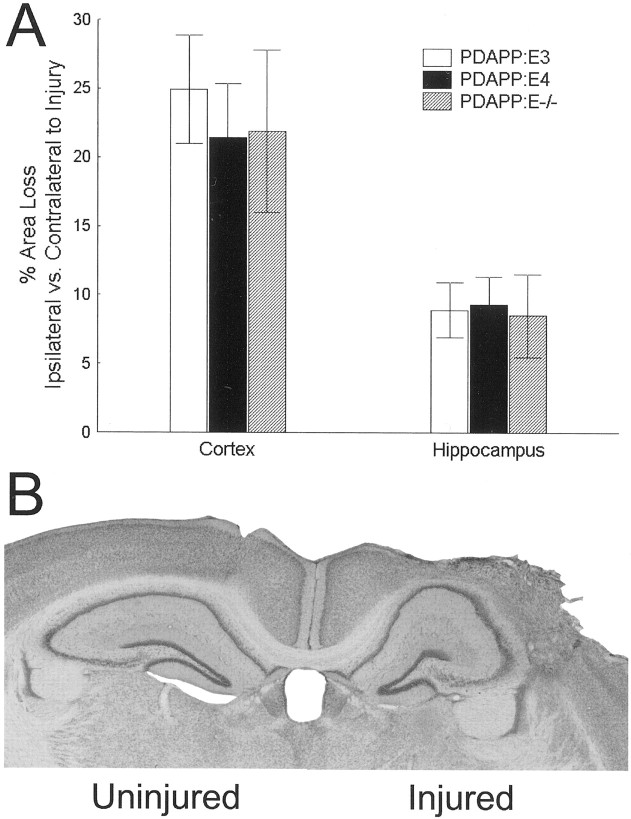
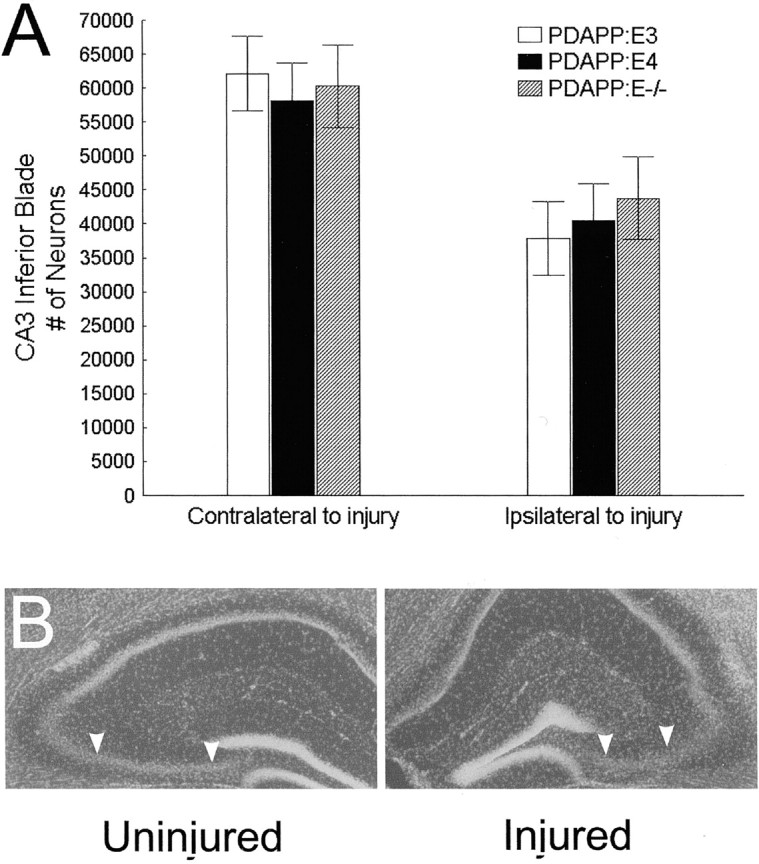
The epsilon4 allele of apolipoprotein E (APOE) and traumatic brain injury (TBI) are both risk factors for the development of Alzheimer's disease (AD). These factors may act synergistically, in that APOE4+ individuals are more likely to develop dementia after TBI. Because the mechanism underlying these effects is unclear, we questioned whether APOE4 and TBI interact either through effects on amyloid-beta (Abeta) or by enhancing cell death/tissue injury. We assessed the effects of TBI in PDAPP mice (transgenic mice that develop AD-like pathology) expressing human APOE3 (PDAPP:E3), human APOE4 (PDAPP:E4), or no APOE (PDAPP:E-/-). Mice were subjected to a unilateral cortical impact injury at 9-10 months of age and allowed to survive for 3 months. Abeta load, hippocampal/cortical volumes, and hippocampal CA3 cell loss were quantified using stereological methods. All of the groups contained mice with Abeta-immunoreactive deposits (56% PDAPP:E4, 20% PDAPP:E3, 75% PDAPP:E-/-), but thioflavine-S-positive Abeta (amyloid) was present only in the molecular layer of the dentate gyrus in the PDAPP:E4 mice (44%). In contrast, our previous studies showed that in the absence of TBI, PDAPP:E3 and PDAPP:E4 mice have little to no Abeta deposition at this age. After TBI, all of the Abeta deposits present in PDAPP:E3 and PDAPP:E-/- mice were diffuse plaques. In contrast to the effect of APOE4 on amyloid, PDAPP:E3, PDAPP:E4, and PDAPP:E-/- mice did not differ in the amount of brain tissue or cell loss. These data support the hypothesis that APOE4 influences the neurodegenerative cascade after TBI via an effect on Abeta.
Figures
References
-
- Bales KR, Verina T, Dodel RC, Du Y, Altstiel L, Bender M, Hyslop P, Johnstone EM, Little SP, Cummins DJ, Piccardo P, Ghetti B, Paul SM. Lack of apolipoprotein E dramatically reduces amyloid β-peptide deposition. Nat Genet. 1997;17:263–264. - PubMed
-
- Chen Y, Lomnitski L, Michaelson DM, Shohami E. Motor and cognitive deficits in apolipoprotein E-deficient mice after closed head injury. Neuroscience. 1997;80:1255–1262. - PubMed
-
- Crawford FC, Vanderploeg RD, Freeman MJ, Singh S, Waisman M, Michaels L, Abdullah L, Warden D, Lipsky R, Salazar A, Mullan MJ. APOE genotype influences acquisition and recall following traumatic brain injury. Neurology. 2002;58:1115–1118. - PubMed
-
- Emmerling MR, Morganti-Kossmann MC, Kossmann T, Stahel PF, Watson MD, Evans LM, Mehta PD, Spiegel K, Kuo YM, Roher AE, Raby CA. Traumatic brain injury elevates the Alzheimer's amyloid peptide Aβ42 in human CSF: a possible role for nerve cell injury. Ann NY Acad Sci. 2000;903:118–122. - PubMed
Publication types
MeSH terms
Substances
Grants and funding
LinkOut - more resources
Full Text Sources
Other Literature Sources
Medical
Molecular Biology Databases
Miscellaneous
