. 2002 Dec;130(3):393-403.
doi: 10.1046/j.1365-2249.2002.02007.x.

Adjuvant modulation of the immune responses and the outcome of infection with Chlamydia pneumoniae

Affiliations

Adjuvant modulation of the immune responses and the outcome of infection with Chlamydia pneumoniae

L Bandholtz et al. Clin Exp Immunol. 2002 Dec.

Abstract

Immunization with different adjuvants resulted in antithetic outcomes of infection with Chlamydia pneumoniae. Immunization with the outer major protein-2 from C. pneumoniae (OMP-2) emulsified in Freund's complete adjuvant (FCA) thus increased the susceptibility of mice to infection with the bacteria. The detrimental effect was not observed upon inoculation of irrelevant antigens or major outer membrane protein (MOMP) in FCA, but was also observed after immunization with FCA-chlamydial heat shock protein-60 (HSP-60). The harmful effect of FCA-OMP-2 depended on the presence of both CD4+ and CD8+ cells and was mediated by IL-10, as shown using gene-ablated mice. The increased susceptibility to infection caused by FCA-OMP-2 immunization was long-lasting and observed in mice infected 4 months after the last dose of immunogen. In contrast, partial protection against C. pneumoniae was observed when FCA was replaced with oligodeoxynucleotides containing immunostimulatory CpG motifs mixed with Freund's incomplete adjuvant (FIA-IS-CpG). These polar outcomes of infection related to the cytokine pattern: antigen-stimulated spleen cells from FCA-OMP-2-immunized mice showed higher IL-10/IFN-gamma ratios than FIA-IS-CpG-OMP-2-immunized animals. In agreement, sera from FCA-OMP-2 showed higher anti-OMP-2 IgG1/IgG2a ratios than FIA-IS-CpG-OMP-2-immunized animals. Finally, OMP-2 also generated a protective response when delivered by a eukaryotic expression vector in tandem with CTLA4, a procedure that targeted OMP-2 to antigen-presenting cells.


Figures
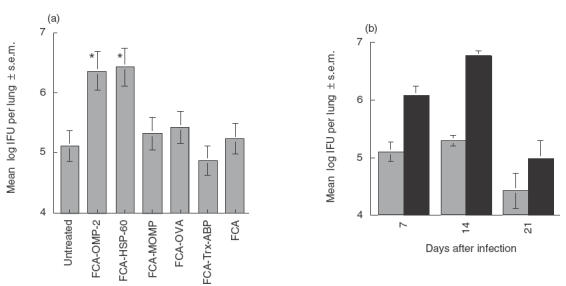
Fig. 1
Fig. 1
Immunization with FCA-OMP-2 diminishes resistance of mice to C. pneumoniae infection. (a) Groups of B6 mice (eight to 24 animals per group) were immunized s.c. with FCA-OMP-2, FCA-HSP-60, FCA-MOMP, FCA-OVA or FCA-Trx-ABP on three occasions at 0, 2 and 4 weeks or left untreated. Mice were infected intranasally with 106 C. pneumoniae 2 weeks after the last immunization dose. Mice were sacrificed 14 days after infection and the amounts of IFU per lung measured. Cumulative data from three independent experiments are shown. Differences vs. Trx-ABP, OVA, MOMP, FCA-treated and infected mice as well as untreated and infected mice are significant (P < 0·05 Student's t-test). (b) Groups of B6 mice (eight to 16 individuals per group) were immunized s.c. with FCA-OMP-2 on three occasions at 0, 2 and 4 weeks. Fourteen days after the last immunization, mice were challenged intranasally with 106 C. pneumoniae. Mice were sacrificed 7, 14 and 21 days after challenge and individual IFU determined in lung homogenates. The means of the log10-transformed IFU per lung ± s.e.m. are depicted. Cumulative data from two independent experiments are shown. (b) formula image, Untreated; ▪, FCA + OMP-2.
Fig. 2
Fig. 2
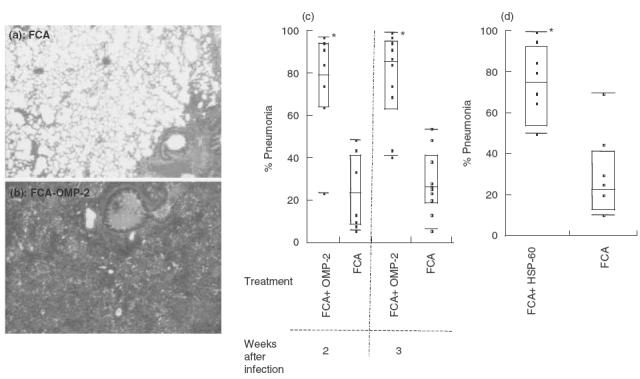
Increased severity of pneumonia in FCA-OMP-2 and FCA-HSP-60 immunized and C. pneumoniae-infected mice. Haematoxylin–eosin stainings of lungs from mice s.c. administered with FCA (a) or FCA-OMP-2 (b) 14 days after infection with C. pneumoniae. Note the large consolidated area in the lung of FCA-0MP-2-immunized mice, whereas a nearly normal lung morphology is preserved in control mice (a = 60×). The individual percentage of pneumonia in lung tissue sections from FCA-OMP-2 immunized mice 14 and 21 days after infection (c) or FCA-HSP-60 immunized mice and 14 days after infection (d). The median pneumonia per group is shown as a line in the middle of each box, and the 25th and 75th quantiles are the ends. The external bars indicate maximum and minimum values. *Differences between FCA-OMP-2 and FCA-HSP-60 versus FCA-treated groups are significant (P < 0·01, Mann–Whitney–Wilcoxon U-test).
Fig. 3
Fig. 3
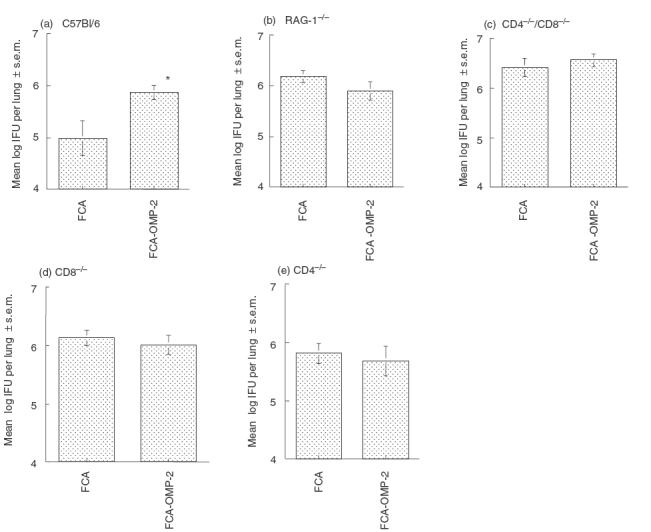
CD4+ and CD8+ T cells are required simultaneously for the harmful effect induced by FCA-OMP-2 immunization. B6 (a), RAG-1−/− [31] (b); CD4−/−/CD8−/− [33] (c); CD8−/−[30] (D); and CD4−/− [29] (e) mice (eight to 16 individuals per group) were immunized with FCA-OMP-2 or FCA as described in legend to Fig. 1. Fourteen days after the last immunization mice were infected with C. pneumoniae. Mice were sacrificed 14 days after challenge and individual IFU determined in lung homogenates. The mean log10 IFU per lung ± s.e.m. are depicted. Cumulative data from two independent experiments are shown. Differences versus FCA-treated and infected mice are significant (P < 0·05, Student's t-test).
Fig. 4
Fig. 4
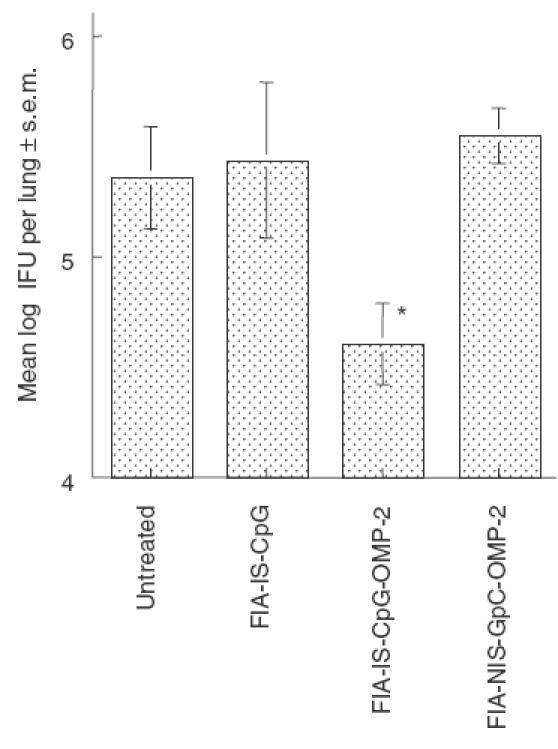
Immunization with OMP-2 using FIA-IS-CpG as adjuvant results in a partial protection against infection with C. pneumoniae. Mice (eight animals per group except FIA-IS-CpG-OMP-2, which contains 15 animals) were immunized with OMP-2 in the presence of immunostimulatory CpG or non-stimulatory GpC oligonucleotides. Control animals were administered with FIA-IS-CpG or left untreated. The mean of the log10 IFU per lung ± s.e.m. is depicted. Cumulative data from two independent experiments are shown. Differences versus FIA-IS-CpG, FIA-NIS-GpC-OMP-2 and untreated, infected mice are significant (P < 0·05, Student's t-test).
Fig. 5
Fig. 5
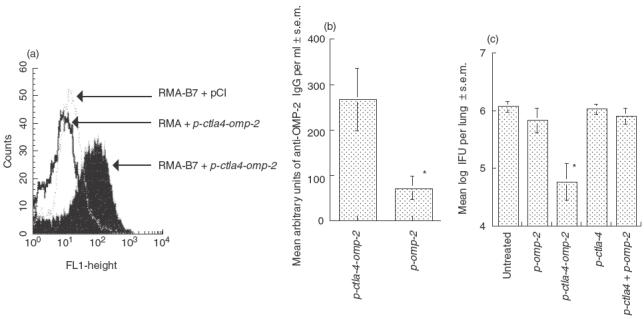
Protective effect of i.n. p-ctla4-omp-2 immunization against C. pneumoniae. (a) CTLA4-OMP-2-secreted protein binds to both B7 and to C. pneumoniae specific antibodies. Supernatants were obtained from p-ctla4-omp-2 or empty plasmid transfected L-293 cells. Supernatants were co-incubated with B7-transfected RMA cells or non-transfected controls. The complex was then stained using anti-C. pneumoniae mouse polyclonal antibodies followed by a FITC-labelled rabbit antimouse secondary antibody. Binding of CTLA4-OMP-2 to the B7 transfected RMA cells was measured by FACS. (b) Titres of anti-OMP-2 IgG were determined in sera from individual immunized mice (eight per group) with p-ctla4-omp-2, p-omp-2 and non-immunized mice 14 days after the last immunization dose. The relative arbitrary units were obtained by comparison with the titration of a positive pool serum. The mean log10 arbitrary units of anti-OMP-2 IgG per ml of sera ± s.e.m. are depicted. *Differences versus p-omp-2-immunized or untreated mice mice are significant (P < 0·05. Student's t-test). (c) Groups of B6 mice (eight to16 individuals per group) were immunized i.n. with p-ctla4-omp-2 on three occasions, at 0, 2 and 4 weeks. Fourteen days after the last immunization, mice were challenged with 106 IFU of C. pneumoniae. Mice were sacrificed 7 days after challenge and IFU determined in lung homogenates from individual mice. Data are pooled from two independent experiments. The means of the log10-transformed IFU per lung ± ss.e.m. are depicted. Differences versus p-omp-2, p-ctla4, p-ctla4 + p-omp-2 and untreated and infected mice are significant (P < 0·05, Student's t-test).
Fig. 6
Fig. 6
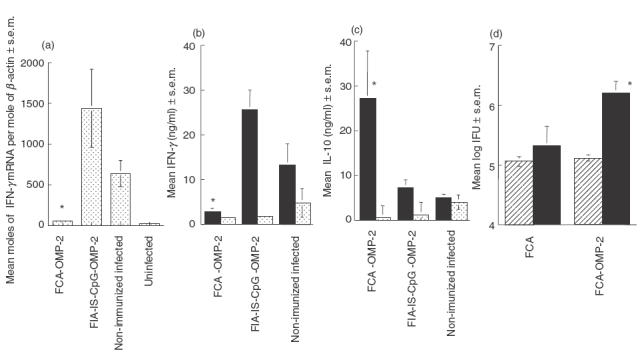
Higher IFN-γ and lower IL-10 levels are present in supernatants from spleen cells of mice immunized with FIA-IS-CpG-OMP-2 and infected with C. pneumoniae compared to those immunized with FCA-OMP-2. (a) Mice were immunized with FCA-OMP-2 and FIA-IS-CpG-OMP-2 before infection with C. pneumoniae. Infected non-immunized and untreated controls wee also used. RNA was extracted from the left lungs of at least four mice per group and reverse transcribed. IFN-γ and β-actin were measured by a competitive PCR. Differences versus FIA-IS-CpG-OMP-2-immunized or non-immunized infected mice are significant (P < 0·05, Student's t-test). (b,c) IFN-γ (b) and IL-10 (c) levels were measured in supernatants from FCA-OMP-2, FIA-IS-CpG-OMP-2-immunized or non-immunized controls 14 days after infection with C. pneumoniae. Spleen cells from individual mice (2 × 10⁶ cells per ml) were co-incubated with recombinant OMP-2 for 48 h at 37°C, and the concentration of IFN-γ and IL-10 in supernatants from at least 6 mice per group were measured by ELISA. Differences in cytokine levels versus FIA-IS-CpG-OMP-2-immunized or non-immunized and infected, OMP-2-stimulated cultures are significant (P < 0·05, Student's t-test). Differences in IFN-γ levels in OMP-2-stimulated spleen cell cultures from FIA-IS-CpG-OMP-2 and untreated infected mice are significant (P < 0·05, Student's t-test). (d) IL-10−/−[32] and WT mice were immunized s.c. three times with FCA-OMP-2 or FCA as described above and challenged with C. pneumoniae 14 days after the last immunization dose. Mice were sacrificed 14 days after C. pneumoniae infection and individual IFU determined in lung homogenates. The mean log10 IFU per lung ± s.e.m. are depicted. Differences versus FCA-treated, infected mice are significant (P < 0·05, Student's t-test). (b) ▪, OMP-2-stimulated; formula image, medium. (d) formula image, IL-10−/−; ▪, WT.
Fig. 7
Fig. 7
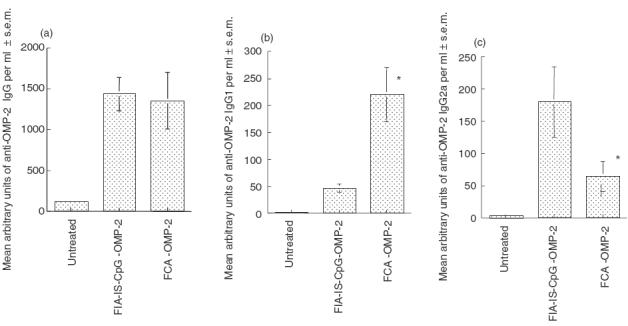
The isotype pattern of anti-OMP-2 antibodies depends on the adjuvant used for OMP-2 immunization. Specific antibody levels production after s.c. protein immunization against C. pneumoniae. The mean titres of anti OMP-2 IgG (a), IgG1 (b) and IgG2a (c) antibodies were determined in individual serum samples from mice (six per group) immunized with FCA-OMP-2 or CpG OMP-2 or non-treated controls. Differences versus FIA-IS-CpG-OMP-2-immunized or untreated infected mice are significant (P < 0·05, Student's t-test).

References

    1. Schnare M, Holt AC, Takeda K, et al. Recognition of CpG DNA is mediated by signaling pathways dependent on the adaptor protein MyD88. Curr Biol. 2000;10:1139–42. - PubMed
    1. Hemmi H, Takeuchi O, Kawai T, et al. A Toll-like receptor recognizes bacterial DNA. Nature. 2000;408:740–5. - PubMed
    1. Krieg AM, Yi AK, Schorr J, et al. The role of CpG dinucleotides in DNA vaccines. Trends Microbiol. 1998;6:23–7. - PubMed
    1. Sun S, Kishimoto H, Sprent J. DNA as an adjuvant: capacity of insect DNA and synthetic oligodeoxynucleotides to augment T cell responses to specific antigen. J Exp Med. 1998;187:1145–50. - PMC - PubMed
    1. Donnelly JJ, Ulmer JB, Shiver JW, et al. DNA Vaccines Annu Rev Immunol. 1997;15:617–48. - PubMed

Publication types

MeSH terms