Comparative Study
. 2002 Dec;236(6):703-11; discussion 711-2.
doi: 10.1097/00000658-200212000-00002.

Liver regeneration is an angiogenesis- associated phenomenon

Affiliations
Comparative Study

Liver regeneration is an angiogenesis- associated phenomenon

Tom A Drixler et al. Ann Surg. 2002 Dec.

Abstract

Objective: To investigate whether liver regeneration is an angiogenesis-associated phenomenon.

Summary background data: Angiogenesis is predominantly known for its pivotal role in tumor growth. However, angiogenesis could also play a role in physiologic processes involving tissue repair, such as liver regeneration.

Methods: Mice subjected to 70% partial hepatectomy were treated with human angiostatin (100 mg/kg body weight). Regeneration-induced hepatic angiogenesis was determined by assessing intrahepatic microvascular density using CD31 staining of frozen liver sections. Liver regeneration was evaluated by assessing wet liver weights and BrdU incorporation in DNA at regular intervals after partial hepatectomy. Possible direct effects of angiostatin on hepatocytes were studied by assessment of liver enzymes (ASAT, ALAT, bilirubin, lactate dehydrogenase), MTT assay (cytotoxicity), aminophenol production (metabolic function), and TUNEL (apoptosis).

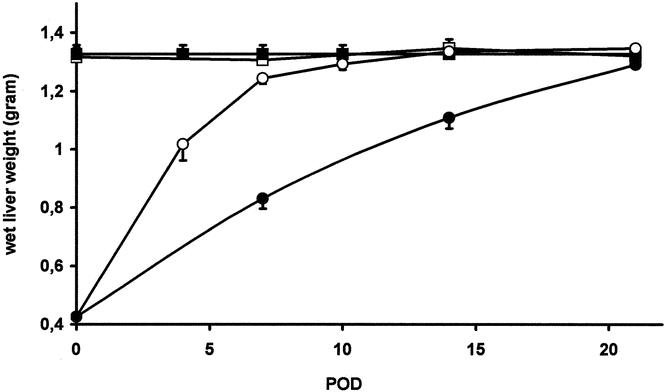
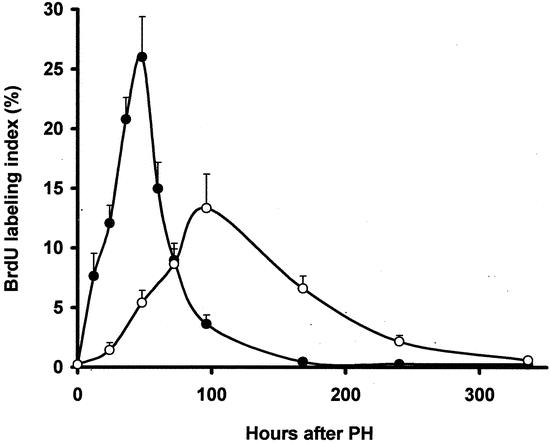
Results: In a regenerating liver, microvascular density increased by 38%. Angiostatin significantly inhibited this response by 60%. In addition, angiostatin inhibited liver regeneration by 50.4% and 24.9% on postoperative days 7 and 14, respectively. In control mice liver weights regained normalcy in 8 days, whereas those in angiostatin-treated mice normalized after 21 days. In angiostatin-treated mice, the maximal BrdU incorporation was decreased and delayed. Direct adverse effects of angiostatin on cultured and in vivo hepatocytes were not observed. Angiostatin neither induced necrosis on hematoxylin and eosin staining nor affected serum levels of liver enzymes.

Conclusions: Liver regeneration is accompanied by intrahepatic angiogenesis. Antiangiogenic treatment using angiostatin inhibits both phenomena. The authors conclude that liver regeneration is, at least in part, an angiogenesis-dependent phenomenon.


Figures
None
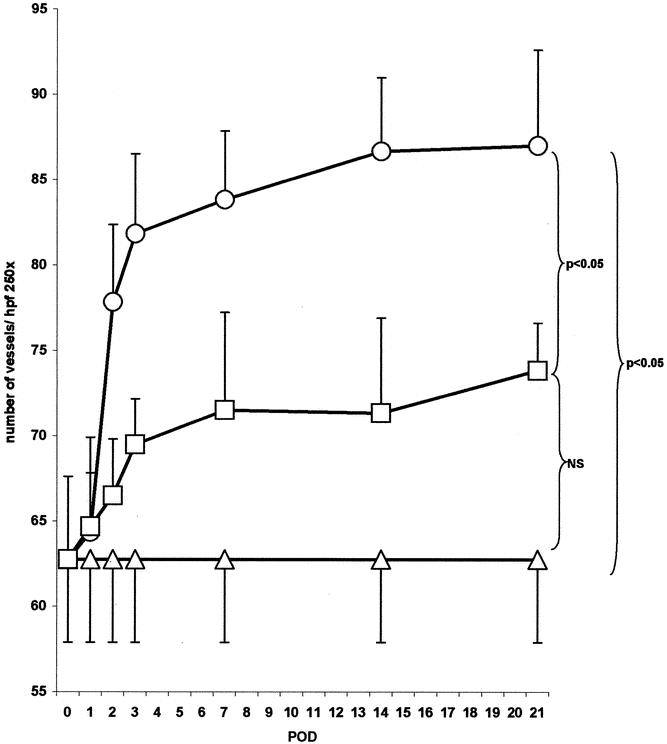
Figure 1. Effects of angiostatin on microvascular density in a regenerating liver. In control mice (ρ) 62.8 ± 4.9 sinusoidal blood vessels per high-power field (hpf) were counted. Following 70% PH (μ = PH-group) microvascular density increased to 87.0 ± 5.6 blood vessels/hpf (P < .05 vs. control; postoperative day 21). In angiostatin-treated mice (ο = AS/PH group) vascular density was reduced to 73.8 ± 2.8 (P = NS from control mice; postoperative day 21).
None
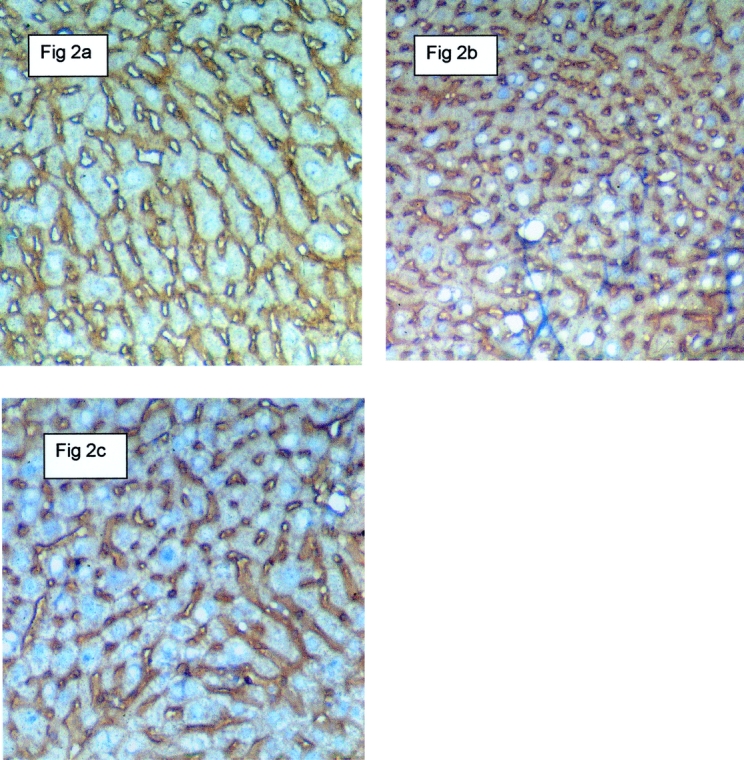
Figure 2. Effects of angiostatin on microvascular density in a regenerating liver 14 days following 70% partial hepatectomy. The identification of sinus endothelial cells was performed by immunostaining with antibodies against CD-31 (PECAM). A, B, and C represent the control group, the partial hepatectomy group, and the partial hepatectomy plus angiostatin group, respectively. Twenty-one days after partial hepatectomy, the microvascular density was increased significantly compared to both angiostatin-treated mice and control, nonhepatectomized mice. Magnification 250×.
None
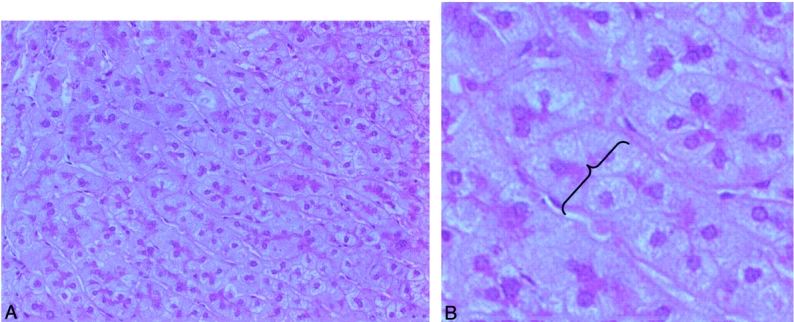
Figure 3. Histologic appearance of regenerating liver 7 days following 70% partial hepatectomy. (A) In angiostatin-treated mice no necrosis was observed after partial hepatectomy (hematoxylin and eosin, magnification 100×). (B) Hyperplasia (increase in the number of hepatocytes) and thickening of the hepatocyte cords (double-cell plates) as pointed out by the accolade (hematoxylin and eosin, magnification 400×).
None
Figure 4. Effects of angiostatin on wet liver weight in resting and regenerating liver. In normal mice (< = control) wet liver weight was 1.326 ± 0.031 g. Angiostatin treatment did not affect wet liver weight in normal mice (ο = AS group): 1.323 ± 0.015 g (P = NS vs. control). Following 70% partial hepatectomy in nontreated mice (μ = PH group), the liver remnant returned to normal (original) weight in 8 days. In angiostatin-treated mice (• = AS/PH-group) this took approximately 3 weeks.
None
Figure 5. Effects of angiostatin on the proliferation of hepatocytes in resting and regenerating liver. BrdU uptake is represented by the ratio of labeled and nonlabeled hepatocytes times 100%. In normal resting liver the hepatocellular BrdU labeling index was approximately 0.2% (data not shown). Two days following 70% partial hepatectomy (PH group) a maximum of 26 ± 3.4% hepatocytes was labeled. In angiostatin-treated mice (PH/AS group) the BrdU labeling index peak was delayed to 96 hours after 70% partial hepatectomy. The BrdU peak was also significantly lower compared to the PH group (13.3 ± 2.9%;P < .001 vs. PH group).
None
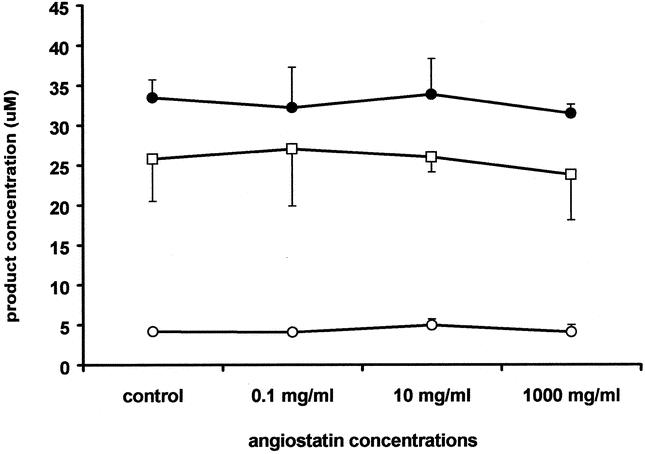
Figure 6. Effects of angiostatin on the synthetic capacity of cultured primary murine hepatocytes. The formation of the C-hydroxylated analine metabolite 4-aminophenol (μ) and its sulfate (ο) and glucuronide (λ) conjugates in primary cultures of mouse hepatocytes was used to investigate the possible effects of plasminogen-derived human angiostatin on these hepatocellular biotransformation processes. For all angiostatin concentrations tested, no significant differences were detectable between treated and control hepatocytes.

References

    1. Folkman J. The role of angiogenesis in tumor growth. Semin Cancer Biol 1992; 3: 65–71. - PubMed
    1. Kerbel RS. Clinical trials of antiangiogenic drugs: opportunities, problems, and assessment of initial results. J Clin Oncol 2001; 19: 45S–51S. - PubMed
    1. Folkman J. Angiogenesis in cancer, vascular, rheumatoid and other disease. Nat Med 1995; 1: 27–31. - PubMed
    1. Holmgren L, O’Reilly MS, Folkman J. Dormancy of micrometastases: balanced proliferation and apoptosis in the presence of angiogenesis suppression. Nat Med 1995; 1: 149–153. - PubMed
    1. Dvorak HF, Nagy JA, Berse B, et al. Vascular permeability factor, fibrin, and the pathogenesis of tumor stroma formation. Ann NY Acad Sci 1992; 667: 101–111. - PubMed

Publication types

MeSH terms

LinkOut - more resources