Comparative Study
. 2002 Apr;1(2):181-90.
doi: 10.1128/EC.1.2.181-190.2002.

Evidence for lateral transfer of genes encoding ferredoxins, nitroreductases, NADH oxidase, and alcohol dehydrogenase 3 from anaerobic prokaryotes to Giardia lamblia and Entamoeba histolytica

Affiliations
Comparative Study

Evidence for lateral transfer of genes encoding ferredoxins, nitroreductases, NADH oxidase, and alcohol dehydrogenase 3 from anaerobic prokaryotes to Giardia lamblia and Entamoeba histolytica

Julie E J Nixon et al. Eukaryot Cell. 2002 Apr.

Abstract

Giardia lamblia and Entamoeba histolytica are amitochondriate, microaerophilic protists which use fermentation enzymes like those of bacteria to survive anaerobic conditions within the intestinal lumen. Genes encoding fermentation enzymes and related electron transport peptides (e.g., ferredoxins) in giardia organisms and amebae are hypothesized to be derived from either an ancient anaerobic eukaryote (amitochondriate fossil hypothesis), a mitochondrial endosymbiont (hydrogen hypothesis), or anaerobic bacteria (lateral transfer hypothesis). The goals here were to complete the molecular characterization of giardial and amebic fermentation enzymes and to determine the origins of the genes encoding them, when possible. A putative giardia [2Fe-2S]ferredoxin which had a hypothetical organelle-targeting sequence at its N terminus showed similarity to mitochondrial ferredoxins and the hydrogenosomal ferredoxin of Trichomonas vaginalis (another luminal protist). However, phylogenetic trees were star shaped, with weak bootstrap support, so we were unable to confirm or rule out the endosymbiotic origin of the giardia [2Fe-2S]ferredoxin gene. Putative giardial and amebic 6-kDa ferredoxins, ferredoxin-nitroreductase fusion proteins, and oxygen-insensitive nitroreductases each tentatively supported the lateral transfer hypothesis. Although there were not enough sequences to perform meaningful phylogenetic analyses, the unique common occurrence of these peptides and enzymes in giardia organisms, amebae, and the few anaerobic prokaryotes suggests the possibility of lateral transfer. In contrast, there was more robust phylogenetic evidence for the lateral transfer of G. lamblia genes encoding an NADH oxidase from a gram-positive coccus and a microbial group 3 alcohol dehydrogenase from thermoanaerobic prokaryotes. In further support of lateral transfer, the G. lamblia NADH oxidase and adh3 genes appeared to have an evolutionary history distinct from those of E. histolytica.


Figures
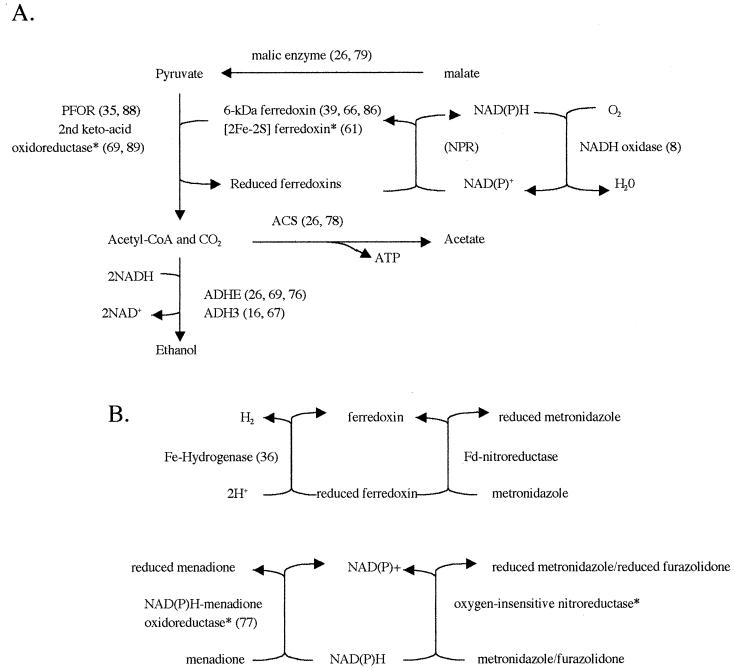
FIG. 1.
FIG. 1.
Metabolic pathways. (A) Fermentation enzymes and other related peptides of G. lamblia and E. histolytica. Relevant references are shown in parentheses. Proteins identified only in giardia organisms are marked with an asterisk. (B) Other hypothetical electron acceptors for ferredoxin and NADH.
FIG. 2.
FIG. 2.
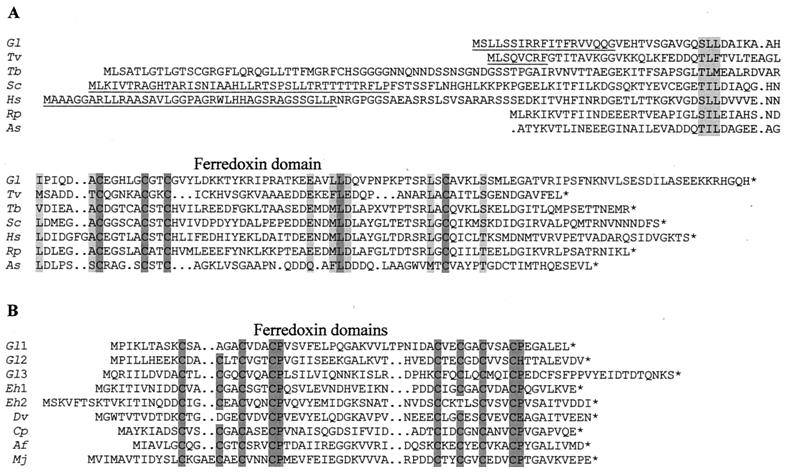
Putative ferredoxins of G. lamblia and E. histolytica. (A) Alignment of a hypothetical [2Fe-2S]ferredoxin of G. lamblia (Gl) (GenBank accession number AF393829) in single-letter code with those of other eukaryotes (T. vaginalis [Tv] [102172], Trypanosoma brucei [Tb] [incomplete microbial genome database], S. cerevisiae [Sc] [6325004], and H. sapiens [Hs] [4758352]) and eubacteria (Rickettsia prowazekii [Rp] [15604072] and Aphanothece sacrum [As] [119940]). Cys residues, which form ligands with the iron-sulfur site, and other residues identical in these ferredoxins are shaded in dark gray. Residues with conservative amino acid substitutions are shaded in light gray. N-terminal organelle-targeting sequences, which are proven (T. vaginalis, S. cerevisiae, and H. sapiens) or hypothetical (G. lamblia), are underlined (10, 14). An asterisk indicates the end of each protein. Gaps are indicated by dots. (B) Alignment of three hypothetical 6-kDa ferredoxins of G. lamblia (Gl1 to Gl3) with selected ferredoxins of E. histolytica (Eh1 and Eh2) (GenBank accession number 158942), eubacteria (Desulfovibrio vulgaris [Dv] [944972] and Clostridium perfringens [Cp] [119990]), and archaea (Archaeglobus fulgidus [Af] [11499725] and Methanococcus jannaschii [Mj] [15668371]). Residues are shaded as described for panel A.
FIG. 3.
FIG. 3.
Putative nitroreductases of G. lamblia and E. histolytica. (A) Alignment of two hypothetical ferredoxin-nitroreductase fusion enzymes of G. lamblia (Gl1 and Gl2) with those of E. histolytica (Eh), Clostridium difficile (Cd) (incomplete microbial genome database), Clostridium acetobutylicum (Ca) (GenBank accession number 15026573), Chlorobium tepidum (Ct) (incomplete microbial genome database), D. vulgaris (Dv) (incomplete microbial genome database), and Geobacter sulfurreducens (Gs) (incomplete microbial genome database). Residues are shaded as described in the legend to Fig. 2A. A dash indicates the end of the available sequence for the E. histolytica ferredoxin-nitroreductase, which was truncated. Gaps are indicated by dots. (B) Alignment of putative oxygen-insensitive nitroreductases of G. lamblia (Gl) with those of Bacillus halodurans (Bh) (GenBank accession number 15612866), a Crenarchaeote sp. (Cs) (14548151), C. acetobutylicum (Ca) (15896791), and T. maritima (Tm) (15643149).
FIG. 4.
FIG. 4.
Phylogenetic tree drawn by distance methods for NADH oxidases of G. lamblia, E. histolytica, archaea (A. fulgidus 1, 2, and 3 [GenBank accession numbers 11498007, 11498012, and 11498556, respectively]; M. jannaschii [15668830]; a Microscilla sp. [14518332]; Pyrococcus abyssi [14521611]; and Sulfolobus tokodaii [15922579]), and eubacteria (B. halodurans [15616338]; Brachyspira hyodysenteriae [642030]; Deinococcus radiodurans [15806015]; Enterococcus faecalis [547994]; Lactococcus lactis 1, 2, and 3 [15672373, 15674108, and 15672768, respectively]; Mycoplasma pulmonis [15828494]; Streptococcus pneumoniae [4416519]; T. maritima [15643161]; Treponema pallidum [15639906]; and Vibrio cholerae [15601402]). Bootstrap values at nodes were from distance/parsimony methods. An asterisk indicates where a bootstrap value was below 50%. Nodes were left blank when both distance and parsimony analyses failed to identify the same bifurcating branch in over 50% of the bootstrap replicates.
FIG. 5.
FIG. 5.
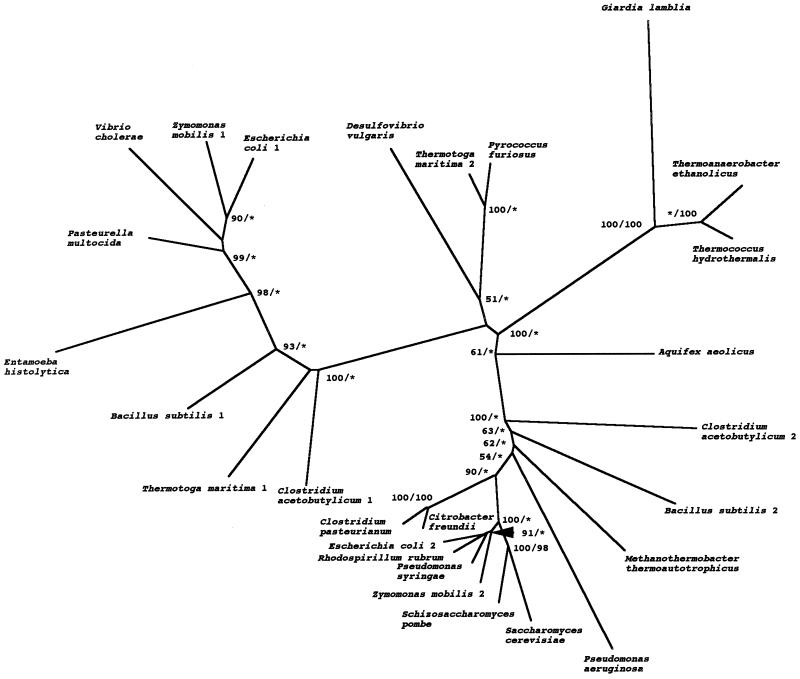
Phylogenetic tree drawn by distance methods for ADH3 enzymes from G. lamblia (GenBank accession number 7288867), E. histolytica (1502307), other eukaryotes (S. cerevisiae [3337] and Schizosaccharomyces pombe [1168356]), archaea (Pyrococcus furiosus [3288811], Methanothermobacter thermoautotrophicus [7431292], and Thermococcus hydrothermalis [2765364]), and eubacteria (Aquifex aeolicus [7431295], Bacillus subtilis 1 and 2 [7431302 and 3023262, respectively], Citrobacter freundii [1169299], C. acetobutylicum 1 and 2 [144714 and 15896543, respectively], Clostridium pasteurianum [2393887], D. vulgaris [incomplete microbial genome database], E. coli 1 and 2 [9911058 and 3025295, respectively], Pasteurella multocida [15602014], Pseudomonas aeruginosa [12698394], Pseudomonas syringae [incomplete microbial genome database], Rhodospirillum rubrum [4519177], Thermoanaerobacter ethanolicus [9863860], T. maritima 1 and 2 [7431300 and 7431301, respectively], V. cholerae [15601458], and Zymomonas mobilis 1 and 2 [113381 and 4378173, respectively]). Bootstrap values are marked as described in the legend to Fig. 4.

References

    1. Adam, R. D. 2001. Biology of Giardia lamblia. Clin. Microbiol. Rev. 14:447-475. - PMC - PubMed
    1. Adams, M. D., S. E. Celniker, R. A. Holt, et al. 2000.. The genome sequence of Drosophila melanogaster. Science 287:2185-2195. - PubMed
    1. Altschul, S. F., T. L. Madden, A. A. Schaffer, J. Zhang, Z. Zhang, W. Miller, and D. J. Lipman. 1997. Gapped BLAST and PSI-BLAST: a new generation of protein database search programs. Nucleic Acids Res. 25:3389-3402. - PMC - PubMed
    1. Andersson, S. G. E., and C. G. Kurland. 1999. Origins of mitochondria and hydrogenosomes. Curr. Opin. Microbiol. 2:535-541. - PubMed
    1. Anonymous. 1998. Genome sequence of the nematode C. elegans: a platform for investigating biology. Science 282:2012-2018. - PubMed

Publication types

MeSH terms

LinkOut - more resources