. 2002 Dec 10;99(25):15873-8.
doi: 10.1073/pnas.252640699. Epub 2002 Nov 27.

Surface crystallization of supercooled water in clouds

Affiliations

Surface crystallization of supercooled water in clouds

A Tabazadeh et al. Proc Natl Acad Sci U S A. .

Abstract

The process by which liquid cloud droplets homogeneously crystallize into ice is still not well understood. The ice nucleation process based on the standard and classical theory of homogeneous freezing initiates within the interior volume of a cloud droplet. Current experimental data on homogeneous freezing rates of ice in droplets of supercooled water, both in air and emulsion oil samples, show considerable scatter. For example, at -33 degrees C, the reported volume-based freezing rates of ice in supercooled water vary by as many as 5 orders of magnitude, which is well outside the range of measurement uncertainties. Here, we show that the process of ice nucleus formation at the air (or oil)-liquid water interface may help to explain why experimental results on ice nucleation rates yield different results in different ambient phases. Our results also suggest that surface crystallization of ice in cloud droplets can explain why low amounts of supercooled water have been observed in the atmosphere near -40 degrees C.


Figures
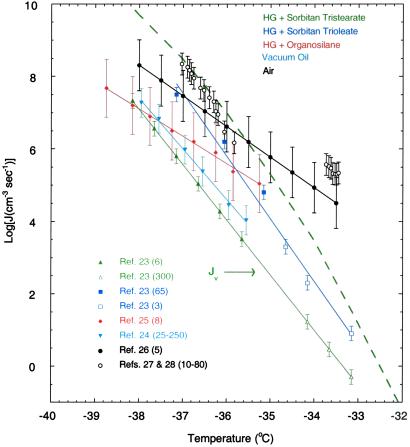
Fig 1.
Fig 1.
Homogeneous volume-based freezing nucleation rates of ice in supercooled water. Symbols and solid lines give raw laboratory data and least-square fits to these data. Note that the least-square fit line to the data presented by open circles (27, 28) is omitted for clarity. The numbers in parentheses give the droplet size range in units of μm. The dashed line gives the homogeneous freezing rate provided by Pruppacher and Klett (1). The error bars show the reported range of measurement uncertainties.
Fig 2.
Fig 2.
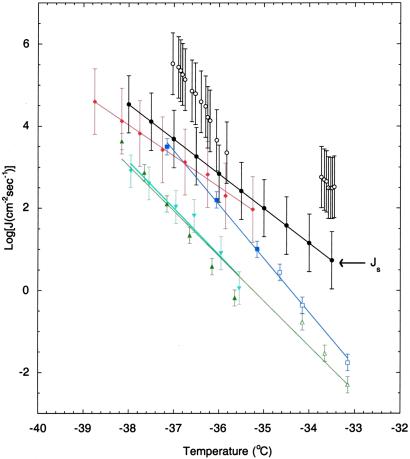
Homogeneous surface-based freezing nucleation rates in supercooled water. Eq. 5 was used to convert the reported volume-based rates, shown in Fig. 1, into surface-based rates. Symbols and color charts are defined in Fig. 1. Note that the error bars on open circles are larger than those shown in Fig. 1 because no information is given in refs. and on the size of particles used for each individual experiment. Thus we have extended the length of the error bar to account for the effect of variation in the droplet size range on the rate of the surface nucleation process.
Fig 3.
Fig 3.
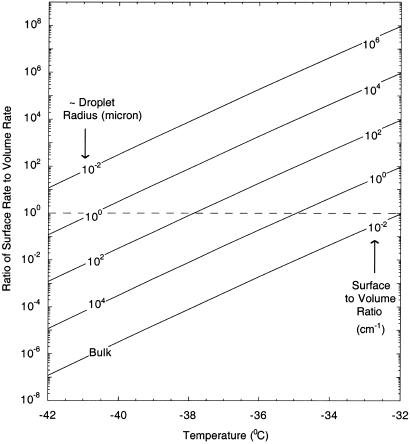
Variation in the ratio of surface freezing rate to volume freezing rate in supercooled water as a function of temperature.
Fig 4.
Fig 4.
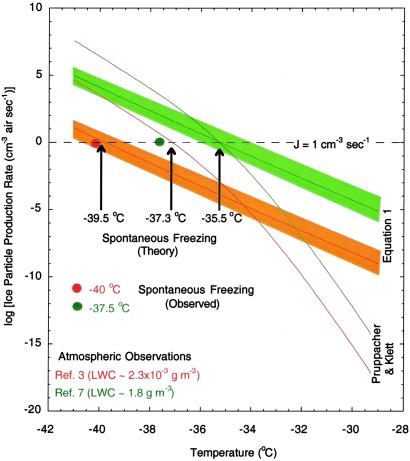
Ice particle production rates in the atmosphere as a function of temperature and liquid water content. The shaded areas show the range of uncertainties in surface rate predictions based on error bars shown in Fig. 2 for the JS line. The liquid water range used in the calculations varies from 2.3 × 10⁻³ (low) to 1.8 (high) g⋅m−3 and is constrained by aircraft observations (3, 7). A monodisperse size distribution with a mode diameter of 5 and 17 μm was used in the calculations to obtain liquid water surface areas in air for low and high water content measurements, respectively. Arrows mark temperatures at which each theory predicts spontaneous freezing of ice will occur in the atmosphere. Symbols mark temperatures where spontaneous ice freezing was observed in the field.

References

    1. Pruppacher H. R. & Klett, J. D., (1997) Microphysics of Clouds and Precipitation (Kluwer, Dordrecht, The Netherlands).
    1. Sassen K., Liou, K. N., Kinne, S. & Griffin, M. (1985) Science 227, 411-413. - PubMed
    1. Heymsfield A. J. & Sabin, R. M. (1989) J. Atmos. Sci. 46, 2252-2264.
    1. Jensen E. J., Toon, O. B., Tabazadeh, A., Sachse, G. W., Anderson, B. E., Chan, K. R., Twohy, C. W., Gandrud, B., Aulenbach, S. M., Hemysfield, A., et al. (1998) Geophys. Res. Lett. 25, 1363-1366.
    1. Rogers D. C., DeMott, P. J., Kreidenweis, S. & Chen, Y. (1998) Geophys. Res. Lett. 25, 1383-1386.

LinkOut - more resources