


Memory for extinction of conditioned fear is long-lasting and persists following spontaneous recovery
- PMID: 12464700
- PMCID: PMC187587
- DOI: 10.1101/lm.49602
Memory for extinction of conditioned fear is long-lasting and persists following spontaneous recovery
Abstract
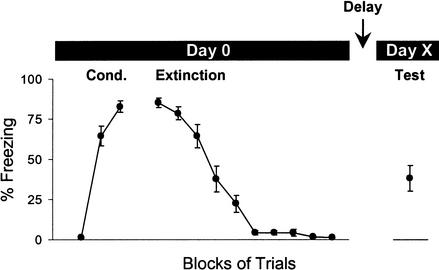
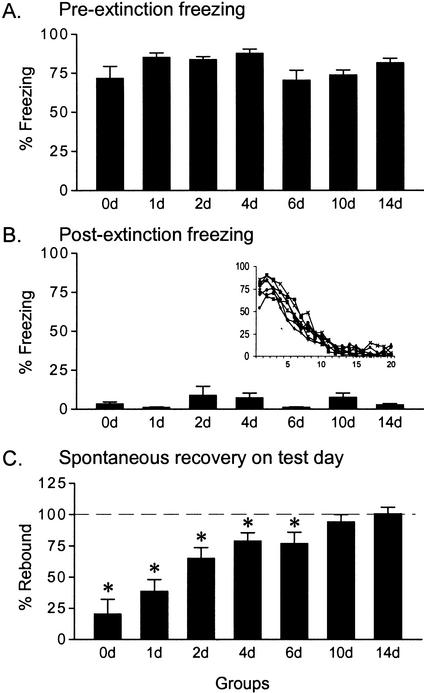
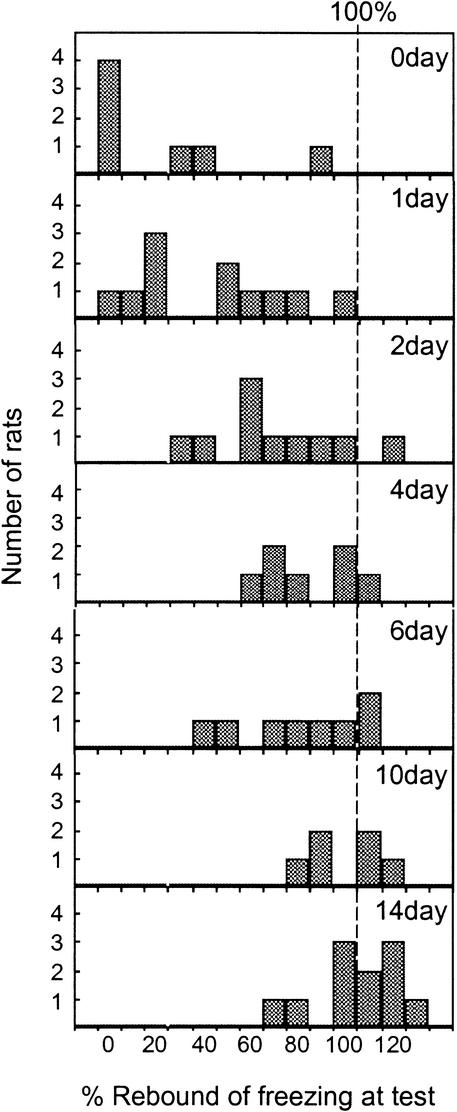
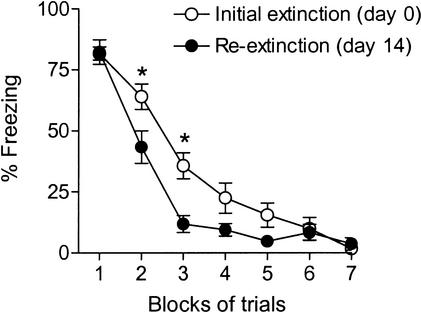
Conditioned fear responses to a tone paired with footshock rapidly extinguish when the tone is presented in the absence of the shock. Rather than erase conditioning, extinction is thought to involve the formation of new memory. In support of this, extinguished freezing spontaneously recovers with the passage of time. It is not known, however, how long extinction memory lasts or whether extinction interferes with consolidation of conditioning if given on the same day. To address this, we gave rats 7 trials of auditory fear conditioning followed 1 h later by 20 extinction trials, and tested for spontaneous recovery after a delay of 0, 1, 2, 4, 6, 10, or 14 d. Conditioned freezing to the tone gradually recovered with time to reach 100% by day 10. No-extinction controls indicated that the increase in freezing with time was not owing to incubation of conditioning memory. Complete spontaneous recovery indicates that extinction training given 1 h after conditioning does not interfere with the consolidation of conditioning memory. Despite complete recovery of freezing, rats showed savings in their rate of re-extinction, indicating persistence of extinction memory. These data support the idea that conditioning and extinction of fear are learned by independent systems, each able to retain a long-term memory.
Figures
Comment in
-
Postextinction of conditioned fear: between two CS-related memories.Learn Mem. 2002 Nov-Dec;9(6):361-3. doi: 10.1101/lm.56402. Learn Mem. 2002. PMID: 12464694 No abstract available.
References
-
- Blanchard DC, Blanchard RJ. Innate and conditioned fear reactions to threat in rats with amygdaloid lesions. J Comp Phys Psychol. 1972;81:281–290. - PubMed
-
- Bouton ME. Context and retrieval in extinction and in other examples of interference in simple associative learning. In: Dachowski L, Flaherty CF, editors. Current topics in animal learning: Brain, emotion and cognition. Hillsdale, NJ: Earlbaum; 1991. pp. 25–53.
-
- ————— Context, time, and memory retrieval in the interference paradigms of Pavlovian learning. Psychol Bull. 1993;114:80–99. - PubMed
-
- ————— Context, ambiguity, and classical conditioning. Curr Dir Psychol Sci. 1994;3:49–53.
-
- Bouton ME, King DA. Contextual control of the extinction of conditioned fear: Tests for the associative value of the context. J Exp Psychol Anim Behav Process. 1983;9:248–265. - PubMed
Publication types
MeSH terms
Grants and funding
LinkOut - more resources
Full Text Sources
Medical