. 2002 Dec;12(12):1815-26.
doi: 10.1101/gr.451502.

Evidence for a fast, intrachromosomal conversion mechanism from mapping of nucleotide variants within a homogeneous alpha-satellite DNA array

Affiliations

Evidence for a fast, intrachromosomal conversion mechanism from mapping of nucleotide variants within a homogeneous alpha-satellite DNA array

Dirk Schindelhauer et al. Genome Res. 2002 Dec.

Abstract

Assuming that patterns of sequence variants within highly homogeneous centromeric tandem repeat arrays can tell us which molecular turnover mechanisms are presently at work, we analyzed the alpha-satellite tandem repeat array DXZ1 of one human X chromosome. Here we present accurate snapshots from this dark matter of the genome. We demonstrate stable and representative cloning of the array in a P1 artificial chromosome (PAC) library, use samples of higher-order repeats subcloned from five unmapped PACs (120-160 kb) to identify common variants, and show that such variants are presently in a fixed transition state. To characterize patterns of variant spread throughout homogeneous array segments, we use a novel partial restriction and pulsed-field gel electrophoresis mapping approach. We find an older large-scale (35-50 kb) duplication event supporting the evolutionarily important unequal crossing-over hypothesis, but generally find independent variant occurrence and a paucity of potential de novo mutations within segments of highest homogeneity (99.1%-99.3%). Within such segments, a highly nonrandom variant clustering within adjacent higher-order repeats was found in the absence of haplotypic repeats. Such variant clusters are hardly explained by interchromosomal, fixation-driving mechanisms and likely reflect a fast, localized, intrachromosomal sequence conversion mechanism.


Figures
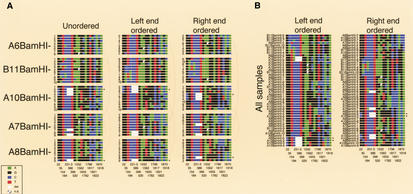
Figure 1
Figure 1
Variant box. For haplotype analysis, the combinations of a set of 18 “common” variants were diagramed for each of the individual 2-kb BamHI subclones from the 5 PAC samples. Little squares were drawn for each nucleotide using the ABI color code (see inset). Variant positions (bottom) belong to the numbering of the satellite sequence in this work (see Supplementary Fig. 1; available online at http://www.genome.org). The 3-bp deletion variant at position 231–233 spans three squares. The variants initially were isolated because they were abundant within a single X-chromosome array and typically revealed a fixed transition state within the population. Within the most homogeneous PACs A7, A8, and A10, such common variants account for the majority of the total variation. The slightly lower homogeneity of PACs A6 and B11 is mainly attributable to a higher fraction of regional variants, possibly owing to a reduced participation in the overall homogenization process (spatially or temporally). The overall sequence divergence of PACs A6 and B11 could well be considerably higher, because a significant fraction of dispersed BamHI fragments with sizes other than 2 kb were not analyzed (Table 2). Of the 3 most homogeneous PACs, only A8 contains such a disruption of the regular BamHI higher-order repeat structure (data not shown). Ordering the combinations of the 18 common variants derived from PAC samples (A) or from all PACs (B) along their left or right ends, neither led to regular patterns reminiscent of a limited number of major haplotypes, nor revealed any obvious relatedness of haplotypes with respect to PAC origin. Of the 46 combinations from individual subclones, 40 are unique and none occurs three times. The six pairs of combinations occurring twice were found within the highly homogeneous PAC A7 (2×), the less homogeneous PAC B11 (containing a duplication of 35–50 kb), between the two homogeneous PACs A10 and A8, or between the homogeneous PAC A7 and diverged PAC A6, as indicated by arches. Asterisks indicate individual clones with identical end sequences. Several combinations of PAC B11 seem to be more related to each other than to the combinations of other PACs, which to some extent could be explained by a somewhat reduced information from the set of 18 variants in this PAC. Interestingly, according to partial restriction mapping, PACs B11, A6, and A7 cannot extensively overlap with each other, and all three cannot extensively overlap with PACs A8 and A10 (which could overlap almost entirely). Nevertheless, ordering the combinations from all PACs results in many possible relationships within and between the PACs. This analysis indicates a lack of major haplotypes within the array, not supporting homogenization via amplification and replacement. In addition, similar haplotype analyses within narrow regions derived from the two or three DraIII and non-DraIII clusters of PAC A7 (see Supplementary Figs. 3, 5; available online at http://www.genome.org) indicate that small regions of amplified haplotypes are also very unlikely.
Figure 2
Figure 2
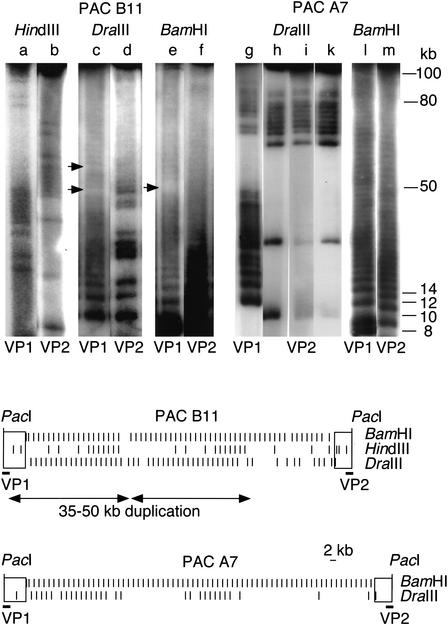
(Top) Large-scale partial restriction mapping. Intact PAC DNA was linearized using the unique PacI site in vector DNA, and electroeluted (Biotrap, Schleicher Schüll). Partial digestions, using 0.1–3 U and 1–2 min of incubation time, were run on a CHEF DRII pulsed-field gel apparatus (Biorad) under conditions separating fragments up to 80–100 kb (switch 2.8 sec, 6 V/cm, 25 h). Gels were Southern-blotted and hybridized with end probes VP1 and VP2. X-Ray images were photographed and processed on a Nicon Cool Scan III. Each lane (a–m) represents one selected condition. PAC B11 (lanes af) shows clustered occurrence of the HindIII variant common within this array segment. Two clusters of 7 higher-order repeats containing the HindIII variant are arranged in tandem, at a distance of ∼50 kb (lanes a,b). The slightly more diverged array of PAC B11 shows disruption of the 2-kb BamHI higher-order repeat structure (lane e) and of the DraIII variant (lane c), possibly marking sites of unequal recombination (little arrows). The highly homogeneous PAC A7 (lanes gm) is entirely composed of 2-kb BamHI higher-order repeats (lanes l,m). The DraIII variant, which is presently in a fixed transition state, occurs in clusters (lanes gk), indicating a rather localized component of spread. Two additional, independent colonies were consecutively replated for 6 d (400 generations), which did not alter the DraIII restriction patterns (lanes i,k), further demonstrating the high stability of α-satellite DNA cloned in PACs. Integrated restriction maps of PACs B11 and A7 are shown at the bottom. Left (VP1) and right (VP2) end probes (bars) are indicated below PAC vectors (open rectangles). Variants presently in transition (HindIII, DraIII) occur in a highly nonrandom fashion, forming clusters of varying size. PAC B11 presents a duplicated pattern of 35–50 kb (duplicate arrows).
Figure 3
Figure 3
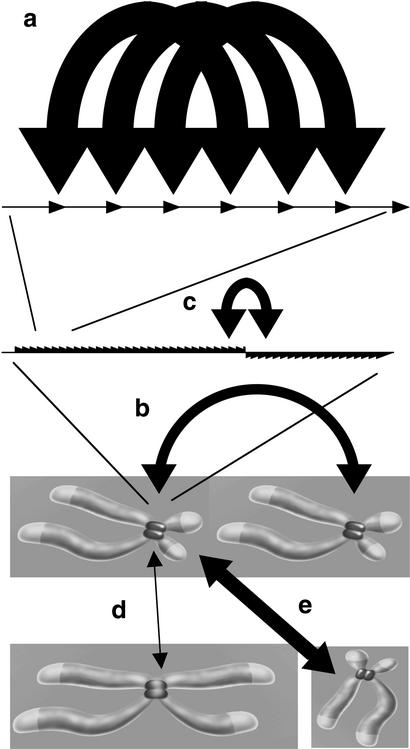
Schematic diagram of several possible trajectories of molecular drive. (a) Localized clustering of variants within neighboring higher-order repeats within highly homogeneous array segments must be the fastest ongoing molecular drive mechanism. The (efficient) interchromosome process, causing fixation in the population (b), is too slow to disintegrate the clusters. Intrachromosomal exchange between distinct array types is generally inefficient, allowing complete fixation of two or more homogeneous array types at a centromere. Sometimes, if closely related array types share sufficient sequence homology, intrachromosomal interarray exchange can be comparably fast evolutionarily (c), preceding complete fixation (Warburton and Willard 1995). Exchange between highly homogeneous (>97%), structurally indistinguishable array types on different chromosomes can be very efficient, as known from pairs of acrocentrics (Greig et al. 1993), or Chromosomes 5 and 19 (e). Any rare exchange between distinct arrays (d) is irrelevant for our mechanistic point of view, which concentrates on the ongoing homogenization within a single homogeneous array, but might well be relevant for the concerted evolution of all the loosely related α-satellite DNA families in general.

References

    1. Alexandrov IA, Mitkevich SP, Yurov YB. The phylogeny of human chromosome specific α satellites. Chromosoma. 1988;96:443–453. - PubMed
    1. Alexandrov IA, Medvedev LI, Mashkova TD, Kisselev LL, Romanova LY, Yurov YB. Definition of a new α satellite suprachromosomal family characterized by monomeric organization. Nucleic Acids Res. 1993;21:2209–2215. - PMC - PubMed
    1. Barry AE, Howman EV, Cancilla MR, Saffery R, Choo KHA. Sequence analysis of an 80 kb human neocentromere. Hum Mol Genet. 1999;8:217–227. - PubMed
    1. Bollag RJ, Waldman AS, Liskay RM. Homologous recombination in mammalian cells. Annu Rev Genet. 1989;23:199–225. - PubMed
    1. Charlesworth B, Sniegowski P, Stephan W. The evolutionary dynamics of repetitive DNA in eukaryotes. Nature. 1994;371:215–220. - PubMed

Publication types

Associated data

LinkOut - more resources