. 2002 Dec 24;99(26):16817-22.
doi: 10.1073/pnas.252617999. Epub 2002 Dec 9.

Satellite imagery characterizes local animal reservoir populations of Sin Nombre virus in the southwestern United States

Affiliations

Satellite imagery characterizes local animal reservoir populations of Sin Nombre virus in the southwestern United States

Gregory E Glass et al. Proc Natl Acad Sci U S A. .

Abstract

The relationship between the risk of hantaviral pulmonary syndrome (HPS), as estimated from satellite imagery, and local rodent populations was examined. HPS risk, predicted before rodent sampling, was highly associated with the abundance of Peromyscus maniculatus, the reservoir of Sin Nombre virus (SNV). P. maniculatus were common in high-risk sites, and populations in high-risk areas were skewed toward adult males, the subclass most frequently infected with SNV. In the year after an El Niño Southern Oscillation (ENSO), captures of P. maniculatus increased only in high-risk areas. During 1998, few sites had infected mice, but by 1999, 1820 of the high-risk sites contained infected mice and the crude prevalence was 30.8%. Only 118 of the low-risk sites contained infected rodents, and the prevalence of infection was lower (8.3%). Satellite imagery identified environmental features associated with SNV transmission within its reservoir population, but at least 2 years of high-risk conditions were needed for SNV to reach high prevalence. Areas with persistently high-risk environmental conditions may serve as refugia for the survival of SNV in local mouse populations.


Figures
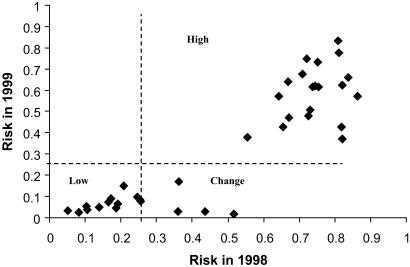
Fig 1.
Fig 1.
Cross tabulation of predicted risk for 38 trapping sites in 1998 (x axis) and 1999 (y axis). Vertical and horizontal lines at 0.25 are thresholds between high- and low-risk categories (5). Low-risk sites were those that were predicted to be low risk during both years of the study (Lower Left). High-risk sites were those that remained at high risk during both years (Upper Right). Sites that changed from high risk in 1998 to low risk in 1999 (Change; Lower Right) were analyzed separately.
Fig 2.
Fig 2.
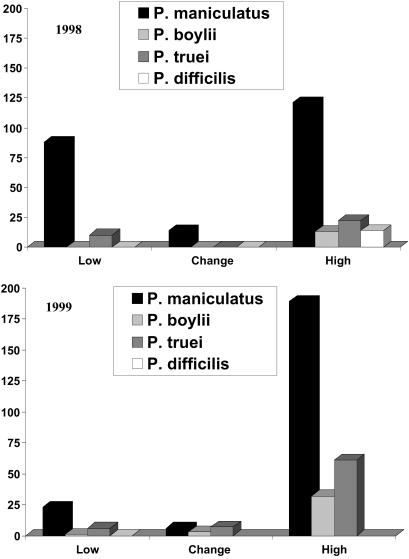
Numbers of Peromyscus species captured in low–moderate (Low), high, and change sites during 1998 (Upper) and 1999 (Lower). P. maniculatus was the most common member of the genus captured. Its abundance decreased in low and change sites in 1999, but its abundance increased in high sites in 1999.
Fig 3.
Fig 3.
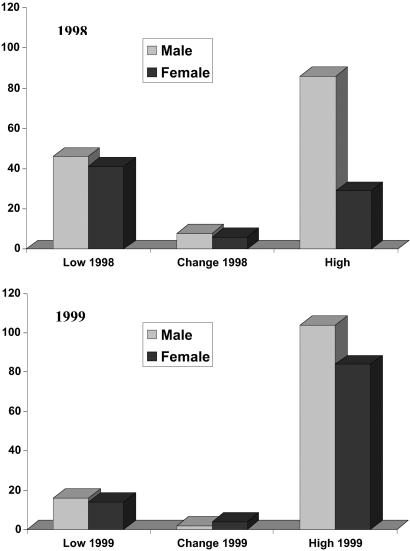
Numbers of male and female P. maniculatus captured in low, high, and change sites during the 2 study years. Sex ratios were skewed toward males in high-risk sites.
Fig 4.
Fig 4.
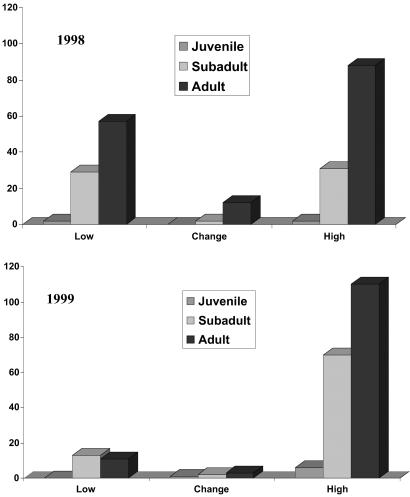
Age structure of P. maniculatus captured in low–moderate (Low), high, and change sites during 1998 (Upper) and 1999 (Lower). The y axis shows the number of individuals captured. High-risk sites were biased toward adults. Age classes were juvenile, ≤10 g; subadult, 10 to <16 g; adult, ≥16 g.
Fig 5.
Fig 5.
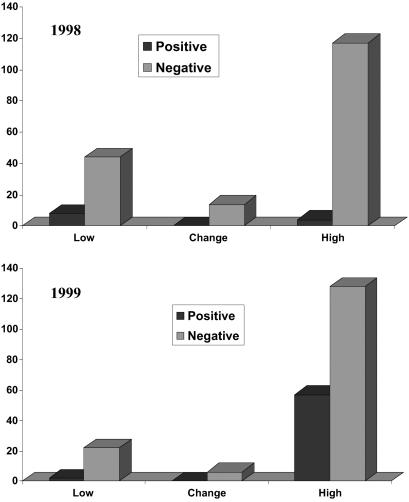
Numbers of P. maniculatus with antibody titers ≥100 (positive) or <100 (negative) for SNV captured in low–moderate (Low), high, and change sites during 1998 (Upper) and 1999 (Lower). The prevalence of infection did not differ among risk categories in 1998. Prevalence was significantly elevated in high sites in 1999.

References

    1. Nichol S. T., Spiropoulou, C. F., Morzunov, S., Rollin, P. E., Ksiazek, T. G., Feldmann, H., Sanchez, A., Childs, J., Zaki, S., Peters, C. J., et al. (1993) Science 262, 914-917. - PubMed
    1. Schmaljohn C. S. & Hjelle, B. (1997) Emerg. Infect. Dis. 3, 95-104. - PMC - PubMed
    1. Mills J. N., Ksiazek, T. G., Ellis, B. A., Rollin, P. E., Nichol, S. T., Yates, T. L., Gannon, W. L., Levy, C. E., Engelthaler, D. M., Davis, T., et al. (1997) Am. J. Trop. Med. Hyg. 56, 273-284. - PubMed
    1. Mills J. N., Ksiazek, T. G., Peters, C. J. & Childs, J. E. (1999) Emerg. Infect. Dis. 5, 135-142. - PMC - PubMed
    1. Glass G. E., Cheek, J. E., Patz, J. A., Shields, T. M., Doyle, T. J., Thoroughman, D. A., Hunt, D. K., Ensore, R. E., Gage, K. L., Irland, C., et al. (2000) Emerg. Infect. Dis. 6, 238-247. - PMC - PubMed

Publication types

LinkOut - more resources