


Associations between human disease genes and overlapping gene groups and multiple amino acid runs
- PMID: 12473749
- PMCID: PMC139260
- DOI: 10.1073/pnas.262658799
Associations between human disease genes and overlapping gene groups and multiple amino acid runs
Abstract
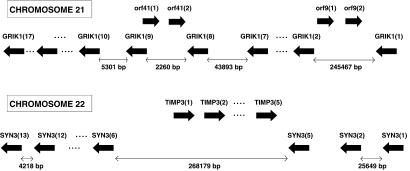
Overlapping gene groups (OGGs) arise when exons of one gene are contained within the introns of another. Typically, the two overlapping genes are encoded on opposite DNA strands. OGGs are often associated with specific disease phenotypes. In this report, we identify genes with OGG architecture and genes encoding multiple long amino acid runs and examine their relations to diseases. OGGs appear to be susceptible to genomic rearrangements as happens commonly with the loci of the DiGeorge syndrome on human chromosome 22. We also examine the degree of conservation of OGGs between human and mouse. Our analyses suggest that (i) a high proportion of genes in OGG regions are disease-associated, (ii) genomic rearrangements are likely to occur within OGGs, possibly as a consequence of anomalous sequence features prevalent in these regions, and (iii) multiple amino acid runs are also frequently associated with pathologies.
References
-
- Hattori M., Fujiyama, A., Taylor, T. D., Watanabe, H., Yada, T., Park, H. S., Toyoda, A., Ishii, K., Totoki, Y., Choi, D. K., et al. (2000) Nature 405, 311-319. - PubMed
-
- Dunham I., Shimizu, N., Roe, B. A., Chissoe, S., Hunt, A. R., Collins, J. E., Bruskiewich, R., Beare, D. M., Clamp, M., Smink, L. J., et al. (1999) Nature 402, 489-495. - PubMed
-
- Edelmann L., Pandita, R. K., Spiteri, E., Funke, B., Goldberg, R., Palanisamy, N., Chaganti, R. S., Magenis, E., Shprintzen, R. J. & Morrow, B. E. (1999) Hum. Mol. Genet. 8, 1157-1167. - PubMed
-
- Rebhan M., Chalifa-Caspi, V., Prilusky, J. & Lancet, D. (1998) Bioinformatics 14, 656-664. - PubMed
Publication types
MeSH terms
Substances
Grants and funding
LinkOut - more resources
Full Text Sources
