


Alternate pathways involving Sgs1/Top3, Mus81/ Mms4, and Srs2 prevent formation of toxic recombination intermediates from single-stranded gaps created by DNA replication
- PMID: 12475932
- PMCID: PMC139239
- DOI: 10.1073/pnas.252652399
Alternate pathways involving Sgs1/Top3, Mus81/ Mms4, and Srs2 prevent formation of toxic recombination intermediates from single-stranded gaps created by DNA replication
Erratum in
- Proc Natl Acad Sci U S A. 2003 Feb 4;100(3):1462
Abstract
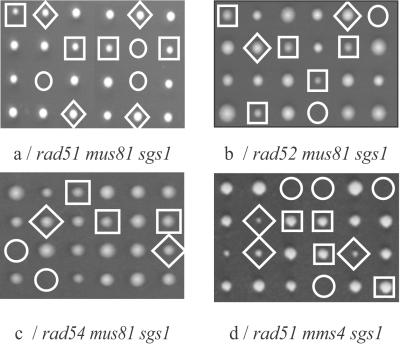
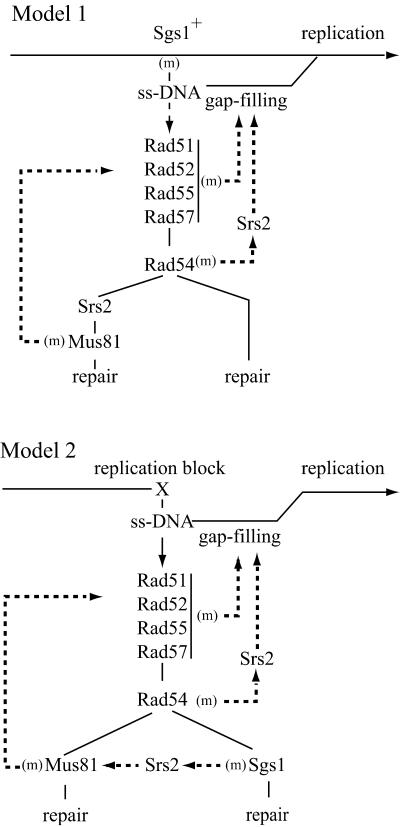
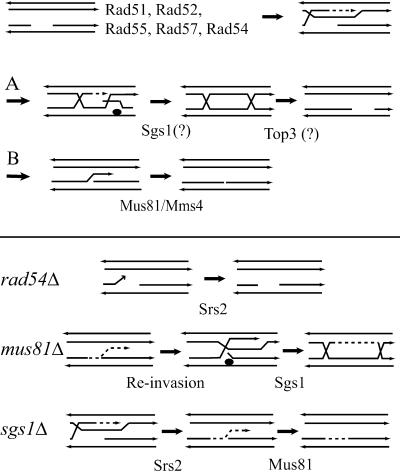
Toxic recombination events are detected in vegetative Saccharomyces cerevisiae cells through negative growth interactions between certain combinations of mutations. For example, mutations affecting both the Srs2 and Sgs1 helicases result in extremely poor growth, a phenotype suppressed by mutations in genes that govern early stages of recombination. Here, we identify a similar interaction involving double mutations affecting Sgs1 or Top3 and Mus81 or Mms4. We also find that the primary DNA structures that initiate these toxic recombination events cannot be double-strand breaks and thus are likely to be single-stranded DNA. We interpret our results in the context of the idea that replication stalling leaves single-stranded DNA, which can then be processed by two competing mechanisms: recombination and nonrecombination gap-filling. Functions involved in preventing toxic recombination would either avoid replicative defects or act on recombination intermediates. Our results suggest that Srs2 channels recombination intermediates back into the gap-filling route, whereas Sgs1Top3 and Mus81Mms4 are involved in recombination andor in replication to allow replication restart.
Figures
References
-
- Oakley T. J., Goodwin, A., Chakraverty, R. K. & Hickson, I. D. (2002) DNA Repair 1, 463-482. - PubMed
-
- Rupp W. D., Wilde, C. E., III, Reno, D. L. & Howard-Flanders, P. (1971) J. Mol. Biol. 61, 25-44. - PubMed
-
- Echols H. & Goodman, M. F. (1991) Annu. Rev. Biochem. 60, 477-511. - PubMed
-
- Higgins N. P., Kato, K. & Strauss, B. (1976) J. Mol. Biol. 101, 417-425. - PubMed
-
- Seigneur M., Bidnenko, V., Ehrlich, S. D. & Michel, B. (1998) Cell 95, 419-430. - PubMed
Publication types
MeSH terms
Substances
Grants and funding
LinkOut - more resources
Full Text Sources
Molecular Biology Databases
Miscellaneous
