. 2002 Dec 24;99(26):16975-80.
doi: 10.1073/pnas.262655399. Epub 2002 Dec 10.

POTE, a highly homologous gene family located on numerous chromosomes and expressed in prostate, ovary, testis, placenta, and prostate cancer

Affiliations

POTE, a highly homologous gene family located on numerous chromosomes and expressed in prostate, ovary, testis, placenta, and prostate cancer

Tapan K Bera et al. Proc Natl Acad Sci U S A. .

Erratum in

  • Proc Natl Acad Sci U S A. 2003 Feb 4;100(3):1462

Abstract

We have identified a gene located on chromosomes 21 that is expressed in normal and neoplastic prostate, and in normal testis, ovary, and placenta. We name this gene POTE (expressed in prostate, ovary, testis, and placenta). The POTE gene has 11 exons and 10 introns and spans approximately equal 32 kb of chromosome 21q11.2 region. The 1.83-kb mRNA of POTE encodes a protein of 66 kDa. Ten paralogs of the gene have been found dispersed among eight different chromosomes (2, 8, 13, 14, 15, 18, 21, and 22) with preservation of ORFs and splice junctions. The synonymous:nonsynonymous ratio indicates that the genes were duplicated rather recently but are diverging at a rate faster than the average for other paralogous genes. In prostate and in testis, at least five different paralogs are expressed. In situ hybridization shows that POTE is expressed in basal and terminal cells of normal prostate epithelium. It is also expressed in some prostate cancers and in the LnCAP prostate cancer cell line. The POTE protein contains seven ankyrin repeats between amino acids 140 and 380. Expression of POTE in prostate cancer and its undetectable expression in normal essential tissues make POTE a candidate for the immunotherapy of prostate cancer. The existence of a large number of closely related but rapidly diverging members, their location on multiple chromosomes and their limited expression pattern suggest an important role for the POTE gene family in reproductive processes.


Figures
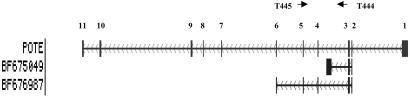
Fig. 1.
Fig. 1.
Schematic showing the genomic organization of a POTE gene. Two ESTs ( and ), which match exons in the POTE gene, are from a prostate cDNA library. There are 11 exons (numbered 1–11) in the POTE gene.
Fig. 2.
Fig. 2.
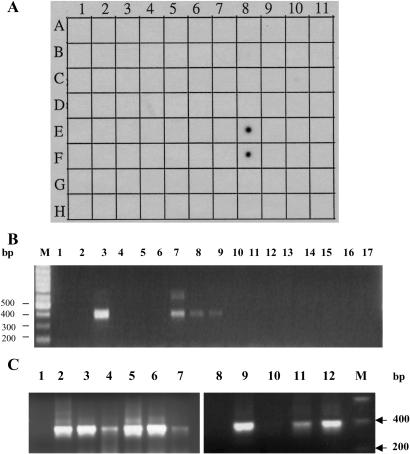
Specificity of POTE mRNA expression. (A) RNA hybridization of a multiple tissue dot blot containing mRNA from 76 normal human cell types or tissues by using a cDNA probe. Strong expression is observed in prostate (E8) and testis (F8). There is no detectable expression in brain (A1), heart (A4), kidney (A7), liver (A9), lung (A8), and colon (A6). (B) PCR on cDNAs from 16 different human tissues. The expected size of the PCR product is 400 bp. A specific 400-bp PCR product is detected in testis (lane 3), prostate (lane 7), placenta (lane 8), and ovary (lane 9). (C) RT-PCR analysis of RNAs from normal prostate, prostate cancer, and prostate cancer cell lines LnCAP and PC3. Lanes: 1 and 8, negative control for PCR; 2–4, three prostate cancer samples; 5–7 and 11, normal prostate samples; 9, LnCAP; 10, PC3; 12, testis. A specific band of 400 bp in size is detected in all lanes except negative controls and PC3.
Fig. 3.
Fig. 3.
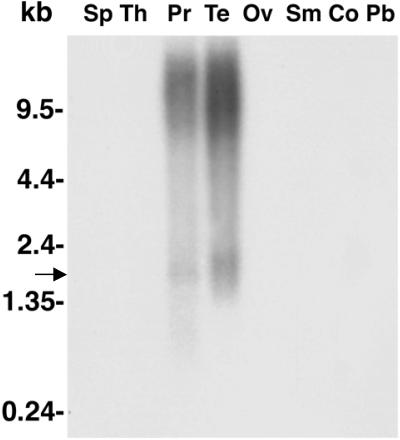
Northern blot analysis of POTE transcript in different normal tissues. Human multiple tissue Northern blot was probed with the same PCR probe used in the dot blot experiment. The only detectable signal is in prostate (Pr) and testis (Te) lanes. In both samples there is a weak band of ≈2 kb (arrow) in size and a smear at the high molecular weight region (which is probably the unprocessed nuclear RNA). There is no detectable signal in spleen (Sp), thymus (Th), ovary (Ov), small intestine (Sm), colon (Co), and peripheral blood leukocytes (Pb).
Fig. 4.
Fig. 4.
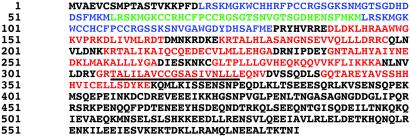
Amino acid sequence of POTE protein. The blue-and green-colored residues are the N-terminal three repeats of 37 residues each. The red colored residues are the seven ankyrin repeats. The prediction for the ankyrin repeat is weak for the first and the last members. The putative membrane-spanning region is underlined.
Fig. 5.
Fig. 5.
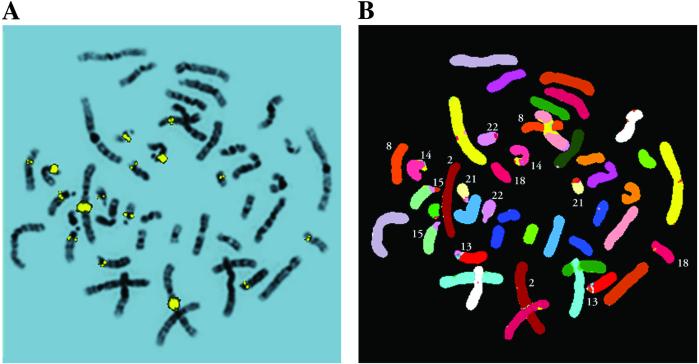
FISH analysis of POTE gene. (A) Digital images of normal human chromosomes hybridized with a biotinylated bacterial artificial chromosome probe for POTE gene counterstained with 4′,6-diamidino-2-phenylindole. Double symmetrical fluorescent signals are distributed on seven chromosome pairs. The signal is localized on G-banded chromosomes generated by contrast enhancement and LUT inversion of the 4′,6-diamidino-2-phenylindole-stained chromosomes. (B) Spectral karyotype of the same metaphase as in A for precise identification of chromosomes with hybridization signal.
Fig. 6.
Fig. 6.
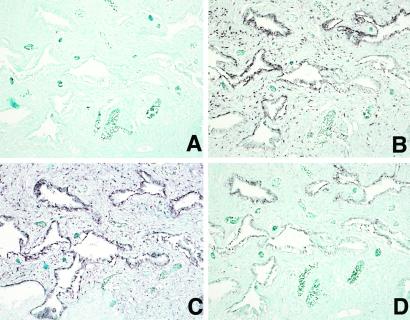
In situ hybridization of prostate tissue sections probed with: CD22 control probe (A), note absence of signal; U6 (B); TARP (C); and POTE (D).
Fig. 7.
Fig. 7.
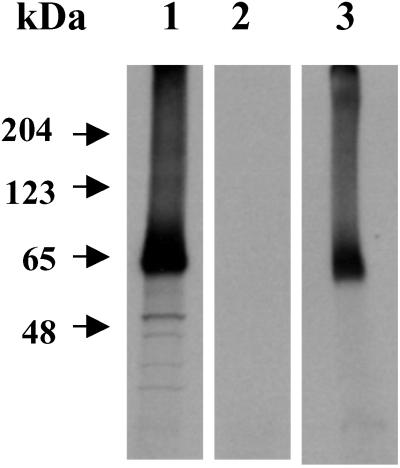
Analysis of the protein encoded by POTE mRNA. POTE cDNA was transcribed in vitro with T7 RNA polymerase, and the RNA was translated with rabbit reticulocyte lysate in the presence of [35S]methionine. The translated products were analyzed by SDS/PAGE and fluorography. Lane 1, luciferase cDNA as positive control; lane 2, empty vector control; and lane 3, POTE cDNA.

References

    1. International Human Sequencing Consortium (2001) Nature 409, 860-920.
    1. Liang P. & Pardee, A. B. (1992) Science 257, 967-971. - PubMed
    1. Hara T., Harada, N., Mitsui, H., Miura, T., Ishizaka, T. & Miyajima, A. (1994) Blood 84, 189-199. - PubMed
    1. Velculescu V. E., Zhang, L., Vogelstein, B. & Kinzler, K. W. (1995) Science 276, 1268-1272. - PubMed
    1. Schena M., Shalon, D., Davis, R. W. & Brown, P. O. (1995) Science 270, 467-470. - PubMed