


Heterogeneity of envelope molecules expressed on primary human immunodeficiency virus type 1 particles as probed by the binding of neutralizing and nonneutralizing antibodies
- PMID: 12477840
- PMCID: PMC140593
- DOI: 10.1128/jvi.77.1.353-365.2003
Heterogeneity of envelope molecules expressed on primary human immunodeficiency virus type 1 particles as probed by the binding of neutralizing and nonneutralizing antibodies
Abstract
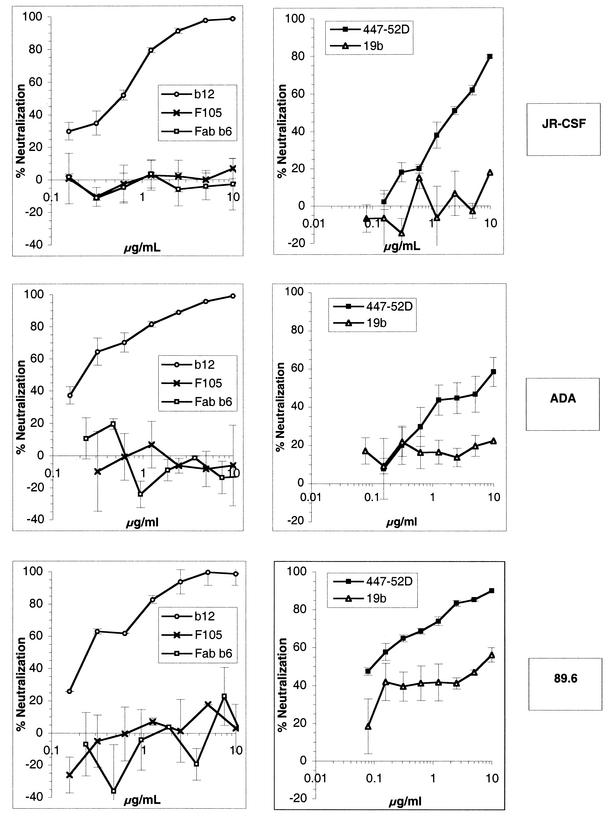
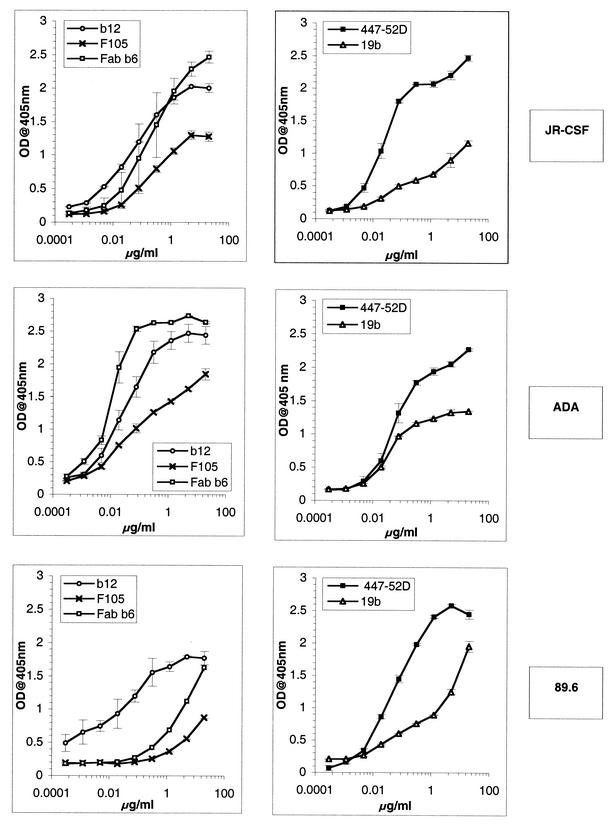
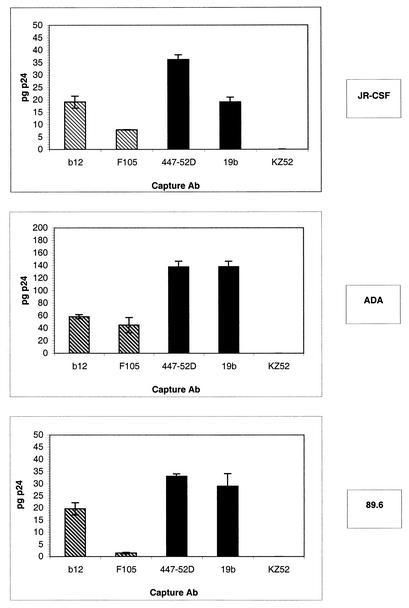
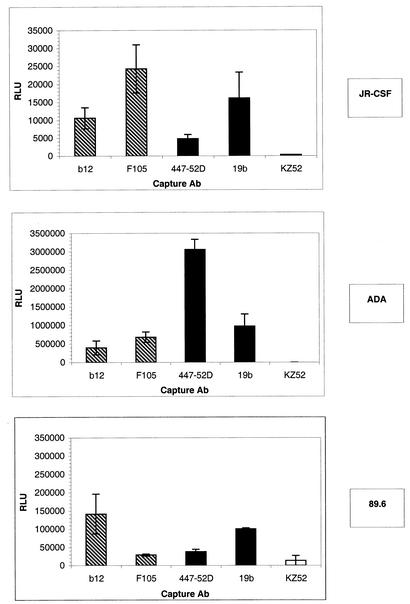
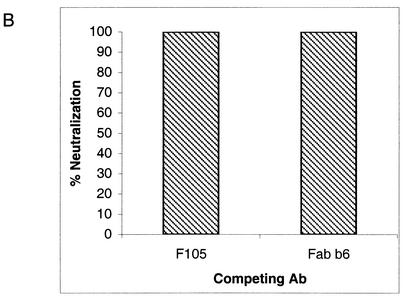
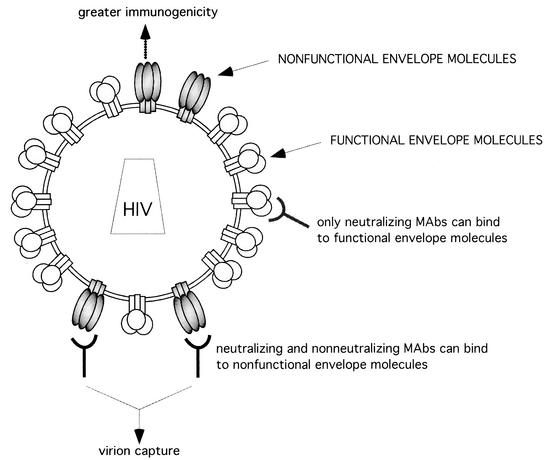
Virion capture assays, in which immobilized antibodies (Abs) capture virus particles, have been used to suggest that nonneutralizing Abs bind effectively to human immunodeficiency virus type 1 (HIV-1) primary viruses. Here, we show that virion capture assays, under conditions commonly reported in the literature, give a poor indication of epitope expression on the surface of infectious primary HIV-1. First, estimation of primary HIV-1 capture by p24 measurements shows a very poor correlation with an estimation based on infectivity measurements. Second, virion capture appears to require relatively low Ab affinity for the virion, as shown by the ability of a monoclonal Ab to capture a wild-type and a neutralization escape variant virus equally well. Nevertheless, in a more interpretable competition format, it is shown that nonneutralizing anti-CD4 binding site (CD4bs) Abs compete with a neutralizing anti-CD4bs Ab (b12) for virus capture, suggesting that the nonneutralizing anti-CD4bs Abs are able to bind to the envelope species that is involved in virion capture in these experiments. However, the nonneutralizing anti-CD4bs Abs do not inhibit neutralization by b12 even at considerable excess. This suggests that the nonneutralizing Abs are unable to bind effectively to the envelope species required for virus infectivity. The results were obtained for three different primary virus envelopes. The explanation that we favor is that infectious HIV-1 primary virions can express two forms of gp120, an accessible nonfunctional form and a functional form with limited access. Binding to the nonfunctional form, which needs only to be present at relatively low density on the virion, permits capture but does not lead to neutralization. The expression of a nonfunctional but accessible form of gp120 on virions may contribute to the general failure of HIV-1 infection to elicit cross-neutralizing Abs and may represent a significant problem for vaccines based on viruses or virus-like particles.
Figures
References
-
- Baba, T. W., V. Liska, R. Hofmann-Lehmann, J. Vlasak, W. Xu, S. Ayehunie, L. A. Cavacini, M. R. Posner, H. Katinger, G. Stiegler, B. J. Bernacky, T. A. Rizvi, R. Schmidt, L. R. Hill, M. E. Keeling, Y. Lu, J. E. Wright, T. C. Chou, and R. M. Ruprecht. 2000. Human neutralizing monoclonal antibodies of the IgG1 subtype protect against mucosal simian-human immunodeficiency virus infection. Nat. Med. 6:200-206. - PubMed
-
- Burton, D., and D. Montefiori. 1997. The antibody response in HIV-1 infection. AIDS 11(Suppl. A):S87-S98. - PubMed
-
- Burton, D. R., and P. W. H. I. Parren. 2000. Vaccines and the induction of functional antibodies: time to look beyond the molecules of natural infection? Nat. Med. 6:123-125. - PubMed
-
- Burton, D. R., J. Pyati, R. Koduri, S. J. Sharp, G. B. Thornton, P. W. H. I. Parren, L. S. Sawyer, R. M. Hendry, N. Dunlop, P. L. Nara, M. Lamacchia, E. Garratty, E. R. Stiehm, Y. J. Bryston, Y. Cao, J. P. Moore, D. D. Ho, and C. F. Barbas III. 1994. Efficient neutralization of primary isolates of HIV-1 by a recombinant human monoclonal antibody. Science 266:1024-1027. - PubMed
-
- D'Souza, M. P., D. Livnat, J. A. Bradac, S. H. Bridges, et al. 1997. Evaluation of monoclonal antibodies to human immunodeficiency virus type 1 primary isolates by neutralization assays: performance criteria for selecting candidate antibodies for clinical trials. J. Infect. Dis. 175:1056-1062. - PubMed
Publication types
MeSH terms
Substances
Grants and funding
LinkOut - more resources
Full Text Sources
Other Literature Sources
Research Materials
