. 2003 Jan;77(1):481-8.
doi: 10.1128/jvi.77.1.481-488.2003.

Ribavirin causes error catastrophe during Hantaan virus replication

Affiliations
Free PMC article

Ribavirin causes error catastrophe during Hantaan virus replication

William E Severson et al. J Virol. 2003 Jan.
Free PMC article

Abstract

Except for ribavirin, no other antiviral drugs for treating hantaviral diseases have been identified. It is well established that ribavirin will inhibit the production of infectious Hantaan virus (HTNV); however, its mechanism of action is unknown. To characterize the inhibitory effect of ribavirin on HTNV, the levels of viral RNAs, proteins, and infectious particles were measured for 3 days posttreatment of HTNV-infected Vero E6 cells. HTNV-infected cells treated with ribavirin showed a slight reduction in the levels of cRNA, viral RNA, and mRNA populations on the first day postinfection. The amount of cRNA and viral RNA increased to that observed for untreated HTNV-infected cells on day 2, whereas mRNA levels were more greatly reduced on days 2 and 3. Despite the finding of S-segment mRNA, albeit low, three of the viral proteins-nucleocapsid (N) protein and glycoproteins G1 and G2-could not be detected by immunohistochemistry in ribavirin-treated cells. To test the hypothesis that these effects were caused by incorporation of ribavirin into nascent RNA and a resultant "error catastrophe" was occurring, we cloned and sequenced the S-segment cRNA/mRNA from ribavirin-treated or untreated cells from day 3. We found a high mutation frequency (9.5/1,000 nucleotides) in viral RNA synthesized in the presence of ribavirin. Hence, the transcripts produced in the presence of the drug were not functional. These results suggest that ribavirin's mechanism of action lies in challenging the fidelity of the hantavirus polymerase, which causes error catastrophe.


Figures

FIG. 1.
FIG. 1.
Effect of ribavirin on HTNV S-segment RNA replication and transcription. Six-well cell culture plates containing Vero E6 cells per well were infected with HTNV at an MOI of 0.01 (A, C, and E) or an MOI of 0.1 (B, D, and F). After 1 h, the monolayers were overlaid with 2 ml of Eagle minimum essential medium containing 0 (▪) or 24 (▩) μg of ribavirin. For each of the following 3 days, total RNA was isolated and probed for cRNA (A and B), vRNA (C and D), and mRNA (E and F) synthesis as described in Materials and Methods. An actin probe was used to control the proportional quantity of cellular RNA (Table 1). The graph shows the area obtained from PhosphorImager analysis of the hybridization signals from two separate experiments of the RNA levels in which the RNA levels were analyzed in triplicate (± the standard deviation). ✽, Up to 4-fold differences from wild-type levels (0 μg of ribavirin); ✽✽, up to 8-fold differences from wild-type levels (0 μg of ribavirin); ✽✽✽, a >8-fold difference from wild-type levels (0 μg of ribavirin).
FIG. 2.
FIG. 2.
Effect of ribavirin on the yield of infectious HTNV. Supernatants were harvested from HTNV-infected cells at MOIs of 0.01 (A) and 0.1 (B) for the various treatments, i.e., 0 (•) or 24 (▪) μg of ribavirin, and then assayed for plaque formation on monolayers of Vero E6 cells.
FIG. 3.
FIG. 3.
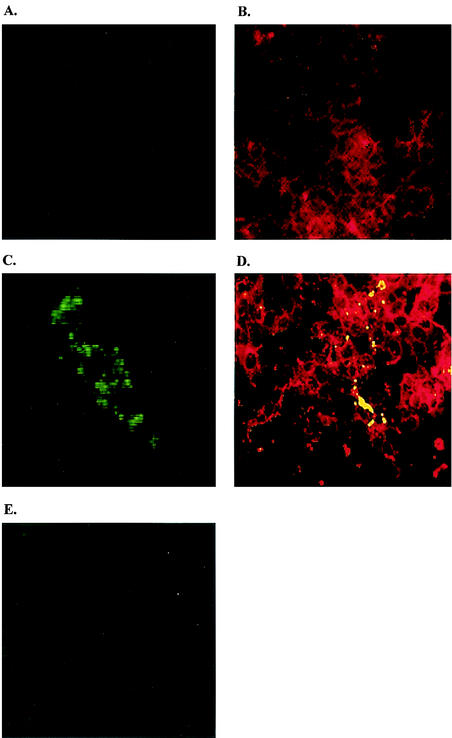
Inhibition of HTNV N protein synthesis by ribavirin. (A) Monolayers of Vero E6 cells. (B) Monolayers of Vero cells stained with anti-laminin antibody, followed by TRITC (tetramethyl rhodamine isothiocyanate)-conjugated anti-rabbit immunoglobulin. (C) Vero cells infected with HTNV 76-118 and stained with N mouse monoclonal antibody (EC02-BD01) (22), followed by FITC-conjugated anti-mouse immunoglobulin. (D) Confocal image (overlay) of Vero cells infected with HTNV, stained with anti-laminin TRITC and N mouse monoclonal antibody FITC and observed by using an LSM 510 META microscope (Zeiss). (E) Vero cells infected with HTNV, treated with 24 μg of ribavirin/ml, and stained with N mouse monoclonal antibody. Cells were fixed 72 h after infection and analyzed by immunofluorescence for the presence of HTNV N protein by using a Zeiss axioscope connected to an Orca 100 camera interfaced to a Macintosh computer with Improvision software.
FIG. 4.
FIG. 4.
Inhibition of HTNV glycoprotein synthesis by ribavirin. (A) Monolayers of Vero cells infected with HTNV 76-118 and stained with monoclonal antibody for G1 (H13-16D2-1-1) (1) as described in Material and Methods. (B) Vero cells infected with HTNV and stained with monoclonal antibody for G2 (EBO6-AAO2) (1). (C) Vero cells infected with HTNV, treated with 24 μg of ribavirin/ml, and stained with G1 mouse monoclonal antibody. Cells were fixed 72 h after infection and analyzed by immunofluorescence for the presence of HTNV G1 and G2 proteins with a Zeiss axioscope connected to an Orca 100 camera interfaced to a Macintosh computer with Improvision software.

References

    1. Arikawa, J., A. L. Schmaljohn, J. M. Dalrymple, and C. S. Schmaljohn. 1989. Characterization of Hantaan virus envelope glycoprotein antigenic determinants defined by monoclonal antibodies. J. Gen. Virol. 70:615-624. - PubMed
    1. Butler, J. C., and C. J. Peters. 1994. Hantaviruses and hantavirus pulmonary syndrome. Clin. Infect. Dis. 19:387-394. - PubMed
    1. Cassidy, L. F., and J. L. Patterson. 1989. Mechanism of La Crosse virus inhibition by ribavirin. Antimicrob. Agents Chemother. 33:2009-2011. - PMC - PubMed
    1. Crotty, S., D. Maag, J. J. Arnold, W. Zhong, J. Y. N. Lau, Z. Hong, R. Andino, and C. E. Cameron. 2000. The broad-spectrum antiviral ribonucleoside ribavirin is an RNA virus mutagen. Nat. Med. 6:1375-1379. - PubMed
    1. Domingo, E., and J. J. Holland. 1994. Mutation rates and rapid evolution of RNA viruses, p. 161-184. In S. S. Morse (ed.), Evolutionary biology of viruses. Raven Press, New York, N.Y.

Publication types

LinkOut - more resources