. 2002 Dec 24;99(26):16859-64.
doi: 10.1073/pnas.232186099. Epub 2002 Dec 11.

Genetic variation in the 22q11 locus and susceptibility to schizophrenia

Affiliations

Genetic variation in the 22q11 locus and susceptibility to schizophrenia

Hui Liu et al. Proc Natl Acad Sci U S A. .

Abstract

An increased prevalence of microdeletions at the 22q11 locus has been reported in samples of patients with schizophrenia. 22q11 microdeletions represent the highest known genetic risk factor for the development of schizophrenia, second only to that of the monozygotic cotwin of an affected individual or the offspring of two schizophrenic parents. It is therefore clear that a schizophrenia susceptibility locus maps to chromosome 22q11. In light of evidence for suggestive linkage for schizophrenia in this region, we hypothesized that, whereas deletions of chromosome 22q11 may account for only a small proportion of schizophrenia cases in the general population (up to approximately 2%), nondeletion variants of individual genes within the 22q11 region may make a larger contribution to susceptibility to schizophrenia in the wider population. By studying a dense collection of markers (average one single nucleotide polymorphism20 kb over 1.5 Mb) in the vicinity of the 22q11 locus, in both family- and population-based samples, we present here results consistent with this assumption. Moreover, our results are consistent with contribution from more than one gene to the strikingly increased disease risk associated with this locus. Finer-scale haplotype mapping has identified two subregions within the 1.5-Mb locus that are likely to harbor candidate schizophrenia susceptibility genes.


Figures
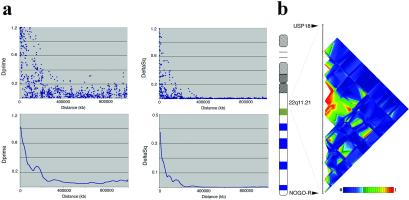
Fig. 1.
Fig. 1.
(a) Decay of LD at the 22q11 locus. (Upper) Scatter plot of D′ and Δ2 values vs. physical distance. Values were calculated on the basis of the haplotype frequencies estimated by using partial phase information in the 106 unrelated AS trios. (Lower) Sliding window averages of disequilibrium coefficients. (b) Distribution of pair-wise disequilibrium (D′) across the 22q11 locus. Multiple pair-wise comparisons are shown with D′ statistics color coded (bright red and bright blue are opposite ends of the scale) and plotted at the marker locations.
Fig. 2.
Fig. 2.
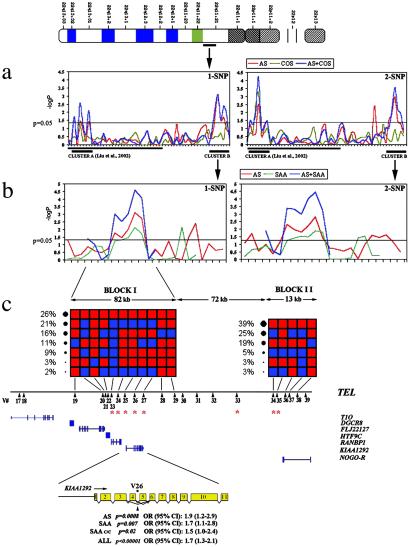
(a) Single SNP and 2-SNP HHRR P values (−log10) across the 22q11 locus. The solid line underneath the x axis indicates the SNPs presented in Liu et al. (15). The remaining SNPs are detailed in Table 2 (blue shading). The two clusters of significant SNP association across the entire 22q11 locus (Clusters A and B) are also underlined. The AS and COS samples were analyzed both separately and as a combined sample, because they originated from the same geographical area (U.S.). Distances are not to scale. (b) Detailed view of HHRR significance levels at Cluster B when additional SNPs were genotyped in the vicinity of the initial association shown in a. Detailed description can be found in Table 2. The family samples used for this analysis were the AS and SAA, as well as a combination of the two (see text). Distances are not to scale. (c) Haplotypic structure of Cluster B. Two haplotypic BLOCKs (I and II) are shown. Red squares indicate major and blue squares minor alleles. Observed haplotype frequencies are shown on the side of each block. The variant number (V#) is indicated at the bottom, and each variant's position relative to the genes residing in this region is also approximately indicated. Asterisks indicate SNPs showing significant association with schizophrenia in the AS and/or SAA samples. The position of the most significantly associated SNP (V26) within intron 4 of the KIAA1292 candidate gene is indicated along with the associated P values and odds ratios (approximate relative risks). Blue bars represent the approximate distribution of exons.
Fig. 3.
Fig. 3.
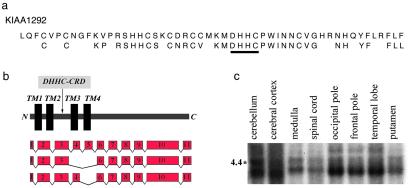
(a) Examination of the deduced KIAA1292 polypeptide sequence shows a new form of cysteine-rich domain called DHHC-CRD that includes a DHHC motif consisting of the amino acids Asp-His-His-Cys (DHHC) and a cysteine-rich domain (CRD) that includes a Cys4 zinc-finger-like metal binding site. The sequence for the KIAA1292 DHHC-CRD as well as a consensus sequence for this domain (32) are indicated. (b) Alternative splice forms of the KIAA1292 gene. Note that the DHHC-CRD is largely part of the loop between adjacent TM2 and TM3 (TM, transmembrane). (c) Brain expression of the KIAA1292 gene.

References

    1. Scambler P. J. (2000) Hum. Mol. Genet. 9, 2421-2426. - PubMed
    1. Pulver A. E., Nestadt, G., Goldberg, R., Shprintzen, R. J., Lamacz, M., Wolyniec, P. S., Morrow, B., Karayiorgou, M., Antonarakis, S. E., Housman, D., et al. (1994) J. Nerv. Ment. Dis. 182, 476-478. - PubMed
    1. Murphy K. C., Jones, L. A. & Owen, M. J. (1999) Arch. Gen. Psychiatry 56, 940-945. - PubMed
    1. American Psychiatric Association, (1994) Diagnostic and Statistical Manual of Mental Disorders (Am. Psychiatric Press, Washington, DC).
    1. du Montcel S. T., Mendizabal, H., Ayme, S., Levy, A. & Philip, N. (1996) J. Med. Genet. 33, 719. - PMC - PubMed

Publication types