. 2002 Dec;130(4):1626-35.
doi: 10.1104/pp.012179.

Contiguous genomic DNA sequence comprising the 19-kD zein gene family from maize

Affiliations

Contiguous genomic DNA sequence comprising the 19-kD zein gene family from maize

Rentao Song et al. Plant Physiol. 2002 Dec.

Abstract

A new approach has been undertaken to analyze the sequences and linear organization of the 19-kD zein genes in maize (Zea mays). A high-coverage, large-insert genomic library of the inbred line B73 based on bacterial artificial chromosomes was used to isolate a redundant set of clones containing members of the 19-kD zein gene family, which previously had been estimated to consist of 50 members. The redundant set of clones was used to create bins of overlapping clones that represented five distinct genomic regions. Representative clones containing the entire set of 19-kD zein genes were chosen from each region and sequenced. Seven bacterial artificial chromosome clones yielded 1,160 kb of genomic DNA. Three of them formed a contiguous sequence of 478 kb, the longest contiguous sequenced region of the maize genome. Altogether, these DNA sequences provide the linear organization of 25 19-kD zein genes, one-half the number previously estimated. It is suggested that the difference is because of haplotypes exhibiting different degrees of gene amplification in the zein multigene family. About one-half the genes present in B73 appear to be expressed. Because some active genes have only been duplicated recently, they are so conserved in their sequence that previous cDNA sequence analysis resulted in "unigenes" that were actually derived from different gene copies. This analysis also shows that the 22- and 19-kD zein gene families shared a common ancestor. Although both ancestral genes had the same incremental gene amplification, the 19-kD zein branch exhibited a greater degree of far-distance gene translocations than the 22-kD zein gene family.


Figures
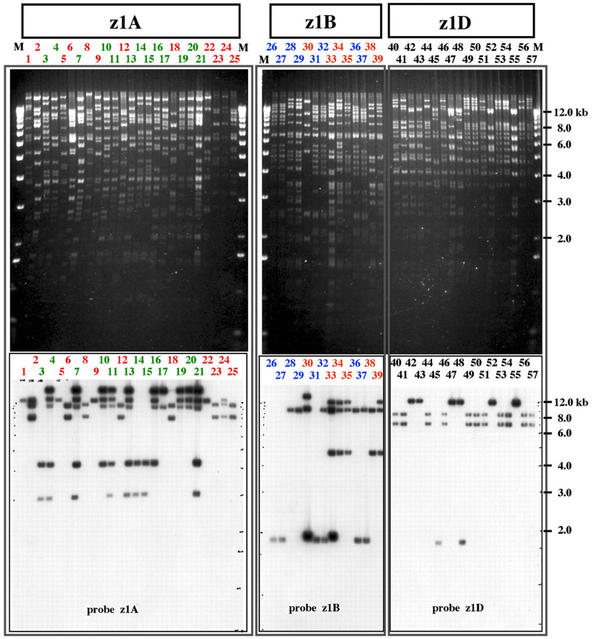
Figure 1
Figure 1
Fingerprinting and Southern-blot analysis of 19-kD-α-zein BAC clones. To maximize comparison, BAC clones were sorted into three groups, z1A, z1B, and z1D, according to different probes (three vertical panels in the figure). DNA was also fingerprinted by HindIII digestion and separated by 1% (w/v) agarose gel electrophoresis. After electrophoresis, the DNA restriction fragment pattern was recorded by a photo, as shown in the upper part of the figure. DNA from the agarose gel was subsequently blotted to nylon membranes and subjected to Southern-blot analysis using z1A-, z1B-, and z1D-specific probes. DNA fragment bands detected by specific probes were visualized by autoradiography as shown in the lower part of the figure. BAC clone designations correspond to those in Table I. M, DNA marker lane, in which a 1-kb DNA ladder was used. In the z1A and z1B panels, BAC clone designations were labeled by two different colors, indicating two different DNA fragment patterns within the group. Size rulers in kb are included on the right side of the picture.
Figure 2
Figure 2
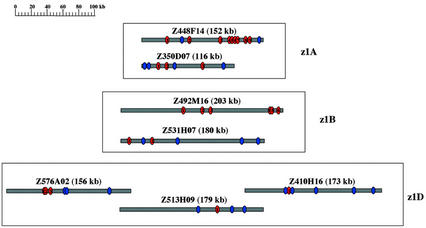
The distribution of 19-kD α-zein genes in different BAC clones. Each BAC clone was presented as a bar with the clone name and size (in parentheses) above it. BAC clones were orientated according to the transcriptional direction of 19-kD zein genes (all from 5′ to 3′). BAC clones were sorted by z1A, z1B, and z1D three subfamilies, as indicated with three boxed sections in the figure. A ruler with size in kb is shown at the left upper corner of the figure. Along the bars, red ovals indicate 19-kD zein genes, and the numbers within them indicate their order from 5′ to 3′ in each BAC clone, corresponding to their gene names in Table IV. Blue ovals indicate the position of other predicted genes.
Figure 3
Figure 3
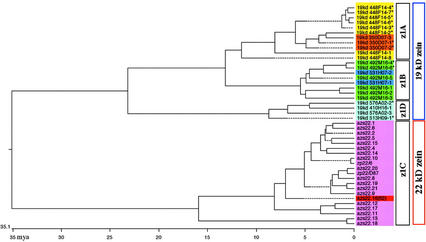
Phylogenetic analysis of the maize α-zein genes. The coding regions of maize α-zein (19- and 22-kD zein) genes were aligned by the Clustal method to generate a phylogenetic tree. Two 19-kD zein genes with large sequence truncation (Z448F14-9 and Z576A02-1) were not included in this study. The 19-kD zein genes with an asterisk on their names mark those with intact coding regions. The data of 22-kD zein genes came from our previous study (Song et al., 2001). The two major clades in the figure correspond to 19-kD zein genes (top) and 22-kD zein genes (bottom). The 19-kD zein gene clade is split into three smaller clades, corresponding to the three subfamilies z1A, z1B, and z1D, respectively. The 22-kD zein gene clade contains a single subfamily z1C. Gene names were color coded according to their relationship within the different genomic locations: Z448F14 (yellow), Z350D07 (orange), Z492M16 (green), Z531H07 (blue), z1D contigs (light blue), z1C gene cluster (pink), and fl2 locus (red). A ruler in the bottom of the figure provides an estimated evolutionary time scale in million years ago (mya).

References

    1. Altschul SF, Gish W, Miller W, Myers EW, Lipman DJ. Basic local alignment search tool. J Mol Biol. 1990;21:5403–5410. - PubMed
    1. Arabidopsis Genome Initiative. Analysis of the genome sequence of the flowering plant Arabidopsis thaliana. Nature. 2000;408:796–815. - PubMed
    1. Arumunganathan K, Earle ED. Nuclear DNA content of some important plant species. Plant Mol Biol Rep. 1991;9:208–219.
    1. Bender W, Spierer P, Hogness DS. Chromosomal walking and jumping to isolate DNA from the Ace and rosy loci and the bithorax complex in Drosophila melanogaster. J Mol Biol. 1983;168:17–33. - PubMed
    1. Burr B, Burr FA. Zein synthesis in maize endosperm by polyribosomes attached to protein bodies. Proc Natl Acad Sci USA. 1976;73:515–519. - PMC - PubMed

Publication types

LinkOut - more resources