


Temperature response of mesophyll conductance. Implications for the determination of Rubisco enzyme kinetics and for limitations to photosynthesis in vivo
- PMID: 12481082
- PMCID: PMC166710
- DOI: 10.1104/pp.008250
Temperature response of mesophyll conductance. Implications for the determination of Rubisco enzyme kinetics and for limitations to photosynthesis in vivo
Abstract
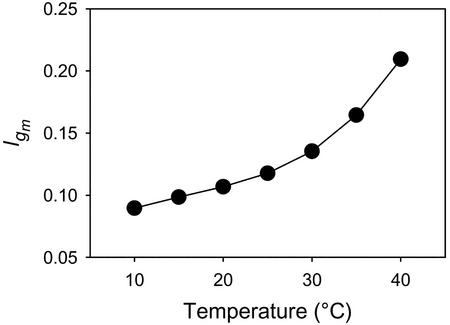
CO(2) transfer conductance from the intercellular airspaces of the leaf into the chloroplast, defined as mesophyll conductance (g(m)), is finite. Therefore, it will limit photosynthesis when CO(2) is not saturating, as in C3 leaves in the present atmosphere. Little is known about the processes that determine the magnitude of g(m). The process dominating g(m) is uncertain, though carbonic anhydrase, aquaporins, and the diffusivity of CO(2) in water have all been suggested. The response of g(m) to temperature (10 degrees C-40 degrees C) in mature leaves of tobacco (Nicotiana tabacum L. cv W38) was determined using measurements of leaf carbon dioxide and water vapor exchange, coupled with modulated chlorophyll fluorescence. These measurements revealed a temperature coefficient (Q(10)) of approximately 2.2 for g(m), suggesting control by a protein-facilitated process because the Q(10) for diffusion of CO(2) in water is about 1.25. Further, g(m) values are maximal at 35 degrees C to 37.5 degrees C, again suggesting a protein-facilitated process, but with a lower energy of deactivation than Rubisco. Using the temperature response of g(m) to calculate CO(2) at Rubisco, the kinetic parameters of Rubisco were calculated in vivo from 10 degrees C to 40 degrees C. Using these parameters, we determined the limitation imposed on photosynthesis by g(m). Despite an exponential rise with temperature, g(m) does not keep pace with increased capacity for CO(2) uptake at the site of Rubisco. The fraction of the total limitations to CO(2) uptake within the leaf attributable to g(m) rose from 0.10 at 10 degrees C to 0.22 at 40 degrees C. This shows that transfer of CO(2) from the intercellular air space to Rubisco is a very substantial limitation on photosynthesis, especially at high temperature.
Figures


References
-
- Badger MR. Photosynthetic oxygen exchange. Annu Rev Plant Physiol. 1985;36:27–53.
-
- Bernacchi CJ, Singsaas EL, Pimentel C, Portis AR, Long SP. Improved temperature response functions for models of Rubisco-limited photosynthesis. Plant Cell Environ. 2001;24:253–259.
Publication types
MeSH terms
Substances
LinkOut - more resources
Full Text Sources
Miscellaneous
