Heart failure and the aging population: an increasing burden in the 21st century?
- PMID: 12482791
- PMCID: PMC1767504
- DOI: 10.1136/heart.89.1.49
Heart failure and the aging population: an increasing burden in the 21st century?
Abstract
Background: Despite an overall decline in age adjusted mortality from coronary heart disease in developed countries, the number of patients with heart failure may be increasing.
Objective: To project the future burden of heart failure in Scotland from contemporary epidemiological data.
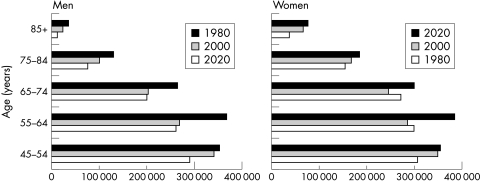
Methods: Scotland, like many industrialised countries, has an aging though numerically stable population (5.1 million). Current estimates of prevalence, general practice (GP) consultation rates, and hospital admission rates related to heart failure were applied to the whole Scottish population. These estimates were then projected over the period 2000 to 2020, on an age and sex specific basis, using expected changes in the age structure of the Scottish population.
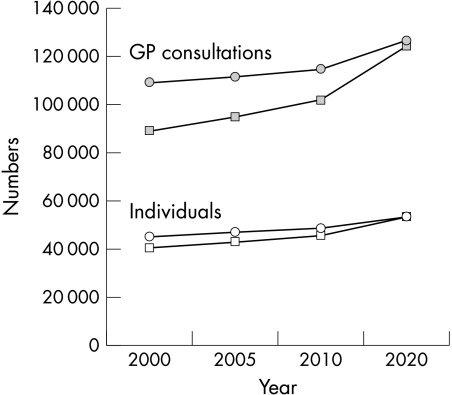
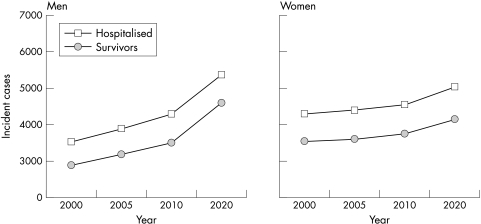
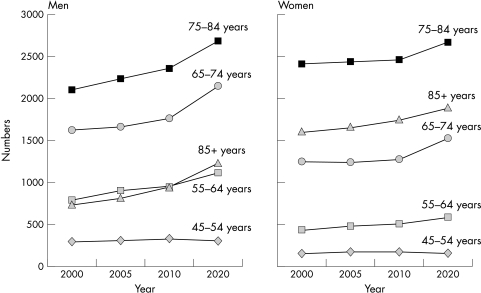
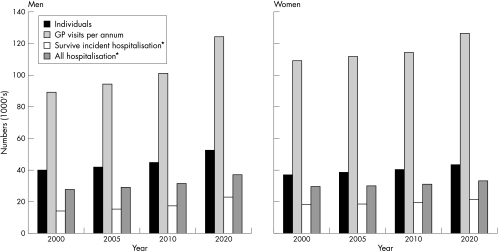
Results: There are currently estimated to be 40 000 men and 45 000 women aged > or = 45 years with heart failure in Scotland. On the basis of population changes alone, these figures will rise in men and women by 2300 (6%) and 1500 (3%) by year 2005, and by 12 300 (31%) and 7800 (17%) in the longer term (2020), respectively. On the same basis, the annual number of male and female GP visits is likely to rise by 6400 (6%) and 2500 (2%) by year 2005, and by 35 200 (40%) and 17 300 (16%) in the longer term (124 000 and 126 000 visits), respectively. In the year 2000 about 3500 men and 4300 women in Scotland had an incident hospital admission for heart failure. By the year 2020 these figures are likely to increase by 52% (1800 more) and 16% (717 more) in men and women, respectively. If recent trends in short term case fatality rates continue to improve, the number of men who survive this event will increase by 59% (1700 more). Overall, by 2020 the annual number of male and female hospital admissions associated with a principal diagnosis of heart failure is expected to increase by 34% (from 5500 to 7500) and by 12% (from 7800 to 8500), respectively.
Conclusions: Unless rapid and major changes occur in the incidence of heart failure, the burden of this disorder will continue to increase in both primary and secondary care over the next two decades. The greatest increase is likely to occur in men. Future health service planning must take this into account.
Figures
References
-
- Kelly DT. Disease burden of cardiovascular disease in the elderly. Coron Artery Dis 1997;8:667–9. - PubMed
-
- Tunstall-Pedoe H, Kuulasmaa K, Mahonen M, et al. Contribution of trends in survival and coronary-event rates to changes in coronary heart disease mortality: 10-year results from 37 WHO MONICA project populations. Monitoring trends and determinants in cardiovascular disease. Lancet 1999;353:1547–57. - PubMed
-
- Goldberg RJ, Yarzebski J, Lessard D, et al. A two-decades (1975 to 1995). Long experience in the incidence, in-hospital and long-term case-fatality rates of acute myocardial infarction: a community-wide perspective. J Am Coll Cardiol 1999;33:1533–9. - PubMed
Publication types
MeSH terms
LinkOut - more resources
Full Text Sources
Other Literature Sources
Medical