. 2002 Dec 24;99(26):16537-42.
doi: 10.1073/pnas.262420099. Epub 2002 Dec 13.

Chemical complementation: a reaction-independent genetic assay for enzyme catalysis

Affiliations

Chemical complementation: a reaction-independent genetic assay for enzyme catalysis

Kathleen Baker et al. Proc Natl Acad Sci U S A. .

Abstract

A high-throughput assay for enzyme activity has been developed that is reaction independent. In this assay, a small-molecule yeast three-hybrid system is used to link enzyme catalysis to transcription of a reporter gene in vivo. Here we demonstrate the feasibility of this approach by using a well-studied enzyme-catalyzed reaction, cephalosporin hydrolysis by the Enterobacter cloacae P99 cephalosporinase (beta-lactam hydrolase, EC ). We show that the three-hybrid system can be used to read out cephalosporinase activity in vivo as a change in the level of transcription of a lacZ reporter gene and that the wild-type cephalosporinase can be isolated from a pool of inactive mutants by using a lacZ screen. The assay has been designed so that it can be applied to different chemical reactions without changing the components of the three-hybrid system. A reaction-independent high-throughput assay for protein function should be a powerful tool for protein engineering and enzymology, drug discovery, and proteomics.


Figures
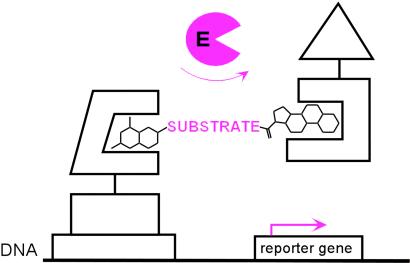
Fig 1.
Fig 1.
Chemical complementation. A reaction-independent complementation assay for enzyme catalysis based on the yeast three-hybrid assay. A heterodimeric small molecule bridges a DNA-binding domain–receptor fusion protein and an activation domain–receptor fusion protein, activating transcription of a downstream reporter gene in vivo. Enzyme catalysis of either cleavage or formation of the bond between the two small molecules can be detected as a change in transcription of the reporter gene. The assay can be applied to new chemical reactions simply by synthesizing small molecules with different substrates as linkers and adding an enzyme as a fourth component to the system.
Fig 2.
Fig 2.
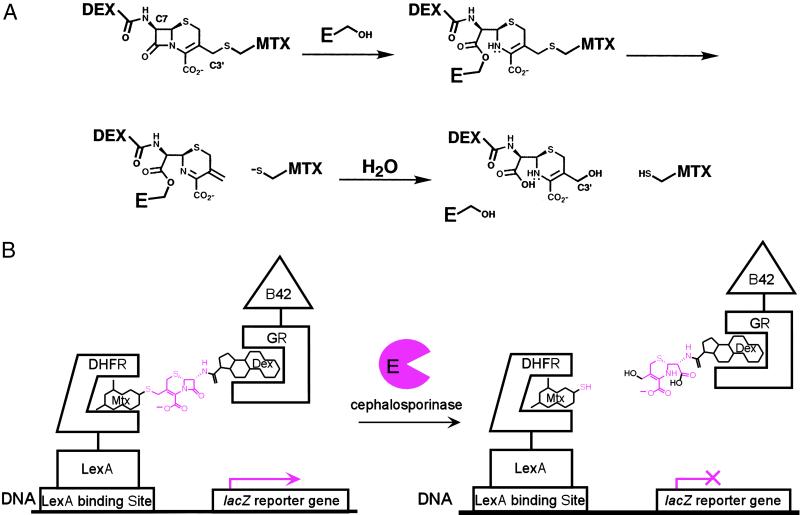
Cephalosporinase model reaction. Cephalosporin hydrolysis provides a simple cleavage reaction to demonstrate the complementation strategy. (A) Cephalosporin hydrolysis by a cephalosporinase enzyme. Cephalosporinases are serine-protease enzymes and catalyze the hydrolysis of cephalosporin antibiotics by means of an acyl-enzyme intermediate. Hydrolysis of the β-lactam bond in Mtx-Cephem-Dex results in expulsion of the leaving group at the C3′ position of the cephem core, effectively breaking the bond between Mtx and Dex. (B) Cephalosporin hydrolysis by the cephalosporinase enzyme disrupts transcription of a lacZ reporter gene. The Mtx-Cephem-Dex substrate dimerizes a LexA DNA-binding domain-dihydrofolate reductase (LexA-DHFR) and a B42 activation domain-glucocorticoid receptor (B42-GR) fusion protein, activating transcription of a lacZ reporter gene. Addition of active cephalosporinase enzyme results in cleavage of the Mtx-Cephem-Dex substrate and disruption of lacZ transcription.
Scheme 1.
Scheme 1.
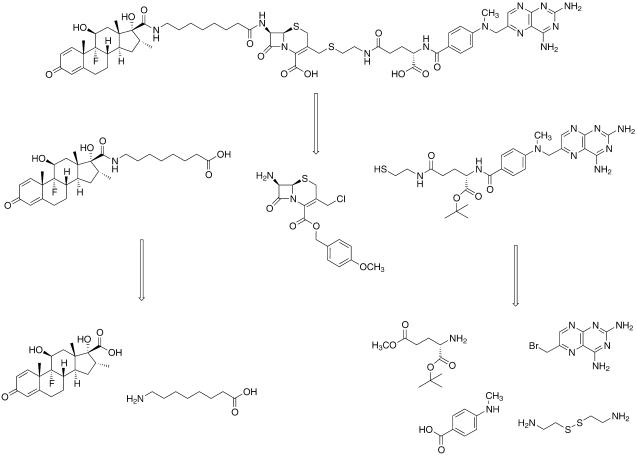
Met-Cephem-Dex retrosynthetic analysis.
Fig 3.
Fig 3.
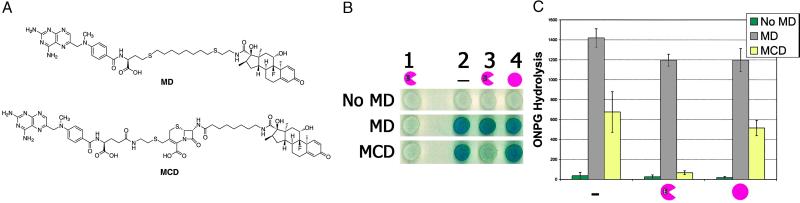
Chemical complementation links enzyme catalysis to reporter gene transcription. (A) Structures of the Mtx-Dex (MD) and Mtx-Cephem-Dex (MCD) heterodimers. (B) X-Gal plate assays of cephalosporinase-dependent Mtx-Cephem-Dex-induced lacZ transcription. Yeast strains containing a lacZ reporter gene were grown on X-Gal indicator plates with or without Mtx-linker-Dex molecules as indicated. Columns 1–4 correspond to yeast strains containing a LexA DNA-binding domain fusion protein, a B42 activation domain fusion protein, and enzyme, as follows: Column 1, LexA-DHFR, B42, P99 cephalosporinase. Plates in column 1 lack GR and are used as negative controls. Column 2, LexA-DHFR, B42-GR, no enzyme; column 3, LexA-DHFR, B42-GR, P99 cephalosporinase; and column 4, LexA-DHFR, B42-GR, P99 Ser-64 → Ala cephalosporinase. The rows correspond to individual X-Gal plates, which have different small molecules as indicated: No MD, No Mtx-Dex; MD, 1 μM Mtx-Dex; MCD, 10 μM Mtx-Cephem-Dex. (C) ONPG liquid assays. Yeast strains expressing the LexA-DHFR and B42-GR fusion proteins and containing a lacZ reporter gene and expressing no enzyme (left), P99 cephalosporinase (center), or P99 Ser-64 → Ala cephalosporinase (right) were grown in liquid culture and assayed for β-galactosidase activity with ONPG as a substrate. The liquid culture contained small molecules as indicated. The assays were done in triplicate. ONPG hydrolysis rates are reported as nmol/min per mg of total protein, and the error bars for the specific activity correspond to the standard deviation from the mean. Strains containing the active P99 cephalosporinase showed an 8-fold decrease in the level of lacZ transcription relative to strains containing the inactive Ser-64 → Ala variant.
Fig 4.
Fig 4.
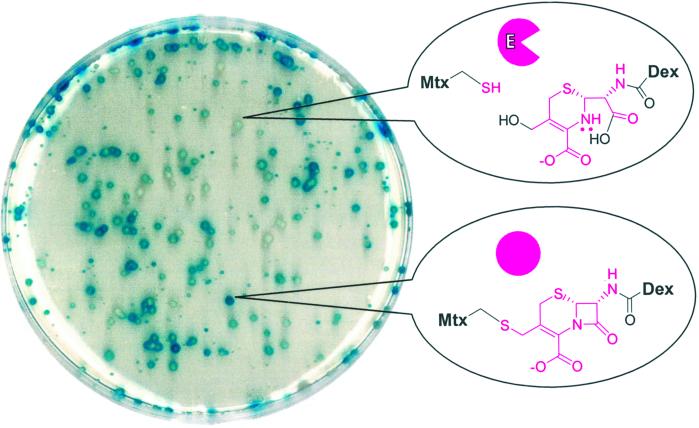
High-throughput chemical complementation screen. Active enzyme can be isolated from a pool of inactive mutants. The yeast selection strain was transformed with a 5:95 mixture of plasmids encoding the wild-type active cephalosporinase enzyme and the inactive Ser-64 → Ala cephalosporinase variant, respectively, and then plated onto an X-Gal indicator plate containing 10 μM Mtx-Cephem-Dex. Cells containing the active enzyme could be distinguished on the basis of the levels of X-Gal hydrolysis and hence lacZ transcription.

Comment in

  • Gene function: getting specific, generally speaking.
    Michnick SW, Valois FX. Michnick SW, et al. Proc Natl Acad Sci U S A. 2002 Dec 24;99(26):16513-5. doi: 10.1073/pnas.012697899. Epub 2002 Dec 16. Proc Natl Acad Sci U S A. 2002. PMID: 12486243 Free PMC article. No abstract available.

References

    1. Arnold F. (2001) Nature 409, 253-257. - PubMed
    1. Lin H. & Cornish, V. W. (2002) Angew. Chem. 114, 4580-4606.; (2002) Angew. Chem. Int. Ed. 41, 4402–4425. - PubMed
    1. Yano T., Oue, S. & Kagamiyama, H. (1998) Proc. Natl. Acad. Sci. USA 95, 5511-5515. - PMC - PubMed
    1. Joo H., Lin, Z. & Arnold, F. (1999) Nature 399, 670-673. - PubMed
    1. Baum E., Bebernitz, G. & Gluzman, Y. (1990) Proc. Natl. Acad. Sci. USA 87, 10023-10027. - PMC - PubMed

Publication types