


Disruption of T helper 2-immune responses in Epstein-Barr virus-induced gene 3-deficient mice
- PMID: 12482940
- PMCID: PMC139250
- DOI: 10.1073/pnas.252648899
Disruption of T helper 2-immune responses in Epstein-Barr virus-induced gene 3-deficient mice
Abstract
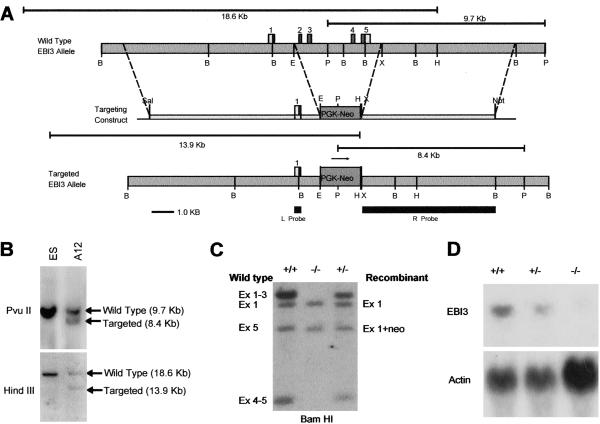
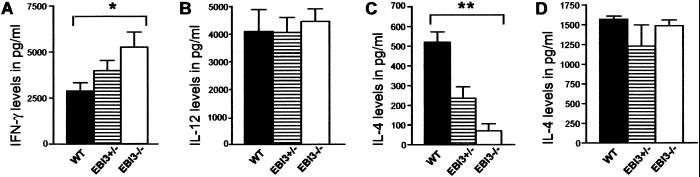
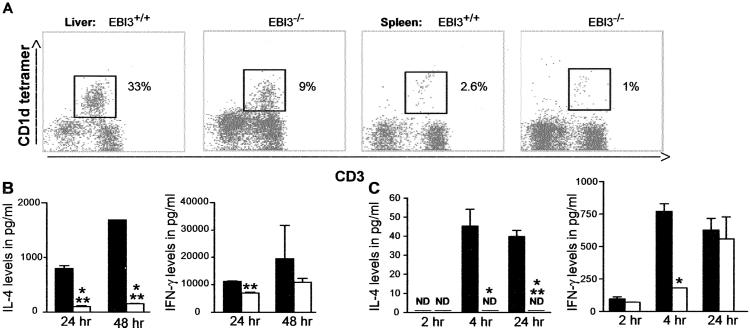
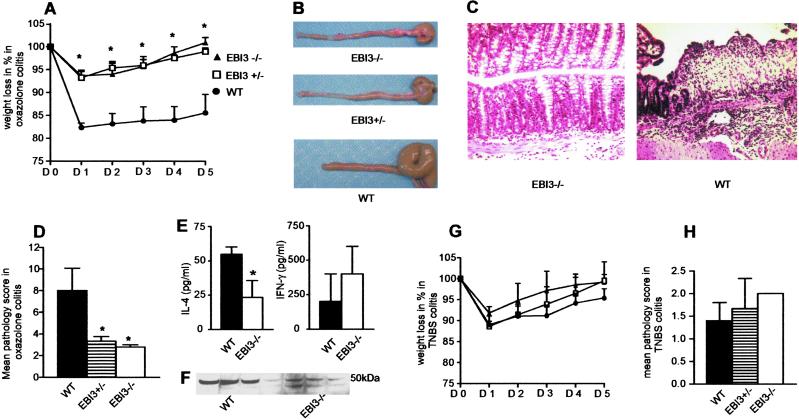
Epstein-Barr virus-induced gene 3 (EBI3) is a widely expressed IL-12p40-related protein that associates as a heterodimer with either IL-12p35 or an IL-12p35 homologue, p28, to create a new cytokine (IL-27). To define the function of EBI3 in vivo, we generated knockout mice in which the ebi3 gene was targeted by homologous recombination. EBI3-/- mice exhibited normal numbers of both naive and mature CD4+ and CD8+ T cells and B cells, but markedly decreased numbers of invariant natural killer T cells (iNKT) as defined by staining with an alpha-galactosylceramide (alphaGalCer)-loaded CD1d-tetramer. iNKT cells from EBI3-/- mice exhibited decreased IL-4 and, to a lesser extent, IFN-gamma production after alphaGalCer stimulation in vitro. A sustained decrease in IL-4 production was also observed in EBI3-/- mice after alphaGalCer stimulation in vivo in contrast to IFN-gamma production, which was only transiently decreased under such stimulation. Notably, EBI3-/- mice were resistant to the induction of immunopathology associated with oxazolone-induced colitis, a colitis model mediated primarily by T helper (Th) 2-type cytokine production by iNKT cells. In contrast, trinitrobenzene sulfonic acid-induced colitis, a predominantly Th1-mediated colitis model, was unaffected. Thus, EBI3 plays a critical regulatory role in the induction of Th2-type immune responses and the development of Th2-mediated tissue inflammation in vivo, which may be mediated through the control of iNKT cell function.
Figures
References
-
- Thierfelder W. E., van Deursen, J. M., Yamamoto, K., Tripp, R. A., Sarawar, S. R., Carson, R. T., Sangster, M. Y., Vignali, D. A., Doherty, P. C., Grosveld, G. C. & Ihle, J. N. (1996) Nature 382, 171-174. - PubMed
-
- Asnagli H. & Murphy, K. M. (2001) Curr. Opin. Immunol. 13, 242-247. - PubMed
-
- Tew J. G., Wu, J., Fakher, M., Szakal, A. K. & Qin, D. (2001) Trends Immunol. 22, 361-367. - PubMed
Publication types
MeSH terms
Substances
Grants and funding
LinkOut - more resources
Full Text Sources
Other Literature Sources
Molecular Biology Databases
Research Materials
