. 2002 Dec 15;22(24):10627-32.
doi: 10.1523/JNEUROSCI.22-24-10627.2002.

Mice lacking M2 and M3 muscarinic acetylcholine receptors are devoid of cholinergic smooth muscle contractions but still viable

Affiliations

Mice lacking M2 and M3 muscarinic acetylcholine receptors are devoid of cholinergic smooth muscle contractions but still viable

Minoru Matsui et al. J Neurosci. .

Abstract

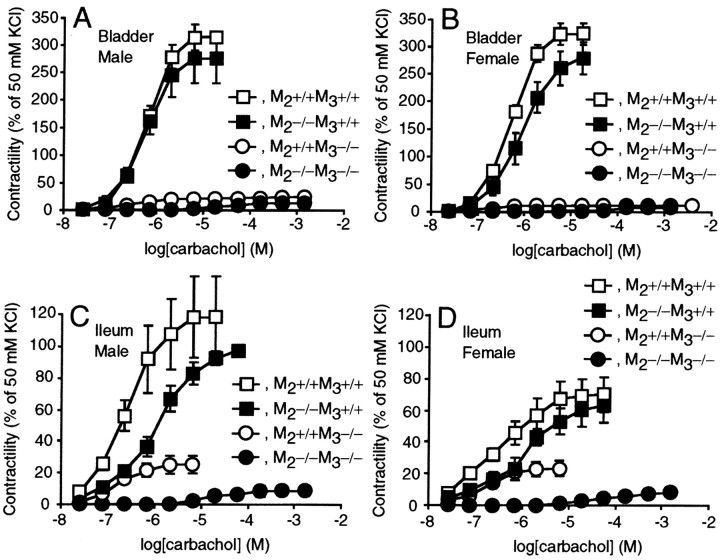
Cholinergic agents elicit prominent smooth muscle contractions via stimulation of muscarinic receptors that comprise five distinct subtypes (M1-M5). Although such contractions are important for autonomic organs, the role of each subtype has not been characterized precisely because of the poor selectivity of the currently available muscarinic ligands. Here, we generated a mutant mouse line (M2-/-M3-/- mice) lacking M2 and M3 receptors that are implicated in such cholinergic contractions. The relative contributions of M2 and M3 receptors in vitro was approximately 5 and 95% for the detrusor muscle contraction and approximately 25 and 75% for the ileal longitudinal muscle contraction, respectively. Thus, M1, M4, or M5 receptors do not seem to play a role in such contractions. Despite the complete lack of cholinergic contractions in vitro, M2-/-M3-/- mice were viable, fertile, and free of apparent intestinal complications. The urinary bladder was distended only in males, which excludes a major contribution by cholinergic mechanisms to the urination in females. Thus, cholinergic mechanisms are dispensable in gastrointestinal motility and female urination. After 10 Hz electrical field stimulation, noncholinergic inputs were found to be increased in the ileum of M2-/-M3-/- females, which may account for the lack of apparent functional deficits. Interestingly, the M2-/-M3-/- mice had smaller ocular pupils than M3-deficient mice. The results suggest a novel role of M2 in the pupillary dilation, contrary to the well known cholinergic constriction. These results collectively suggest that an additional mechanism operates in the control of pupillary constriction-dilatation.


Figures
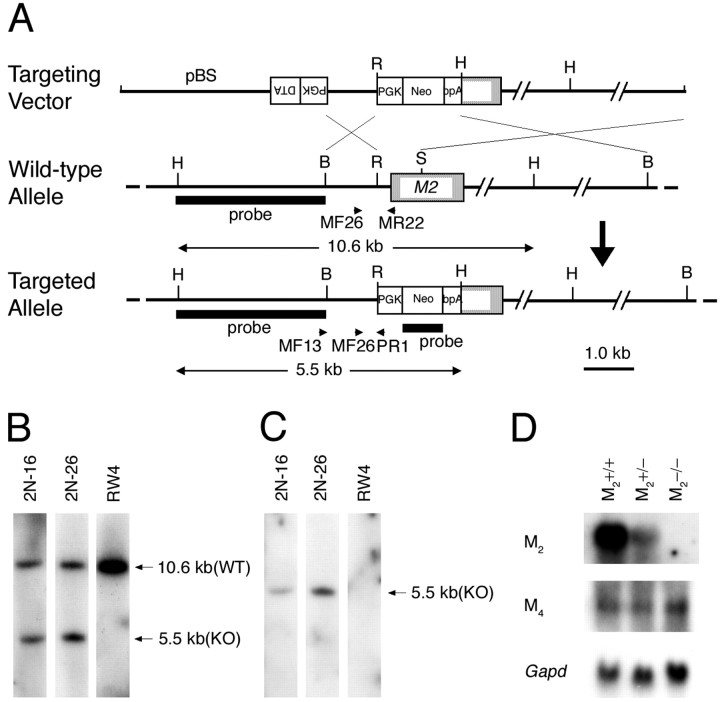
Fig. 1.
Fig. 1.
Generation of M2−/− mice.A, Targeting strategy. Arrows MF13 andPR1 indicate the PCR primers used for homologous recombinant screening, and arrows MF26,MR22, and PR1 indicate PCR primers used for genotyping. BamHI (B),HindIII (H),EcoRI (R), and SmaI (S) sites relevant to the identification of homologous recombinant clones are shown together with the expected sizes hybridizable to the M2 and the neoprobes. B, Hybridization with the M2 probe showing a 5.5 kb band specific to the targeted allele (KO) and a 10.6 kb band derived from the wild-type allele (WT). C, Hybridization with the neo probe showing a 5.5 kb band specific to the targeted allele. D, Northern analysis showing mRNA levels of M2 and M4 in the brains of wild-type, M2+/−, and M2−/− mice. Note that the M2 mRNA in the M2+/− brain decreased to approximately half of the wild-type brain and was absent in the M2−/− brain. The mRNA levels of M4 are not different among the three genotypes. Bottom, Signals hybridized with a Gapd probe used as an internal control.
Fig. 2.
Fig. 2.
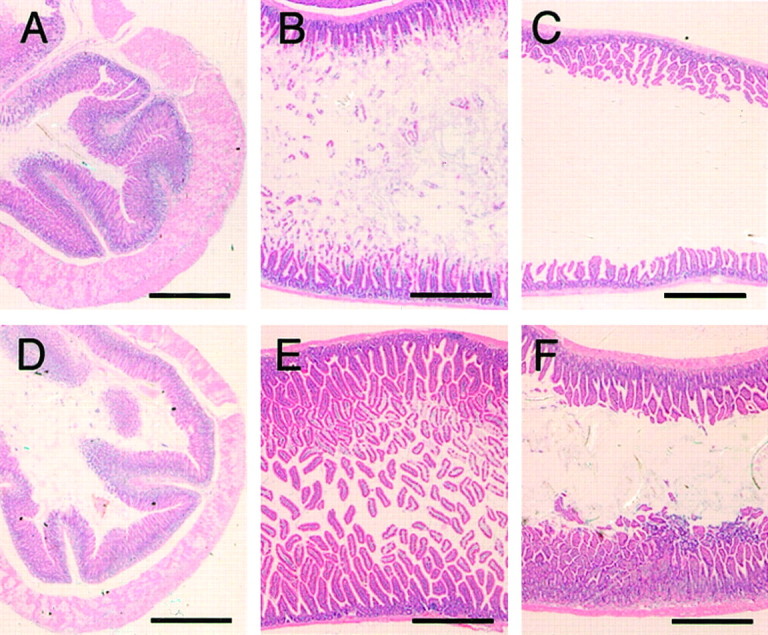
Normal histology of the gastrointestinal tract of M2−/−M3−/− mice. Sections of the stomach (A, D), jejunum (B, E), and ileum (C,F), stained with hematoxylin and eosin. Note that the diameter of the lumen and morphology of the muscular or mucosal layers are indistinguishable between the wild-type (AC) and the M2−/−M3−/− (DF) mice. Scale bars, 0.5 mm.
Fig. 3.
Fig. 3.
Abolished bladder (A,B) and ileal (C, D) smooth muscle contractions in response to carbachol in the M2−/−M3−/− mice. Responses to carbachol are shown (mean ± SEM) as percentages of those to 50 mmKCl in the male (A, C) wild-type, M2−/−, M3−/−, and M2−/−M3−/− mice and the female (B, D) wild-type, M2−/−, M3−/−, and M2−/−M3−/− mice. Each symbol represents the data of four experiments. The data of the M3−/− mice have been published previously (Matsui et al., 2000).
Fig. 4.
Fig. 4.
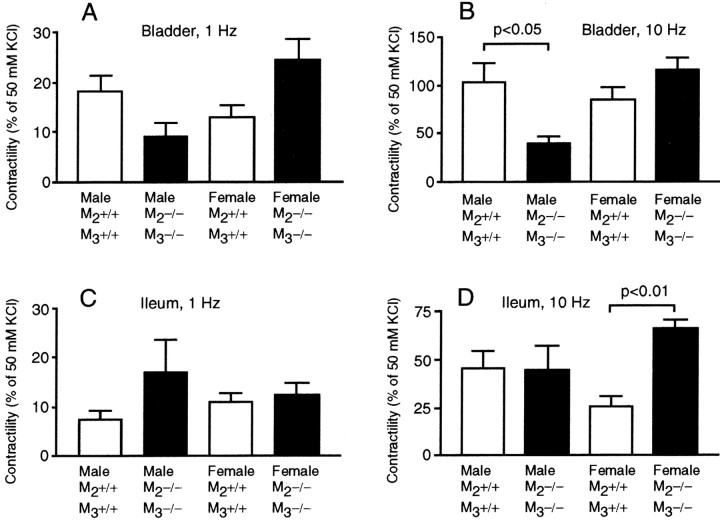
Noncholinergic contractile responses to EFS of the bladder (A, B) and ileal (C, D) smooth muscles. Responses to EFS (1 Hz, A, C; 10 Hz, B,D) are shown (mean with SEM; each bar represents the data from four mice) as percentages of those to 50 mmKCl.
Fig. 5.
Fig. 5.
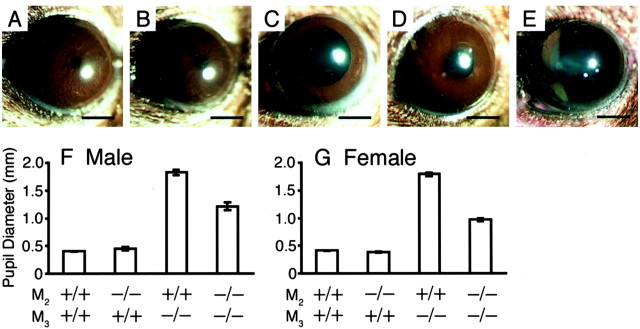
Appearance of pupils of the wild-type (A), M2−/− (B), M3−/− (C), and M2−/−M3−/− (D) mice. The pupils of the M2−/−M3−/− mice (D) are smaller than those of the M3−/− mice (C). Full mydriasis was achieved in the M2−/−M3−/− mouse after instillation of atropine solution (E). The pupils of the M2−/− mice (B) are indistinguishable from those of the wild-type mice (A). Scale bars, 1 mm. F,G, Pupil diameter (mean ± SEM;n = 4–30) of the mutant mice, measured in a bright room (∼1000 lux). The M2−/−M3−/− mice have smaller pupils than the M3−/− mice in both sexes.

References

    1. Andersson KE. The importance of the cholinergic system in neurourology. Eur Urol. 1998;34:6–9. - PubMed
    1. Arunlakshana O, Schild HO. Some quantitative uses of drug antagonists. Br J Pharmacol. 1959;14:48–58. - PMC - PubMed
    1. Bognar IT, Wesner MT, Fuder H. Muscarine receptor types mediating autoinhibition of acetylcholine release and sphincter contraction in the guinea-pig iris. Naunyn Schmiedebergs Arch Pharmacol. 1990;341:22–29. - PubMed
    1. Boschero AC, Szpak-Glasman M, Carneiro EM, Bordin S, Paul I, Rojas E, Atwater I. Oxotremorine-m potentiation of glucose-induced insulin release from rat islets involves M3 muscarinic receptors. Am J Physiol. 1995;268:E336–E342. - PubMed
    1. Burnstock G, Dumsday B, Smythe A. Atropine-resistant excitation of the urinary bladder: possibility of transmission via nerves releasing a purine nucleotide. Br J Pharmacol. 1972;44:451–461. - PMC - PubMed

Publication types

MeSH terms

LinkOut - more resources