. 2002 Dec 15;22(24):10864-70.
doi: 10.1523/JNEUROSCI.22-24-10864.2002.

Vocal control neuron incorporation decreases with age in the adult zebra finch

Affiliations

Vocal control neuron incorporation decreases with age in the adult zebra finch

Niangui Wang et al. J Neurosci. .

Abstract

In adult male zebra finches, high vocal center (HVC) neurons continuously die and are replaced. Many of these cells are projection neurons that form part of the efferent pathway controlling learned song production. Although it is known that HVC receives new neurons well into adulthood, it is unknown whether this occurs at a constant rate or declines with adult age. We used [3H]thymidine to label new HVC neurons in male zebra finches that were 3-36 months of age. Birds were killed 4 months after 3H injections to measure the long-term incorporation of new HVC neurons. HVC neurons projecting to the robust nucleus of the archistriatum (HVC-RA) were retrogradely labeled with Fluoro-Gold 4 d before death. We found a dramatic age-related decline in the number of 3H-labeled HVC-RA neurons present 4 months after cell birth dating. A similar decline in new HVC neurons was found as soon as 1 month after their formation. These results indicate that the production or early survival of adult-formed neurons decreases with age. HVC volume and total neuron number did not change with bird age, suggesting that the age-related decrease in new neuron addition was balanced by increased survivorship of neurons incorporated previously. Reliance of song structure on auditory feedback also wanes with age. We propose that with aging, fewer new cells are added as the numbers of functionally appropriate cells increase, a process that may be linked to age-related increases in motor program stability.


Figures
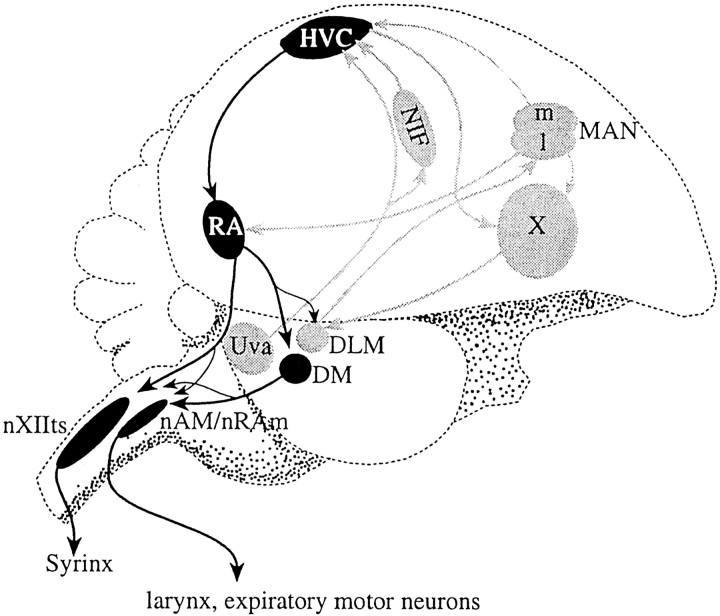
Fig. 1.
Fig. 1.
Schematic diagram of the major brain regions involved in song learning and control. The efferent pathway for song control is highlighted in black. Our main focus is the HVC and the neurons incorporated into the HVC that project to the RA.nAM, Nucleus ambiguus; DLM, medial portion of the dorsolateral nucleus of the thalamus; DM, dorsomedial nucleus of the intercollicular complex;lMAN, lateral subdivision of the magnocellular nucleus of the anterior neostriatum; mMAN, medial subdivision of the magnocellular nucleus of the anterior neostriatum;NIF, nucleus interface; nRAm, nucleus retroambigualis; Uva, nucleus uvaeformis;X, area X; nXIIts, tracheosyringeal part of the hypoglossal nucleus.
Fig. 2.
Fig. 2.
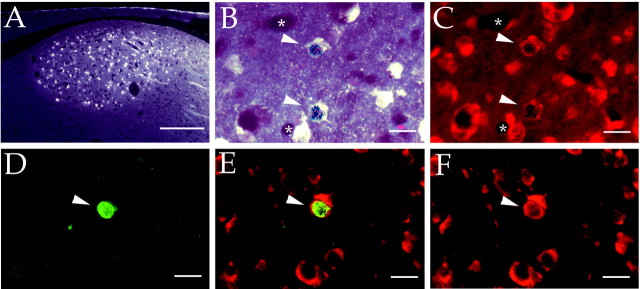
A, Low-magnification fluorescence (UV) photomicrograph of the HVC after retrograde labeling with Fluoro-Gold injections into the RA. B, Higher-power magnification of two HVC-RA projection neurons formed in adulthood (arrowheads) viewed with combined bright-field and UV illumination. These neurons have developed silver grains overlying their nucleus and Fluoro-Gold in their cytoplasm. C, Same view as in B, showing all cells counterstained with fluorescent cresyl violet and viewed under combined rhodamine fluorescence and bright-field optics. Arrowheads point to the same 3H-labeled neurons shown in B.Asterisks in B and C label blood vessels cut in cross section. D–F, The same field is shown using different fluorescence filters to reveal a cell double labeled with BrdU (green) and Hu (red; arrowheads). D, BrdU-labeled cell nucleus viewed under FITC fluorescence.E, Same field viewed with dual FITC–rhodamine filter. Cytoplasmic staining with the neuronal marker Hu surrounds the BrdU-labeled cell nucleus. F, Same field viewed under rhodamine fluorescence. Scale bars: A, 100 μm;B–F, 10 μm.
Fig. 3.
Fig. 3.
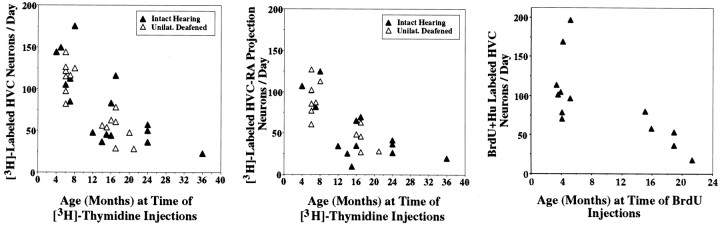
The number of [3H]thymidine-labeled neurons per day of treatment as a function of bird age at the time of injection (leftand middle). Birds were killed 4 months after [3H]thymidine injections. Eachtriangle represents one bird. Both hearing-intact birds and unilaterally deafened birds showed a decline in the total number of new HVC neurons. This was also true for adult-formed HVC-RA projection neurons (middle) identified by double labeling with [3H]thymidine and Fluoro-Gold. At 1 month after cell birth dating with BrdU, the number of new neurons double labeled with BrdU and Hu per day of BrdU injections also declined with bird age (right). These results indicate that the production or survival of new neurons while migrating or shortly after arrival in the HVC decreases with bird age.
Fig. 4.
Fig. 4.
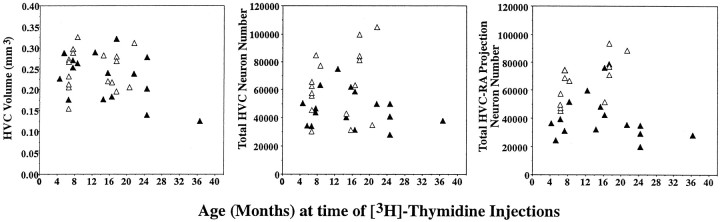
HVC volume (left), total neuron number (middle), and total HVC-RA projection neuron number (right) for all birds used in the 4 month survival study (Fig. 3), plotted as a function of age at the time of [3H]thymidine injections. Despite the dramatic age-related decline in adult-formed neuron number in these birds, HVC volume and the numbers of HVC neurons remained relatively stable with age.
Fig. 5.
Fig. 5.
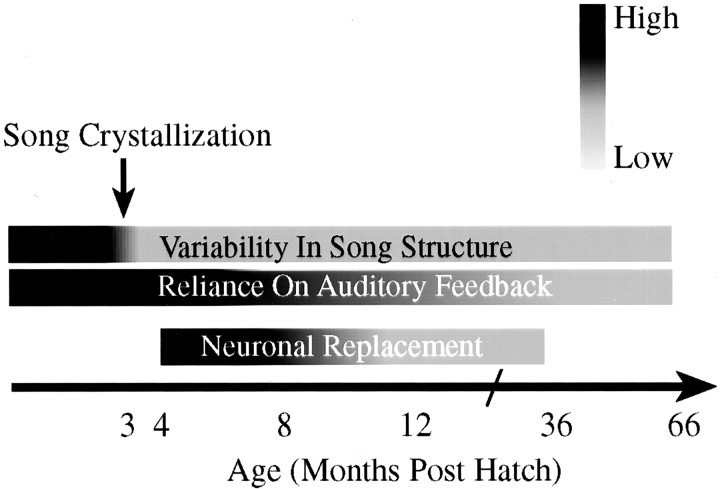
A model integrating previous behavioral work with the present results. Song crystallization occurs at ∼90 d after hatching. Before this age, song structure and amplitude are highly variable. After crystallization, song structure remains highly stereotyped throughout adulthood. However, even after song structure becomes stable, song stereotypy relies on the bird's ability to compare vocal output with song memories and make motor adjustments accordingly. Therefore, song stereotypy requires sensorimotor flexibility. With increasing adult age, the motor program for song becomes increasingly stable and independent of auditory feedback. Our results indicate that over the same interval, neuronal incorporation decreases, and the population of replaceable HVC neurons becomes more stable.

References

    1. Alvarez-Buylla A, Garcia-Verdugo JM. Neurogenesis in adult subventricular zone. J Neurosci. 2002;22:629–634. - PMC - PubMed
    1. Alvarez-Buylla A, Kirn JR. Birth, migration, incorporation, and death of vocal control neurons in adult songbirds. J Neurobiol. 1997;33:585–601. - PubMed
    1. Alvarez-Buylla A, Nottebohm F. Migration of young neurons in adult avian brain. Nature. 1988;335:353–354. - PubMed
    1. Alvarez-Buylla A, Kirn JR, Nottebohm F. Birth of projection neurons in adult avian brain may be related to perceptual or motor learning. Science. 1990;249:1444–1446. - PubMed
    1. Arnold AP. Effects of castration on song development in zebra finches (Poephila guttata). J Exp Zool. 1975;191:261–277. - PubMed

Publication types