


doi: 10.1073/pnas.262427799.
Epub 2002 Dec 16.
Photoresponsive polymer-enzyme switches
Affiliations
- PMID: 12486222
- PMCID: PMC139188
- DOI: 10.1073/pnas.262427799
Item in Clipboard
Photoresponsive polymer-enzyme switches
Proc Natl Acad Sci U S A.
.
Abstract
The ability to photoregulate enzyme activities could provide important new opportunities for development of diagnostic assays, sequential bioprocessing, and lab assays in both traditional and microfluidic formats. We show here that the photoinduced changes in the size and hydration of a "smart" polymer chain coil can be used to regulate substrate access and enzyme activity when conjugated to the enzyme at a specific point just outside the active site. The photoresponsive polymers thus serve jointly as antennae and actuators that reversibly respond to distinct optical signals to switch the polymer-enzyme conjugates on and off, and work when the conjugate is free in solution or when immobilized on magnetic beads.
Figures
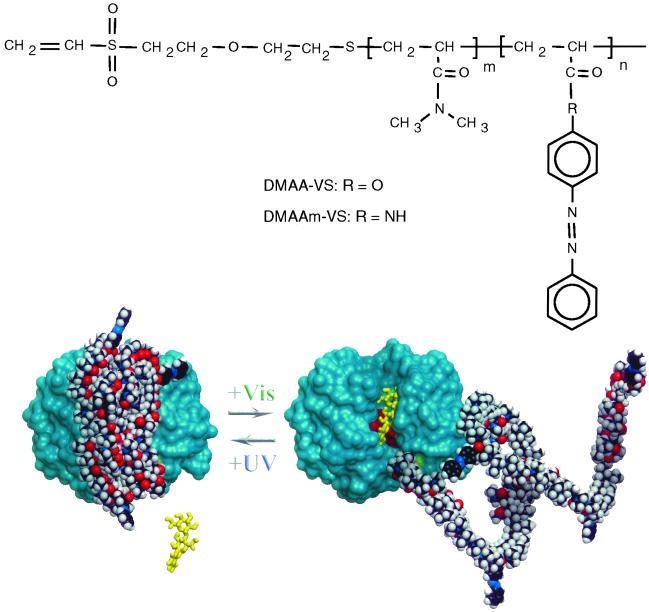
Schematic model for the photoresponsive enzyme switch. The photoresponsive copolymer compositions are shown with the end-modified vinyl sulfone terminus for thiol-specific conjugations. The 3D model of EG 12A displays the relative locations of position 55 (colored green with schematic polymer coil attached) and the catalytic active site residues D99, E116, and E200 shown in red. The ONPC substrate is shown schematically to show the orientation of the active site groove. The polymer coil is shown as a 10-kDa chain with a distribution of nine DMA monomers to one azobenzene monomer.
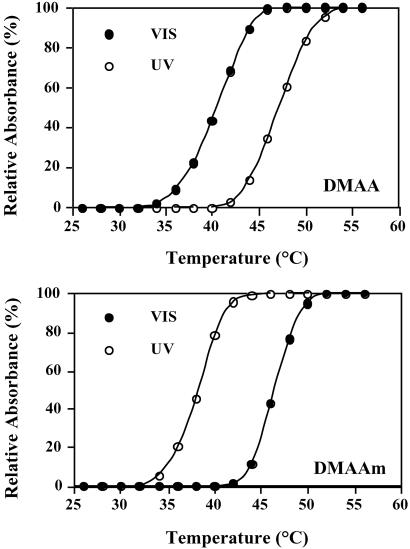
The LCST behavior under UV and VIS photoirradiation of the DMAA and DMAAm polymers used to construct EG 12A conjugates. The polymer concentration was 2 mg/ml in 100 mM phosphate buffer, pH 7.2.
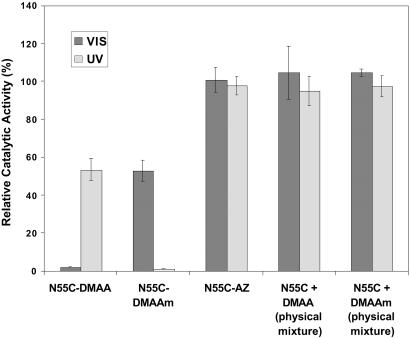
Photoinduced activity changes of N55C-DMAA, N55C-DMAAm, and N55C-AZ conjugates, along with control physical mixtures of the polymers and N55C EG 12A. The activity was measured for 100 nM conjugates using 8 mM ONPC as a substrate in 50 mM sodium acetate buffer, pH 5.5, at 45°C, and normalized to the activity of the unconjugated N55C EG 12A.
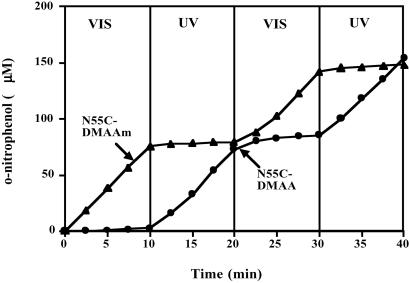
Sequential photoswitching of the activity of the N55C-DMAA and N55C-DMAAm conjugates. The product (o-nitrophenol) concentration was measured for 100 nM conjugates with free polymer present, using ONPC (8 mM) as a substrate 45°C in 50 mM sodium acetate buffer, pH 5.5.
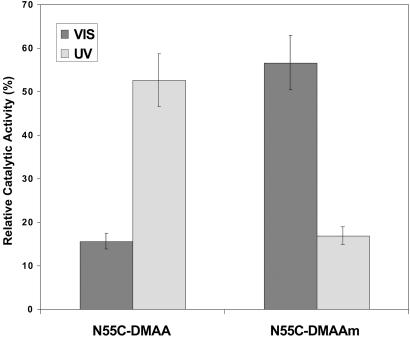
Photoinduced activity changes of N55C-DMAA and N55C-DMAAm conjugates when immobilized on streptavidin-coated magnetic beads. Conditions are described in Materials and Methods.
References
-
- Haupt W. (1983) Philos. Trans. R. Soc. London B 303, 467-478.
-
- Smith H., (1975) Photochrome and Photomorphogenesis (McGraw-Hill, London), pp. 22.
-
- Feher G., Allen, J. P., Okamura, M. Y. & Rees, D. C. (1989) Nature 339, 111-116.
-
- Stryer L. (1986) Am. Rev. Neurosci. 9, 87-119. - PubMed
-
- Willner I. & Rubin, S. (1996) Angew. Chem. Int. Ed. Engl. 35, 367-385.
Publication types
MeSH terms
Substances
Grants and funding
LinkOut - more resources
Full Text Sources
Other Literature Sources
Miscellaneous
