


Glutamine/proline-rich PQE-1 proteins protect Caenorhabditis elegans neurons from huntingtin polyglutamine neurotoxicity
- PMID: 12486229
- PMCID: PMC139281
- DOI: 10.1073/pnas.262544899
Glutamine/proline-rich PQE-1 proteins protect Caenorhabditis elegans neurons from huntingtin polyglutamine neurotoxicity
Abstract
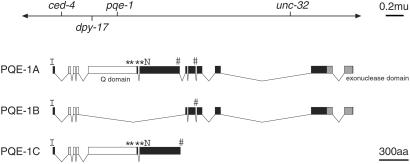
Huntington's disease is a progressive neurodegenerative disease caused by a polyglutamine (polyQ) repeat expansion in the huntingtin protein [Huntington's Disease Collaborative Research Group (1993) Cell 72, 971-983]. To understand the mechanism by which polyQ repeats cause neurodegeneration and cell death, we modeled polyQ neurotoxicity in Caenorhabditis elegans. In our model, expression of N-terminal fragments of human huntingtin causes polyQ-dependent degeneration of neurons. We conducted a genetic screen to identify proteins that protect neurons from the toxic effects of expanded polyQ tracts. Loss of polyQ enhancer-1 (pqe-1) gene function strongly and specifically exacerbates neurodegeneration and cell death, whereas overexpression of a pqe-1 cDNA protects C. elegans neurons from the toxic effects of expanded huntingtin fragments. A glutamineproline-rich domain, along with a charged domain, is critical for PQE-1 protein function. Analysis of pqe-1 suggests that proteins exist that specifically protect neurons from the toxic effects of expanded polyQ disease proteins.
Figures
References
-
- Zoghbi H. Y. & Orr, H. T. (2000) Annu. Rev. Neurosci. 23 217-247. - PubMed
-
- Huntington's Disease Collaborative Research Group (1993) Cell 72 971-983. - PubMed
-
- Strong T. V., Tagle, D. A., Valdes, J. M., Elmer, L. W., Boehm, K., Swaroop, M., Kaatz, K. W., Collins, F. S. & Albin, R. L. (1993) Nat. Genet. 5 259-265. - PubMed
-
- Vonsattel J. P., Myers, R. H., Stevens, T. J., Ferrante, R. J., Bird, E. D. & Richardson, E. P., Jr. (1985) J. Neuropathol. Exp. Neurol. 44 559-577. - PubMed
-
- Martin J. B. & Gusella, J. F. (1986) N. Engl. J. Med. 315 1267-1276. - PubMed
Publication types
MeSH terms
Substances
Grants and funding
LinkOut - more resources
Full Text Sources
Other Literature Sources
Medical
Molecular Biology Databases
