Flow cytometric assessment of susceptibilities of Streptococcus pyogenes to erythromycin and rokitamycin
- PMID: 12499226
- PMCID: PMC148962
- DOI: 10.1128/AAC.47.1.408-412.2003
Flow cytometric assessment of susceptibilities of Streptococcus pyogenes to erythromycin and rokitamycin
Abstract
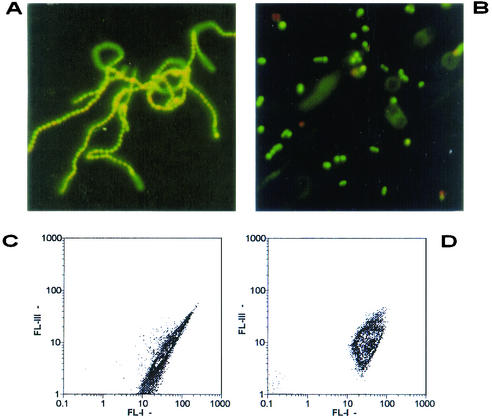
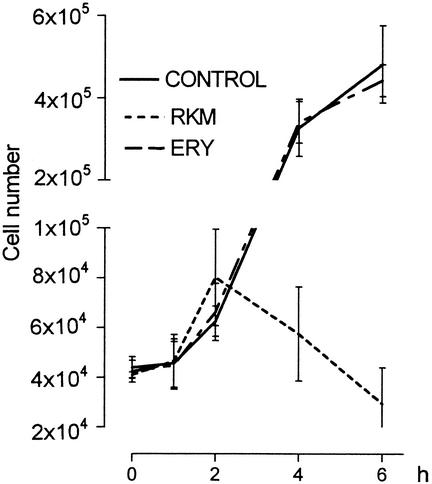
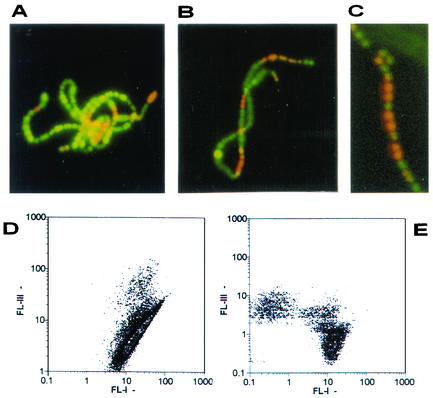
The effects of erythromycin (a 14-membered ring macrolide) and rokitamycin (a 16-membered ring macrolide) on the viability of the Streptococcus pyogenes M phenotype were studied by means of flow cytometry and fluorescence microscopy by using a combination of two fluorochromes (syto 9 and propidium iodide) that stains live bacteria green and dead bacteria red. In order to apply the flow cytometry, a bacterial sonication procedure was expressly set up to separate single cells from the long, intralaced S. pyogenes chains of up to 30 to 40 cells that have previously prevented the application of flow cytometry to this type of bacteria. The association of flow cytometry using an appropriate sonication procedure, together with a combination of fluorescent probes, offered the possibility of very quickly investigating the different microbiological effects of rokitamycin at 2 microg/ml, which was active on the S. pyogenes M phenotype, and of erythromycin at doses of up to 32 microg/ml, which was not.
Figures
References
-
- Allman, R., R. Manchee, and D. Lloyd. 1993. Flow cytometric analysis of heterogeneous bacterial populations, p. 27-47. In D. Lloyd (ed.), Flow cytometry in microbiology. Springer-Verlag, London, United Kingdom.
-
- Azimi, N. T., F. E. Lytle, D. M. Huber, J. E. Whitaker, and R. P. Haugland. 1990. Multiple reagent aminopeptidase profiling of bacteria. Appl. Spectrosc. 44:400-403.
-
- Boye, E., and H. B. Steen. 1993. The physical and biological basis for flow cytometry of Escherichia coli, p. 11-25. In D. Lloyd (ed.), Flow cytometry in microbiology. Springer-Verlag, London, United Kingdom.
-
- Braga, P. C. 2002. Rokitamycin: bacterial resistance to a 16-membered ring macrolide differs from that to 14- and 15-membered ring macrolides. J. Chemother. 14:115-131. - PubMed
Publication types
MeSH terms
Substances
LinkOut - more resources
Full Text Sources
Other Literature Sources