Diagnostic role of tests for T cell receptor (TCR) genes
- PMID: 12499424
- PMCID: PMC1769865
- DOI: 10.1136/jcp.56.1.1
Diagnostic role of tests for T cell receptor (TCR) genes
Abstract
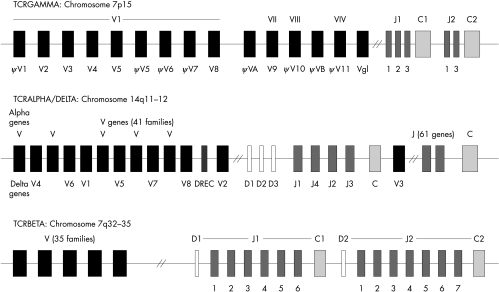
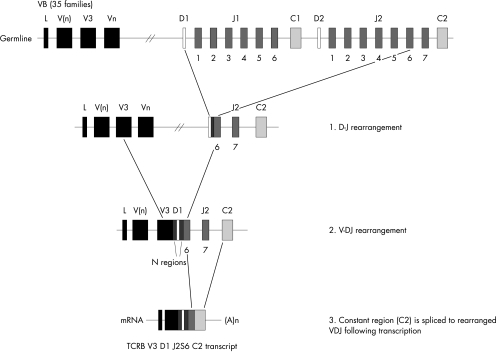
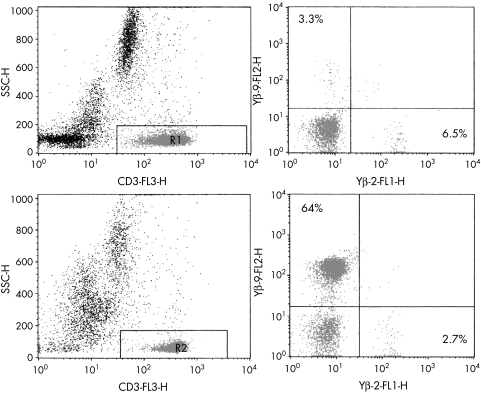
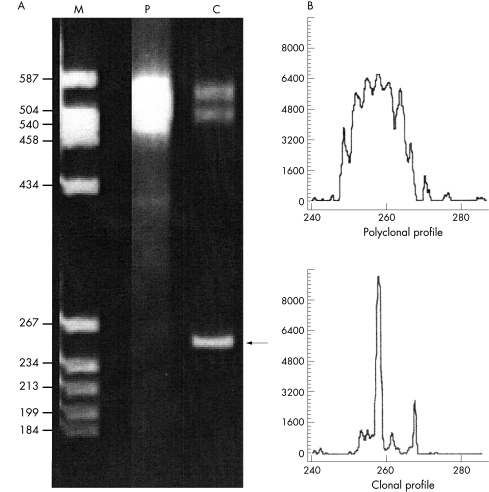
Rapid advances in molecular biological techniques have made it possible to study disease pathogenesis at a genomic level. T cell receptor (TCR) gene rearrangement is an important event in T cell ontogeny that enables T cells to recognise antigens specifically, and any dysregulation in this complex yet highly regulated process may result in disease. Using techniques such as Southern blot hybridisation, polymerase chain reaction, and flow cytometry it has been possible to characterise T cell proliferations in malignancy and in diseases where T cells have been implicated in the pathogenesis. The main aim of this article is to discuss briefly the process of TCR gene rearrangement and highlight the disorders in which expansions or clonal proliferations of T cells have been recognised. It will also describe various methods that are currently used to study T cell populations in body fluids and tissue, their diagnostic role, and current limitations of the methodology.
Figures
References
-
- Clevers H, Alarcon B, Wileman T, et al. The T cell receptor/CD3 complex: a dynamic protein ensemble. Annu Rev Immunol 1988;6:629–62. - PubMed
-
- Rudd CE, Janssen O, Cai YC, et al. Two-step TCR zeta/CD3-CD4 and CD28 signaling in T cells: SH2/SH3 domains, protein-tyrosine and lipid kinases. Immunol Today 1994;15:225–34. - PubMed
-
- Weiss A, Iwashima M, Irving B, et al. Molecular and genetic insights into T cell antigen receptor signal transduction. Adv Exp Med Biol 1994;365:53–62. - PubMed
-
- Esin S, Shigematsu M, Nagai S, et al. Different percentages of peripheral blood gamma delta + T cells in healthy individuals from different areas of the world. Scand J Immunol 1996;43:593–6. - PubMed
Publication types
MeSH terms
Substances
LinkOut - more resources
Full Text Sources
Other Literature Sources