. 2002 Dec 15;16(24):3186-98.
doi: 10.1101/gad.1032202.

Biological functions of the ISWI chromatin remodeling complex NURF

Affiliations

Biological functions of the ISWI chromatin remodeling complex NURF

Paul Badenhorst et al. Genes Dev. .

Abstract

The nucleosome remodeling factor (NURF) is one of several ISWI-containing protein complexes that catalyze ATP-dependent nucleosome sliding and facilitate transcription of chromatin in vitro. To establish the physiological requirements of NURF, and to distinguish NURF genetically from other ISWI-containing complexes, we isolated mutations in the gene encoding the large NURF subunit, nurf301. We confirm that NURF is required for transcription activation in vivo. In animals lacking NURF301, heat-shock transcription factor binding to and transcription of the hsp70 and hsp26 genes are impaired. Additionally, we show that NURF is required for homeotic gene expression. Consistent with this, nurf301 mutants recapitulate the phenotypes of Enhancer of bithorax, a positive regulator of the Bithorax-Complex previously localized to the same genetic interval. Finally, mutants in NURF subunits exhibit neoplastic transformation of larval blood cells that causes melanotic tumors to form.


Figures
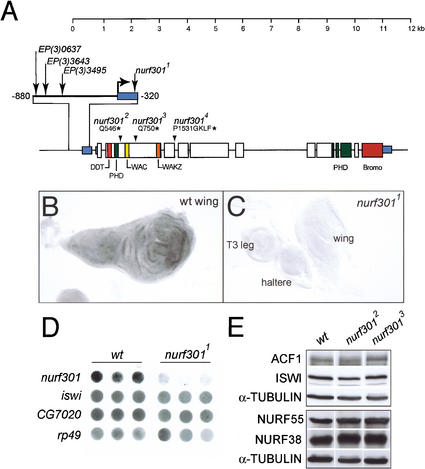
Figure 1
Figure 1
Characterization of nurf301 mutants. (A) The structure of the nurf301 locus, the position of P-element insertion lines, and the location of EMS-induced lesions are shown. nurf3012 and nurf3013 encode glutamine to stop codon changes at amino acids 546 and 750, respectively. nurf3014 contains a splice-donor site mutation that blocks splicing of the fourth intron. The aberrant transcript introduces four additional amino acids (GKLF) and an in-frame stop codon after proline residue 1531. (B,C) In situ hybridization using a 1.3-kb probe spanning the 3′ end of nurf301 (nucleotides 6800–8000) shows that ubiquitous expression of nurf301 is lost in homozygous mutant nurf3011 larvae (cf. wild-type and mutant third instar discs). (D) Dot-blot analysis of third larval instar total RNA (in triplicate) shows that nurf301 RNA is reduced in nurf3011 mutants relative to wild-type. In contrast, iswi and CG7020, a putative gene located upstream of nurf301 (a fragment from the EST clone LP07661 was used as a probe), are unaffected. rp49 provides a loading control. (E) Protein levels of the NURF subunits. NURF38, NURF55, and ISWI, and the ACF1 subunit of ACF are unchanged in nurf3012 and nurf3013 mutants, relative to α-TUBULIN as shown by Western analysis of extracts from third instar larvae.
Figure 2
Figure 2
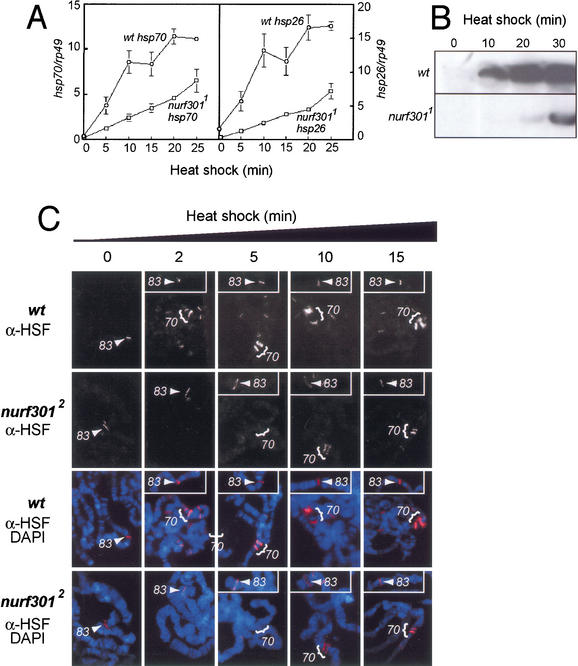
nurf301 is required for heat-shock gene induction. (A) A quantitation of RNA dot-blots shows delay in hsp26 and hsp70 transcription in nurf3011 mutant animals. hsp26 and hsp70 transcript levels are normalized to rp49. Points and bars represent the mean and standard deviation of three independent determinations. (B) Western blotting shows that HSP70 protein synthesis in homozygous mutant animals is reduced relative to the wild-type. (C) HSF was localized to the hsp70 loci (brackets) and hsp83 locus (arrowheads) on polytene chromosomes with antibodies against HSF, following 0-, 2-, 5-, 10- and 15-min heat-shock. HSF-binding to the major heat-shock loci is impaired in nurf3012 mutants.
Figure 3
Figure 3
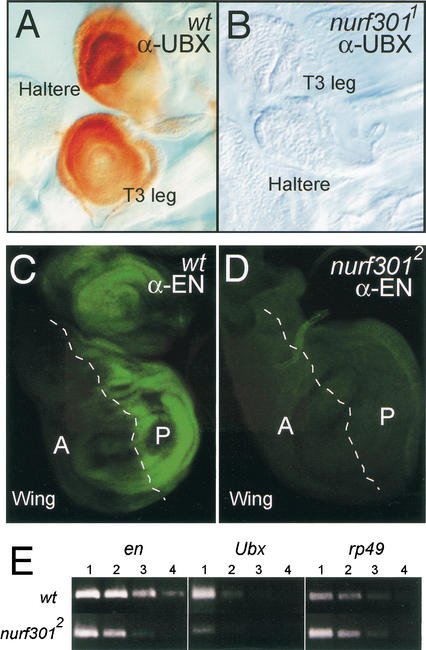
nurf301 is required for homeotic gene expression. (A,B) UBX protein in imaginal discs of the third thoracic segment (brown staining) is undetectable in nurf3011 homozygotes. (C,D) Antibody staining shows that EN protein (revealed in green), which normally can be detected in the posterior compartment of all imaginal discs, is lost in nurf3012 mutant larvae. (E) Semiquantitative RT–PCR analysis confirms that Ubx and en transcript abundance is reduced between 5- and 25-fold in total RNA isolated from nurf301 mutant animals. Lanes represent fivefold serial dilutions of mutant and wild-type total RNA (lane 1, 200 ng; lane 2, 40 ng; lane 3, 8 ng; and lane 4, 1.6 ng).
Figure 4
Figure 4
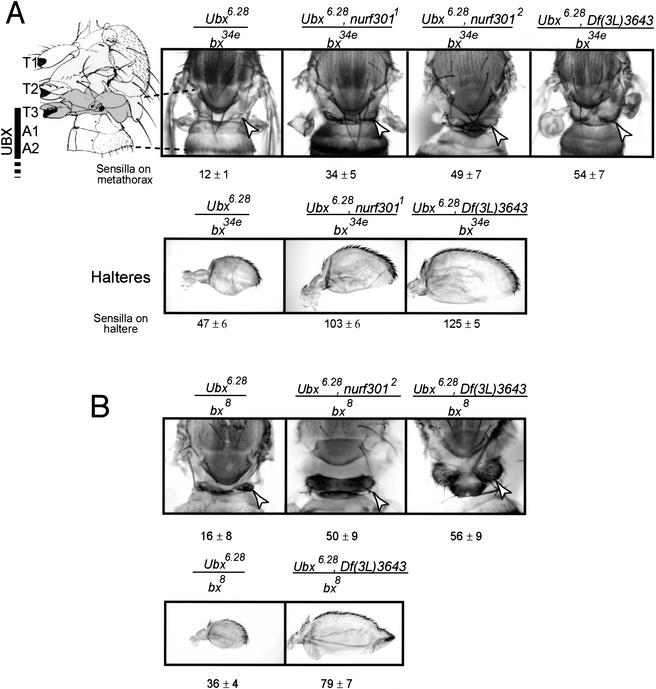
nurf301 corresponds to E(bx). In the presence of one copy of either nurf3011, nurf3012, or the nurf301 deficiency Df(3L)3643, the strength of the anterior transformation seen in bithorax mutant combinations is increased. Transformation is scored both by increases in the size and bristle number on the metathoracic segment and the severity of the haltere (T3) to wing (T2) transformation. A shows bx34e/Ubx6.28 combinations and B shows bx8/Ubx6.28 combinations. Mean haltere and T3 bristle numbers ± standard deviation for 20 flies of each genotype are indicated. Arrowheads denote the metathorax (T3). Photographs of nota are composites of three images taken at different focal planes of the animals.
Figure 5
Figure 5
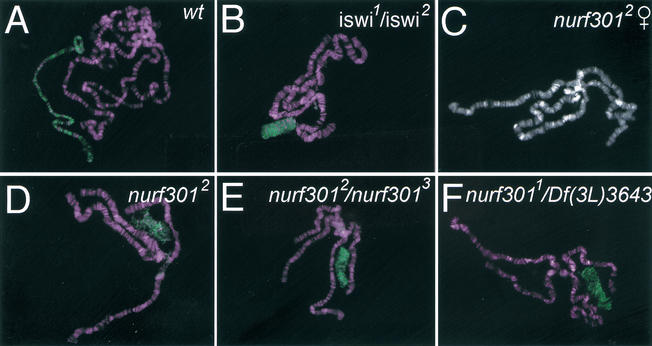
Aberrant male X chromosome in nurf301 mutant animals. Polytene chromosomes prepared from male wt (A), iswi (B), and nurf301 (D–F) mutant animals were stained with antibodies against MSL2 (shown in green) to reveal the male X chromosome. As seen in iswi1/iswi2 mutant animals (Deuring et al. 2000), male X chromosome morphology is perturbed in nurf301 mutants. (C) The X chromosome morphology in female nurf301 mutants is unaffected.
Figure 6
Figure 6
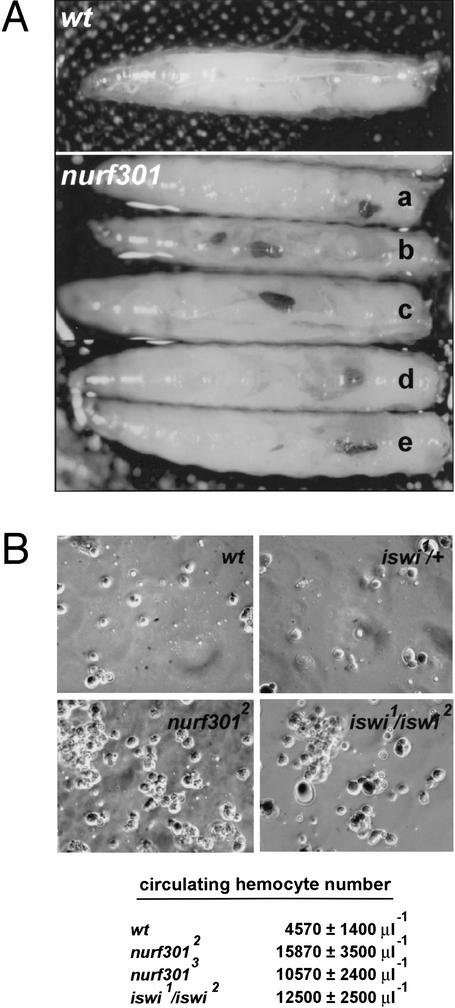
Melanotic tumors in NURF mutant animals. Melanotic tumors occur in homozygous mutant nurf301 third instar larvae. (A) Tumors are observed in all combinations of nurf301 mutant alleles. Genotypes displayed are nurf3012/nurf3012 (a), nurf3012/nurf3013 (b), nurf3012/nurf3014 (c), nurf3011/nurf3012 (d), and nurf3011/nurf3013 (e). (B) The circulating hemocyte cell number in hemolymph isolated from nurf301 and iswi mutant third instar larvae is increased considerably with respect to wild-type animals.
Figure 7
Figure 7
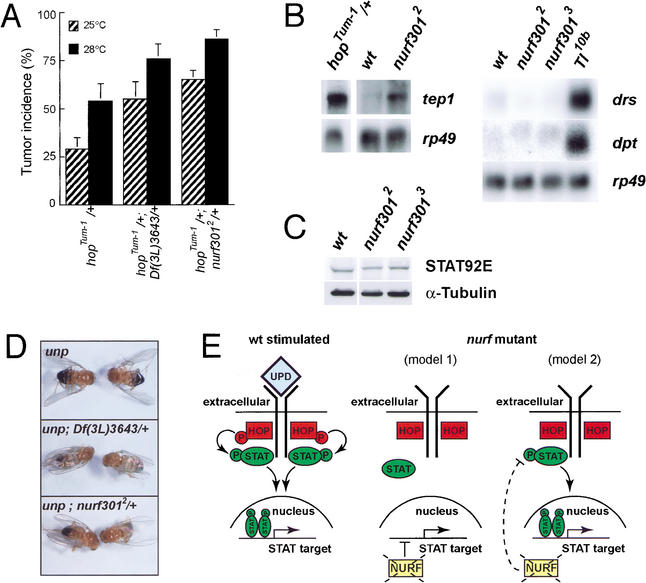
NURF is a negative regulator of the JAK/STAT signaling pathway. (A) Reduction of nurf301 levels enhances gain-of-function hopTum-1 mutant phenotypes. Vials of flies were raised at either 25°C or 28°C. The percentage of adult female flies of each genotype in a vial that display tumors was scored as tumor incidence. Data are the mean and standard deviation of at least six vials of flies. (B) nurf301 mutant animals express elevated levels of tep1 but neither the antimicrobial peptide gene drosomycin (drs) nor diptericin (dpt) is induced. (C) Levels of the STAT92E transcription factor are not elevated in nurf301 mutant animals. (D) Reduction of NURF301 levels suppresses the phenotypes of mutations in a ligand for the JAK receptor UNPAIRED (outstretched). (E) Models for how NURF may down-regulate the HOP/STAT92E signaling pathway. NURF could either repress targets of STAT92E or be required for expression of a negative regulator of STAT92E activation. In either case, in the absence of NURF, STAT92E target genes will be transcribed, mimicking STAT92E activation.

References

    1. Andres AJ, Thummel CS. Methods for quantitative analysis of transcription in larvae and prepupae. Methods Cell Biol. 1994;44:565–573. - PubMed
    1. Bantignies F, Goodman RH, Smolik SM. The interaction between the coactivator dCBP and Modulo, a chromatin-associated factor, affects segmentation and melanotic tumor formation in Drosophila. Proc Natl Acad Sci. 2001;99:2895–2900. - PMC - PubMed
    1. Bender W, Akam ME, Karch F, Beachy PA, Peifer M, Spierer P, Lewis EB, Hogness DS. Molecular genetics of the Bithorax Complex in Drosophila melanogaster. Science. 1983;221:23–29. - PubMed
    1. Berg CA, Spradling AC. Studies on the rate and site-specificity of P-element transposition. Genetics. 1991;127:515–524. - PMC - PubMed
    1. Betz A, Lampen N, Martinek S, Young MW, Darnell JE. A Drosophila PIAS homolog negatively regulates stat92E. Proc Natl Acad Sci. 2001;98:9563–9568. - PMC - PubMed

Publication types

MeSH terms