. 2003 Jan;77(2):1069-74.
doi: 10.1128/jvi.77.2.1069-1074.2003.

Identification of protective epitopes on ebola virus glycoprotein at the single amino acid level by using recombinant vesicular stomatitis viruses

Affiliations

Identification of protective epitopes on ebola virus glycoprotein at the single amino acid level by using recombinant vesicular stomatitis viruses

Ayato Takada et al. J Virol. 2003 Jan.

Abstract

Ebola virus causes lethal hemorrhagic fever in humans, but currently there are no effective vaccines or antiviral compounds for this infectious disease. Passive transfer of monoclonal antibodies (MAbs) protects mice from lethal Ebola virus infection (J. A. Wilson, M. Hevey, R. Bakken, S. Guest, M. Bray, A. L. Schmaljohn, and M. K. Hart, Science 287:1664-1666, 2000). However, the epitopes responsible for neutralization have been only partially characterized because some of the MAbs do not recognize the short synthetic peptides used for epitope mapping. To identify the amino acids recognized by neutralizing and protective antibodies, we generated a recombinant vesicular stomatitis virus (VSV) containing the Ebola virus glycoprotein-encoding gene instead of the VSV G protein-encoding gene and used it to select escape variants by growing it in the presence of a MAb (133/3.16 or 226/8.1) that neutralizes the infectivity of the virus. All three variants selected by MAb 133/3.16 contained a single amino acid substitution at amino acid position 549 in the GP2 subunit. By contrast, MAb 226/8.1 selected three different variants containing substitutions at positions 134, 194, and 199 in the GP1 subunit, suggesting that this antibody recognized a conformational epitope. Passive transfer of each of these MAbs completely protected mice from a lethal Ebola virus infection. These data indicate that neutralizing antibody cocktails for passive prophylaxis and therapy of Ebola hemorrhagic fever can reduce the possibility of the emergence of antigenic variants in infected individuals.


Figures
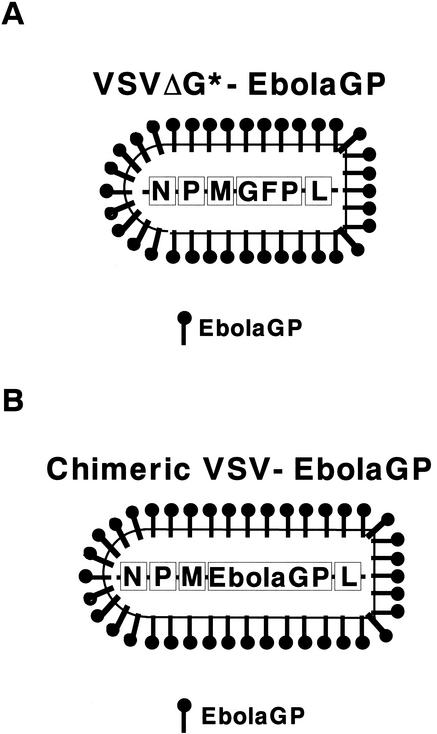
FIG. 1.
FIG. 1.
Schematic diagram of the two recombinant VSVs used in this study. (A) VSVΔG*-EbolaGP is a VSV pseudotyped with Ebola virus GP that contains the GFP-encoding gene instead of the VSV G protein-encoding gene and thus is not infectious unless a receptor binding/fusion protein (e.g., Ebola virus GP) is provided in trans. (B) Chimeric VSV-EbolaGP contains the Ebola virus GP-encoding gene in place of the VSV G protein-encoding gene and therefore can undergo multiple cycles of replication without complementation.
FIG. 2.
FIG. 2.
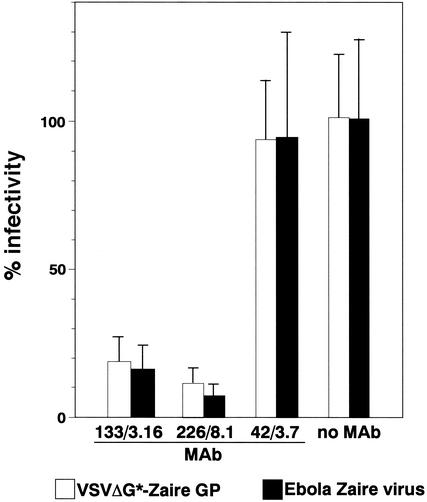
Neutralizing activity of MAbs to Zaire GP. VSV pseudotyped with GP of Ebola virus species Zaire or authentic Ebola virus species Zaire was incubated with purified antibodies (10 μg/ml) and inoculated onto 293 cells. Infectivity was determined by counting fluorescent cells. The relative percentage of infectivity was determined by setting the number of infected cells in the presence of normal mouse ascites (approximately 50 to 100 GFP-positive cells per microscopic field) at 100.
FIG. 3.
FIG. 3.
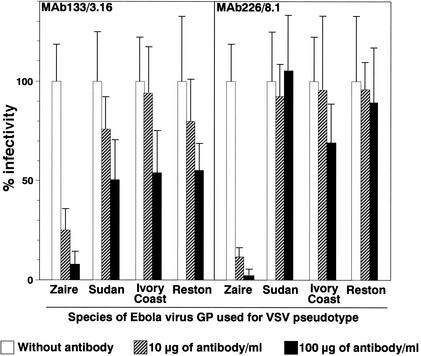
Cross-neutralizing activities of MAbs. VSV pseudotyped with GP of Ebola virus species Zaire, Sudan, Ivory Coast, or Reston was incubated with the indicated concentrations of the purified antibodies and inoculated onto 293 cells. The other experimental conditions were the same as those described in the legend to Fig. 2.
FIG. 4.
FIG. 4.
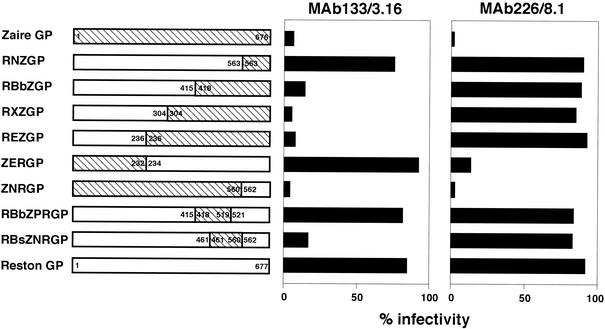
Identification of GP regions containing B-cell epitopes by use of VSV pseudotyped with chimeric GPs. The numbers inside the bars are the amino acid positions of GP of Ebola virus species Zaire and Reston. All of the chimeric GPs were functional and complemented infectivity of VSVΔG*. For neutralization tests, viruses were incubated with appropriately diluted mouse ascites (50 μg of specific antibodies/ml) and inoculated onto 293 cells. The relative percentage of infected cells was determined by setting the number of infected cells in the presence of normal mouse ascites (approximately 50 to 100 GFP-positive cells per microscopic field) at 100. Experiments were done three times, and representative data are shown.
FIG. 5.
FIG. 5.
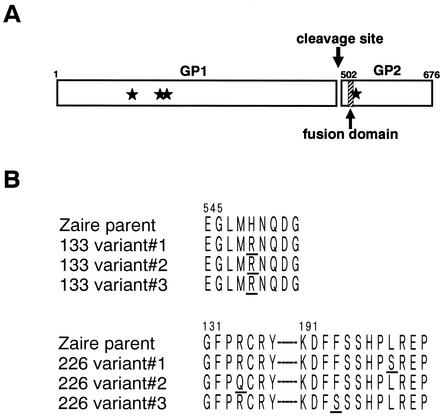
(A) Schematic diagram of Ebola virus GP. Ebola virus GP is proteolytically cleaved into GP1 and GP2 subunits (20). The fusion domain, a highly conserved hydrophobic region (amino acids 524 to 539), is located 24 amino acids downstream of the N terminus of the GP2 subunit. Stars represent the positions of amino acid substitutions. (B) Amino acid substitutions found in escape mutants selected by MAbs 133/3.16 (133 variants 1 to 3) and 226/8.1 (226 variants 1 to 3). Substituted amino acids are underlined.

References

    1. Bray, M., K. Davis, T. Geisbert, C. Schmaljohn, and J. Huggins. 1998. A mouse model for evaluation of prophylaxis and therapy of Ebola hemorrhagic fever. J. Infect. Dis. 178:651-661. - PubMed
    1. Feldmann, H., and M. P. Kiley. 1999. Classification, structure, and replication of filoviruses. Curr. Top. Microbiol. Immunol. 235:1-22. - PubMed
    1. Gupta, M., S. Mahanty, M. Bray, R. Ahmed, and P. E. Rollin. 2001. Passive transfer of antibodies protects immunocompetent and immunodeficient mice against lethal Ebola virus infection without complete inhibition of viral replication. J. Virol. 75:4649-4654. - PMC - PubMed
    1. Ito, H., S. Watanabe, A. Takada, and Y. Kawaoka. 2001. Ebola virus glycoprotein: proteolytic processing, acylation, cell tropism, and detection of neutralizing antibodies. J. Virol. 75:1576-1580. - PMC - PubMed
    1. Jahrling, P. B., T. W. Geisbert, J. B. Geisbert, J. R. Swearengen, M. Bray, N. K. Jaax, J. W. Huggins, J. W. LeDuc, and C. J. Peters. 1999. Evaluation of immune globulin and recombinant interferon-alpha2b for treatment of experimental Ebola virus infections. J. Infect. Dis. 179(Suppl. 1):S224-S234. - PubMed

Publication types

MeSH terms

LinkOut - more resources