. 2003 Jan;162(1):11-7.
doi: 10.1016/S0002-9440(10)63793-5.

Up-regulation of macrophage migration inhibitory factor gene and protein expression in glial tumor cells during hypoxic and hypoglycemic stress indicates a critical role for angiogenesis in glioblastoma multiforme

Affiliations

Up-regulation of macrophage migration inhibitory factor gene and protein expression in glial tumor cells during hypoxic and hypoglycemic stress indicates a critical role for angiogenesis in glioblastoma multiforme

Michael Bacher et al. Am J Pathol. 2003 Jan.

Abstract

Glioblastoma multiforme (GBM) is the most malignant variant of human glial tumors. A prominent feature of this tumor is the occurrence of necrosis and vascular proliferation. The regulation of glial neovascularization is still poorly understood and the characterization of factors involved in this process is of major clinical interest. Macrophage migration inhibitory factor (MIF) is a pleiotropic cytokine released by leukocytes and by a variety of cells outside of the immune system. Recent work has shown that MIF may function to regulate cellular differentiation and proliferation in normal and tumor-derived cell lines, and may also contribute to the neovascularization of tumors. Our immunohistological analysis of MIF distribution in GBM tissues revealed the strong MIF protein accumulation in close association with necrotic areas and in tumor cells surrounding blood vessels. In addition, MIF expression was frequently associated with the presence of the tumor-suppressor gene p53. To substantiate the concept that MIF might be involved in the regulation of angiogenesis in GBM, we analyzed the MIF gene and protein expression under hypoxic and hypoglycemic stress conditions in vitro. Northern blot analysis showed a clear increase of MIF mRNA after hypoxia and hypoglycemia. We could also demonstrate that the increase of MIF transcripts on hypoxic stress can be explained by a profound transcriptional activation of the MIF gene. In parallel to the increase of MIF transcripts, we observed a significant rise in extracellular MIF protein on angiogenic stimulation. The data of our preliminary study suggest that the up-regulation of MIF expression during hypoxic and hypoglycemic stress might play a critical role for the neovascularization of glial tumors.


Figures
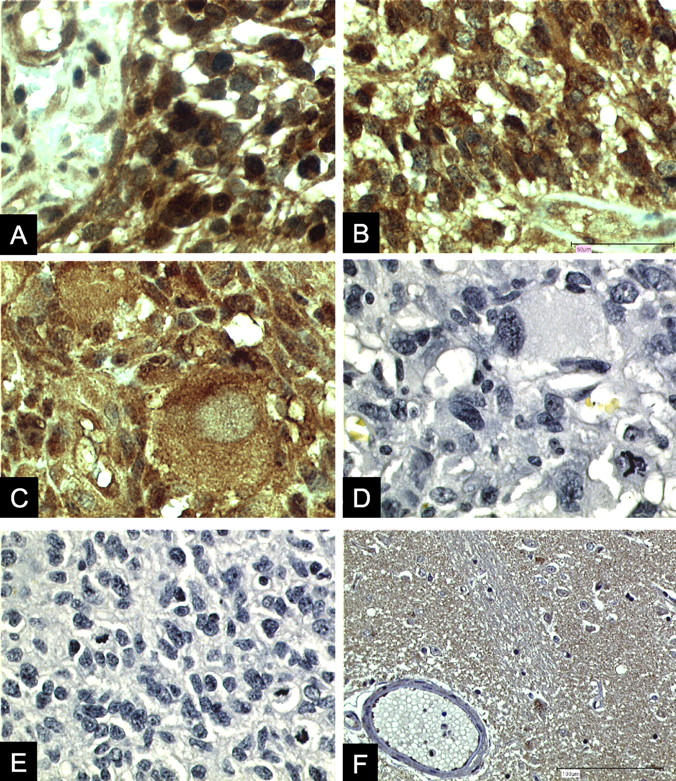
Figure 1.
Figure 1.
MIF immunolabel in human GBM sections A to C. A and B: Prominent MIF immunostain (brown label) was frequently detected in the vicinity of tumor-associated blood vessels. MIF immunostain was also detected in tumor vasculature endothelial cells. C: MIF immunostain was frequently detected within the cytoplasm of large tumor cells. D and E: Control sections of GBM samples in which the primary anti-MIF antibodies were preabsorbed with rMIF. F: MIF immunoreactivity within a section of normal brain. MIF protein was only localized in a few scattered cells. We observed a complete lack of MIF in cerebral vasculature endothelial cells. Immunolabel was performed using the labeled streptavidin biotin (LSAB) kit from DAKO. Original magnifications: ×200 (A–E); ×100 (F).
Figure 2.
Figure 2.
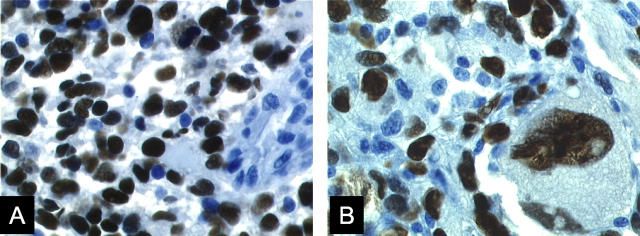
Immunolocalization of p53 in human GBM samples A to B. A: Profound p53 protein accumulation within the nuclei of tumor cells. B: Strong p53 immunostain was frequently observed in large tumor cells. A monoclonal antibody against human p53 (DAKO) was used as primary antibody. Original magnifications, ×200.
Figure 3.
Figure 3.
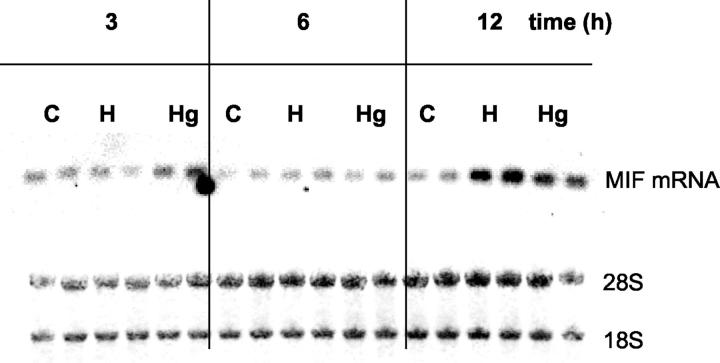
Kinetics of MIF steady-state mRNA levels in a human glioblastoma cell line (LN18) after normal (C), hypoxic (H), and hypoglycemic (Hg) conditions. Total RNA was isolated from duplicate cultures at the indicated time points. Five μg of RNA per sample was blotted onto Nylon membranes and hybridized with a DIG-labeled human MIF cRNA probe (top). To assess integrity and equal loading of all RNA samples, the same amount of RNA was also transferred onto nitrocellulose membranes and stained with methylene blue (bottom).
Figure 4.
Figure 4.
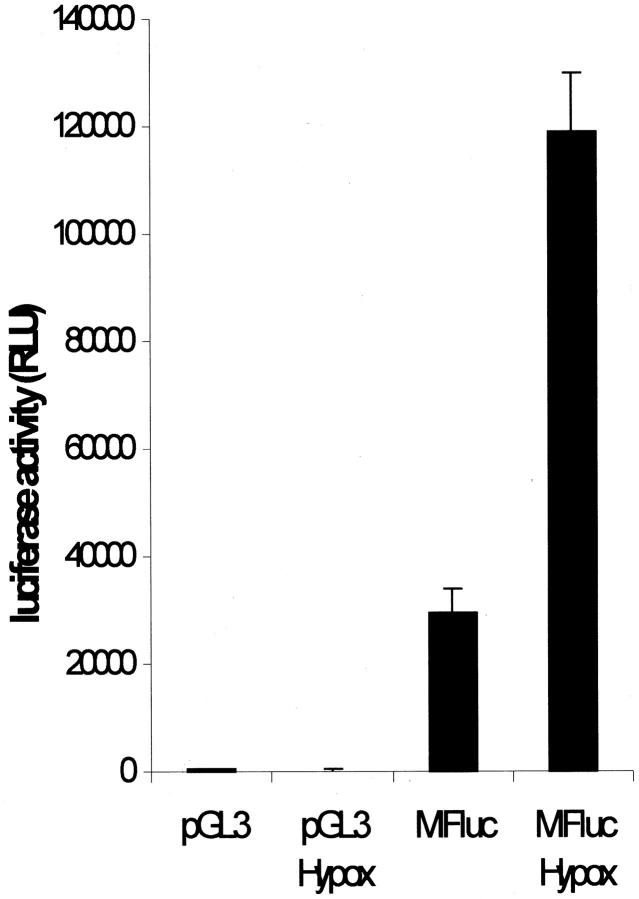
Transcriptional activity of the MIF promoter in rat glioma RGL3 cells. The MIF promoter fused to the luciferase gene was transiently transfected into rat glioma cells. The construct drove very high transcriptional activity (29.3 ± 4.5 × 10³ RLU, ∼80-fold more than the promoterless plasmid), which was further enhanced (3.9-fold) when the cell cultures were incubated for 8 hours under hypoxic conditions (118.9 ± 11.1 × 10³ RLU). The bars represent the mean ± SD of values obtained from duplicate culture in eight separate experiments.
Figure 5.
Figure 5.
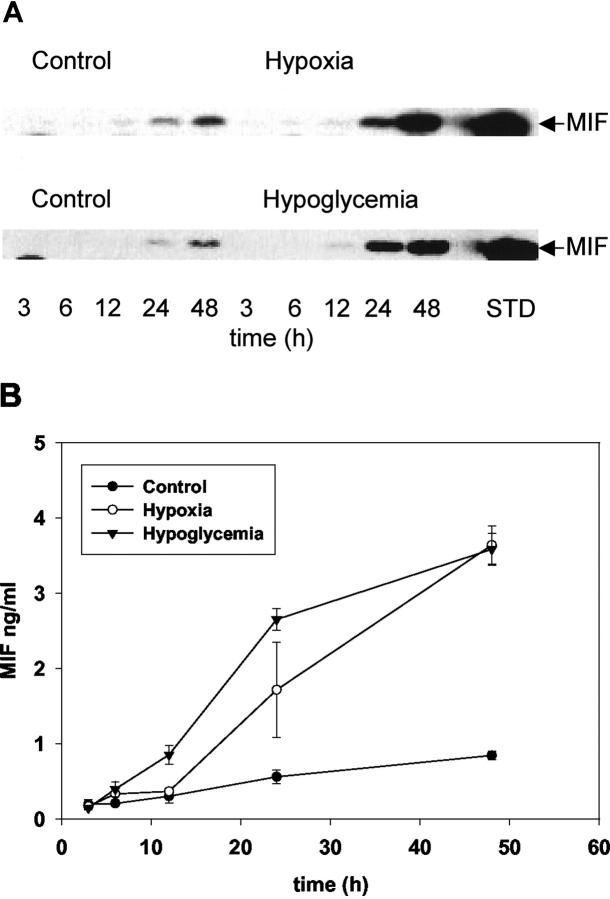
Analysis of extracellular MIF production in normal LN18 cells, and after hypoxic or hypoglycemic conditions by Western blot (A) and ELISA (B). A: Supernatants were prepared as described in Materials and Methods. Ten-μl aliquots of the supernatants at the indicated times were electrophoresed and transferred onto nitrocellulose membranes and the MIF content was analyzed by reaction with an anti-MIF antibody as described in Materials and Methods. Recombinant MIF (50 ng) was electrophoresed as standard (STD). B: MIF release was analyzed by sandwich ELISA of supernatants collected at the indicated time points from control cells (filled circles), after hypoxia (open circles), and after hypoglycemia (inverted filled triangle). Measurements were performed in triplicate cultures; the data shown are the mean ± SD of one representative experiment of a group of five separate experiments with similar results.

References

    1. Holland EC: Glioblastoma multiforme: the terminator. Proc Natl Acad Sci USA 2000, 97:6242-6244 - PMC - PubMed
    1. Plate KH, Breier G, Weich HA, Risau W: Vascular endothelial growth factor is a potential tumour angiogenesis factor in human gliomas in vivo. Nature , 359:845-848 - PubMed
    1. David JR, Bozza M, Carini C: Macrophage migration inhibitory factor. Aggraval BB Gutterman JU eds. Human Cytokines. Handbook for Basic and Clinical Research, 1996, vol 2.:pp 222-256 Blackwell Science, Cambridge
    1. Bucala R: MIF rediscovered: cytokine, pituitary hormone, and glucocorticoid regulator of the immune response. EMBO J 1996, 10:1607-1613 - PubMed
    1. Lan HY, Mu W, Yang N, Meinhardt A, Nikolic-Paterson DJ, Ng YY, Bacher M, Atkins RC, Bucala R: De novo renal expression of macrophage migration inhibitory factor during the development of rat crescentic glomerulonephritis. Am J Pathol 1996, 149:1119-1127 - PMC - PubMed

MeSH terms

Substances