. 2003 Jan;185(2):525-33.
doi: 10.1128/JB.185.2.525-533.2003.

Transcription of the Salmonella invasion gene activator, hilA, requires HilD activation in the absence of negative regulators

Affiliations

Transcription of the Salmonella invasion gene activator, hilA, requires HilD activation in the absence of negative regulators

Jennifer D Boddicker et al. J Bacteriol. 2003 Jan.

Abstract

Salmonella enterica serovar Typhimurium causes human gastroenteritis and a systemic typhoid-like infection in mice. Infection is initiated by entry of the bacteria into intestinal epithelial cells and is mediated by a type III secretion system that is encoded by genes in Salmonella pathogenicity island 1. The expression of invasion genes is tightly regulated by environmental conditions such as oxygen and osmolarity, as well as by many bacterial factors. The hilA gene encodes an OmpR/ToxR family transcriptional regulator that activates the expression of invasion genes in response to both environmental and genetic regulatory factors. HilD is an AraC/XylS regulator that has been postulated to act as a derepressor of hilA expression that promotes transcription by interfering with repressor binding at the hilA promoter. Our research group has identified four genes (hilE, hha, pag, and ams) that negatively affect hilA transcription. Since the postulated function of HilD at the hilA promoter is to counteract the effects of repressors, we examined this model by measuring hilA::Tn5lacZY expression in strains containing negative regulator mutations in the presence or absence of functional HilD. Single negative regulator mutations caused significant derepression of hilA expression, and two or more negative regulator mutations led to very high level expression of hilA. However, in all strains tested, the absence of hilD resulted in low-level expression of hilA, suggesting that HilD is required for activation of hilA expression, whether or not negative regulators are present. We also observed that deletion of the HilD binding sites in the chromosomal hilA promoter severely decreased hilA expression. In addition, we found that a single point mutation at leucine 289 in the C-terminal domain of the alpha subunit of RNA polymerase leads to very low levels of hilA::Tn5lacZY expression, suggesting that HilD activates transcription of hilA by contacting and recruiting RNA polymerase to the hilA promoter.


Figures
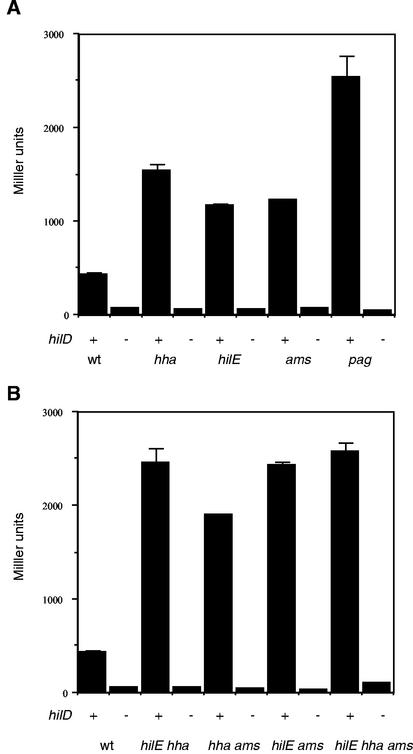
FIG. 1.
FIG. 1.
Single or multiple mutations in negative regulators do not relieve repression of hilA in the absence of hilD. (A) Effect of single mutations in hha, hilE, ams, and pag on the expression of a serovar Typhimurium hilA::Tn5lacZY reporter in the presence or absence of hilD. (B) Effect of multiple repressor mutations on hilA::Tn5lacZY chromosomal expression in the presence or absence of hilD. All bacterial cultures were incubated statically in LB with 1% NaCl under oxygen-limiting conditions to induce expression of the hilA::Tn5lacZY reporter. Data are representative of at least three independent experiments.
FIG. 2.
FIG. 2.
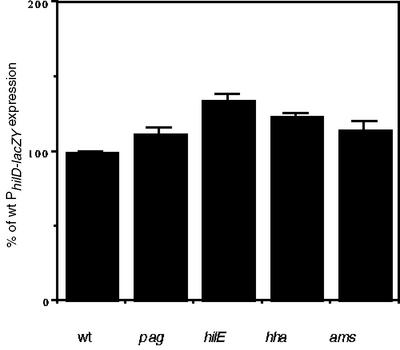
Effect of hha::Tn5, hilE::Tn5, ams::Tn5, or pag::Tn5 mutations on PhilD-lacZY expression from pJB5 in serovar Typhimurium. β-Galactosidase activity for the hilD-lacZY reporter was quantitated as a percentage of the β-galactosidase activity of the reporter in wild-type Salmonella, which was set at 100%. Bacterial cultures were incubated statically in LB with 1% NaCl under oxygen-limiting conditions. Data are representative of at least three independent experiments.
FIG. 3.
FIG. 3.
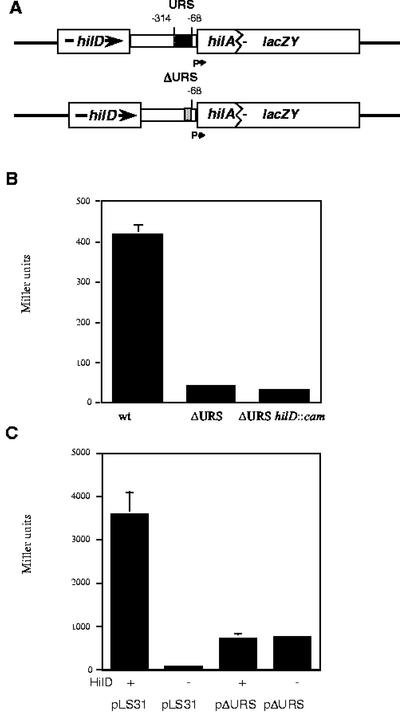
Deletion of upstream promoter sequences results in an unactivatable hilA promoter. (A) Chromosomal or plasmid pLS31 sequences from positions −68 to −314 of the hilA promoter were replaced, by allelic exchange and deletion, with 84 bp of unrelated sequence to create a Salmonella hilA::Tn5lacZY reporter strain lacking URS sequences. (B) Expression of chromosomal hilA::Tn5lacZY was examined in the parent strain EE658 and the EE658 derivatives BJ2565 (ΔURS) and BJ2566 (ΔURS hilD::cam). (C) Effect of ΔURS mutation created in plasmid pLS31 in Salmonella in the presence or absence of hilD. β-Galactosidase expression was quantitated after growth in low-oxygen, high-osmolarity conditions. Data are representative of at least three independent experiments.
FIG. 4.
FIG. 4.
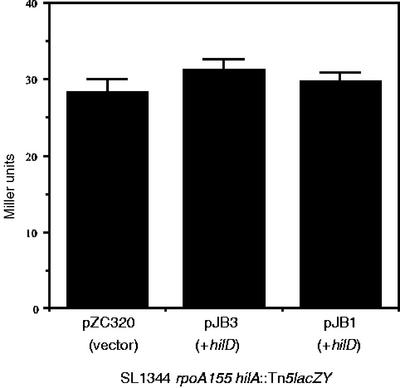
Expression of hilD from the lac promoter on plasmid pJB3 does not increase hilA::Tn5lacZY in SL1344 rpoA155. Plasmid pJB1 or pJB3 or the parent vector, pZC320, was introduced into SL1344 rpoA155 hilA::Tn5lacZY, and β-galactosidase expression was quantitated from each strain after growth under low-oxygen, high-osmolarity conditions. Plasmid pJB1 expresses hilD from its own promoter, whereas plasmid pJB3 expresses hilD from the vector lac promoter. Data are representative of at least three independent experiments performed in triplicate.
FIG. 5.
FIG. 5.
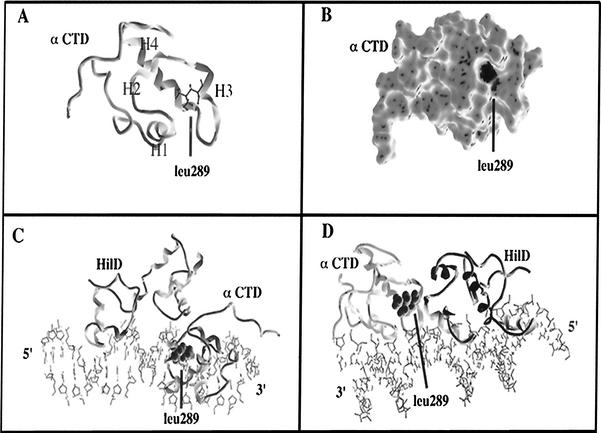
Structural model of possible HilD interaction with the αCTD on promoter DNA. (A) Ribbon structure of the αCTD of RNA polymerase with leucine 289 highlighted and each alpha helix labeled as H1, H2, H3, or H4 (25). (B) Leucine 289 is predicted to be surface exposed on the αCTD of RNA polymerase. (C) Structural model of the possible interaction of HilD and leucine 289 of the αCTD of RNA polymerase, with DNA in the 5′-to-3′ direction. (D) A different view of the model presented in panel C, showing the 3′-to-5′ orientation of the DNA. Modeling was done by using Sybyl software (version 6.7; Tripos Associate, St. Louis, Mo.) on an O2 workstation (SGI, Mountain View, Calif.). Sybyl-Molcad was used to create panel B, which shows the solvent-exposed Connolly surface, by using the Connolly program to calculate the solvent-accessible surface of the molecule given the coordinates of its atoms (10). The Sybyl-Composer model was used to perform homology modeling for panels C and D to build structures for the CTD of HilD, from amino acids 211 to 309, based on the crystal structure of Rob, an AraC/XylS regulator that is homologous to HilD in its helix-turn-helix DNA-binding domain (31).

References

    1. Altier, C., M. Suyemoto, and S. D. Lawhon. 2000. Regulation of Salmonella enterica serovar Typhimurium invasion genes by csrA. Infect. Immun. 68:6790-6797. - PMC - PubMed
    1. Altier, C., M. Suyemoto, A. I. Ruiz, K. D. Burnham, and R. Maurer. 2000. Characterization of two novel regulatory genes affecting Salmonella invasion gene expression. Mol. Microbiol. 35:1872-1882. - PubMed
    1. Ayers, D. J., M. G. Sunshine, E. W. Six, and G. E. Christie. 1994. Mutations affecting two adjacent amino acid residues in the alpha subunit of RNA polymerase block transcriptional activation by the bacteriophage P2 Ogr protein. J. Bacteriol. 176:7430-7438. - PMC - PubMed
    1. Bajaj, V., C. Hwang, and C. A. Lee. 1995. hilA is a novel ompR/toxR family member that activates the expression of Salmonella typhimurium invasion genes. Mol. Microbiol. 18:715-727. - PubMed
    1. Bajaj, V., R. L. Lucas, C. Hwang, and C. A. Lee. 1996. Co-ordinate regulation of Salmonella typhimurium invasion genes by environmental and regulatory factors is mediated by control of hilA expression. Mol. Microbiol. 22:703-714. - PubMed

Publication types

MeSH terms

LinkOut - more resources