. 2003 Jan;185(2):645-53.
doi: 10.1128/JB.185.2.645-653.2003.

Development of methicillin resistance in clinical isolates of Staphylococcus sciuri by transcriptional activation of the mecA homologue native to s

Affiliations

Development of methicillin resistance in clinical isolates of Staphylococcus sciuri by transcriptional activation of the mecA homologue native to s

Isabel Couto et al. J Bacteriol. 2003 Jan.

Abstract

The beta-lactam resistance gene mecA was acquired by Staphylococcus aureus from an extraspecies source. The search for the possible origin of this gene has led to the identification of a close structural homologue of mecA as a native gene in the animal species Staphylococcus sciuri. Surprisingly, the overwhelming majority of S. sciuri isolates were fully susceptible to beta-lactam antibiotics in spite of the ubiquitous presence of the mecA homologue in the bacteria. We now describe two unusual S. sciuri strains isolated from humans-SS-37 and SS-41-that showed resistance to methicillin associated with high rates of transcription of the mecA homologue and production of a protein resembling penicillin binding protein 2a, the gene product of S. aureus mecA. In strain SS-37 increased transcription of the mecA homologue was related to insertion of an IS256 element upstream of the structural gene, and strain SS-41 had single nucleotide alterations in the promoter region of the mecA homologue which appear to be related to up-regulation of the rate of transcription. A third methicillin-resistant human isolate of S. sciuri that carries both the native mecA homologue and a methicillin-resistant S. aureus (MRSA) type mecA, strain K3, was now shown to be unstable in the absence of drug selection, causing the segregation of antibiotic-susceptible cells accompanied by the loss of the MRSA type mecA. These observations illustrate the remarkable variety of strategies available to bacteria for acquiring mechanisms of drug resistance in the in vivo environment.


Figures
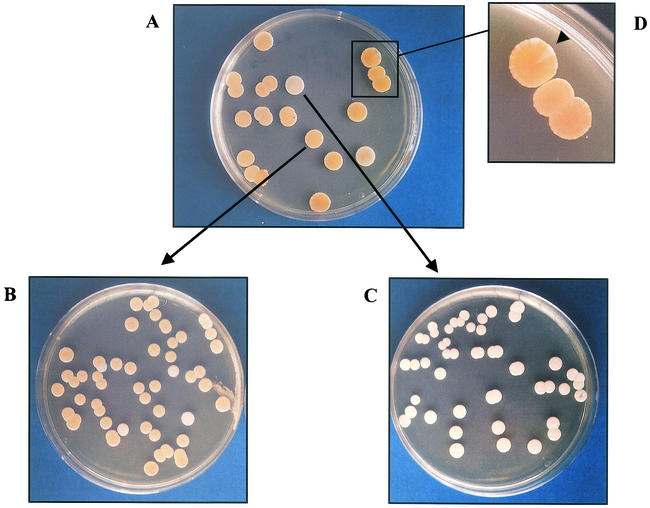
FIG. 1.
FIG. 1.
Segregation of K3 yellow and white variants in TSA after incubation at 37°C for 48 h. (A through C) Plate prepared from a K3 culture showing yellow and white colonies (A), which generate, respectively, both yellow and white colonies (B) or only white colonies (C). (D) Yellow colonies from a K3 culture showing white sectors of growth (arrowhead).
FIG. 2.
FIG. 2.
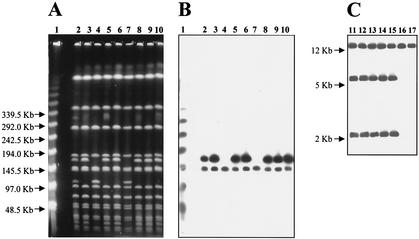
Genotypic analysis of the K3y and K3w variants. (A) PFGE patterns of the K3y and K3w variants after SmaI digestion. Lane 1, PFGE lambda marker; lanes 2 to 4, SmaI restriction patterns of K3 (original culture), K3y, and K3w, respectively; lanes 5 to 10, SmaI restriction patterns of cultures prepared from independent yellow (lanes 5, 6, and 8 to 10) or white (lane 7) segregated colonies. (B) Hybridization of the K3y and K3w variant SmaI digests shown in panel A with a DNA probe for mecA. (C) Hybridization of the K3y and K3w variant ClaI digests with the DNA probe for mecA. Lanes 11 to 17, ClaI restriction patterns of cultures prepared from independent yellow (lanes 11 to 15) or white (lanes 16 and 17) segregated colonies. Arrows indicate molecular size marker positions.
FIG. 3.
FIG. 3.
Northern blot analysis of mecA transcription in S. sciuri strains isolated in vivo (K1, K3w, SS-37, and SS-41) or methicillin step selected (K1M200 and K3wM200).
FIG. 4.
FIG. 4.
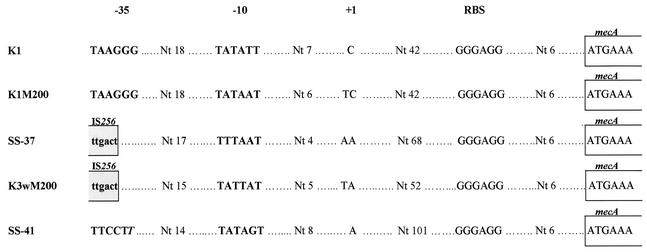
Nucleotide sequence analysis of the region upstream of mecA for strains K1, K1M200, SS-37, SS-41, and K3wM200, specifying the mapped 5′ ends of the mRNAs identified by primer extension (+1), the putative promoter regions (−10 and −35), and the putative ribosome-binding sites (RBS). The putative promoter regions are boldfaced. The point mutation identified in SS-41 is italicized. White and gray open boxes represent the 5′ end of mecA and the 3′ end of IS256, respectively. The 3′ region of IS256 is lowercased.
FIG. 5.
FIG. 5.
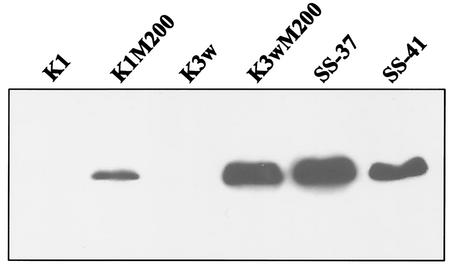
Western blot analysis of membrane preparations against an antibody for PBP2a. Strains SS-37, SS-41, and K3wM200 produced a protein that reacted with the antibody for PBP2a, with the same molecular mass as the protein produced by K1M200, i.e., 84 kDa (29).
FIG. 6.
FIG. 6.
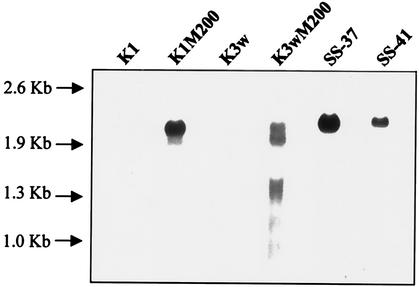
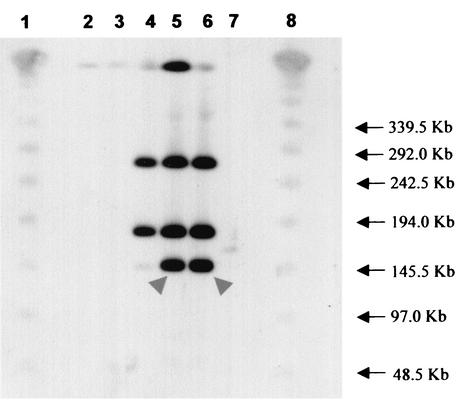
Hybridization of SmaI digests with a probe for IS256. Lanes 1 and 8, PFGE lambda ladder; lanes 2 to 7, K1, K1M200, K3w, K3wM200, SS-37, and SS-41, respectively. Arrowheads indicate the SmaI bands hybridizing with S. sciuri mecA for strains K3wM200 and SS-37.
FIG. 7.
FIG. 7.
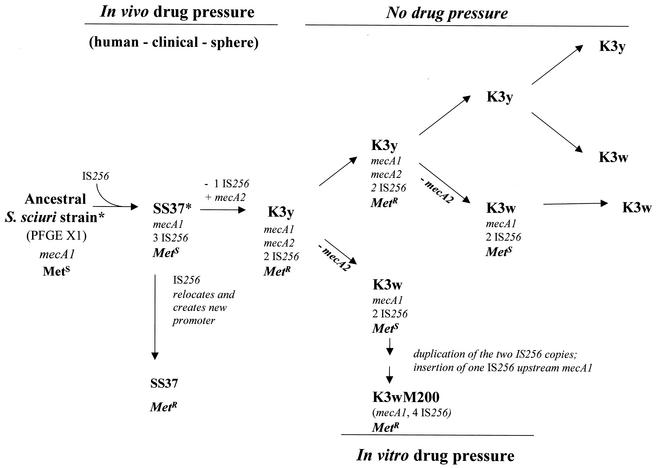
Putative evolutionary sequence of events for strains K3w, K3y, and SS-37.

References

    1. Archer, G. L., and D. M. Niemeyer. 1994. Origin and evolution of DNA associated with resistance to methicillin in staphylococci. Trends Microbiol. 2:343-347. - PubMed
    1. Ausubel, F. M., R. Brent, R. E. Kingston, D. D. Moore, J. G. Seidman, J. A. Smith, and K. Struhl. 1992. Short protocols in molecular biology. Greene Publishing Associates and John Wiley & Sons, Inc., New York, N.Y.
    1. Bayer, M. G., J. H. Heinrichs, and A. L. Cheung. 1996. The molecular architecture of the sar locus in Staphylococcus aureus. J. Bacteriol. 178:4563-4570. - PMC - PubMed
    1. Byrne, M. E., D. A. Rouch, and R. A. Skurray. 1989. Nucleotide sequence analysis of IS256 from the Staphylococcus aureus gentamicin-tobramycin-kanamycin-resistance transposon Tn4001. Gene 81:361-367. - PubMed
    1. Chambers, H. F. 1997. Methicillin resistance in staphylococci: molecular and biochemical basis and clinical implications. Clin. Microbiol. Rev. 10:781-791. - PMC - PubMed

Publication types

MeSH terms

LinkOut - more resources